[FRA – Cet article est une traduction en anglais d’un article paru à l’hiver 2016 sur le site Internet du bimestriel français L’Esprit du judo.
ENG – This article is an English translation of an article published in winter 2016 on the website of the French bimonthly magazine L’Esprit du judo.]
Sunday 24 January 2016, the Institut Lumière in Lyon presented The Legend of the Great Judo (Sugata Sanshiro in Japanese), the first film by Akira Kurosawa (1910 – 1998). Looking back on a history of screenings.
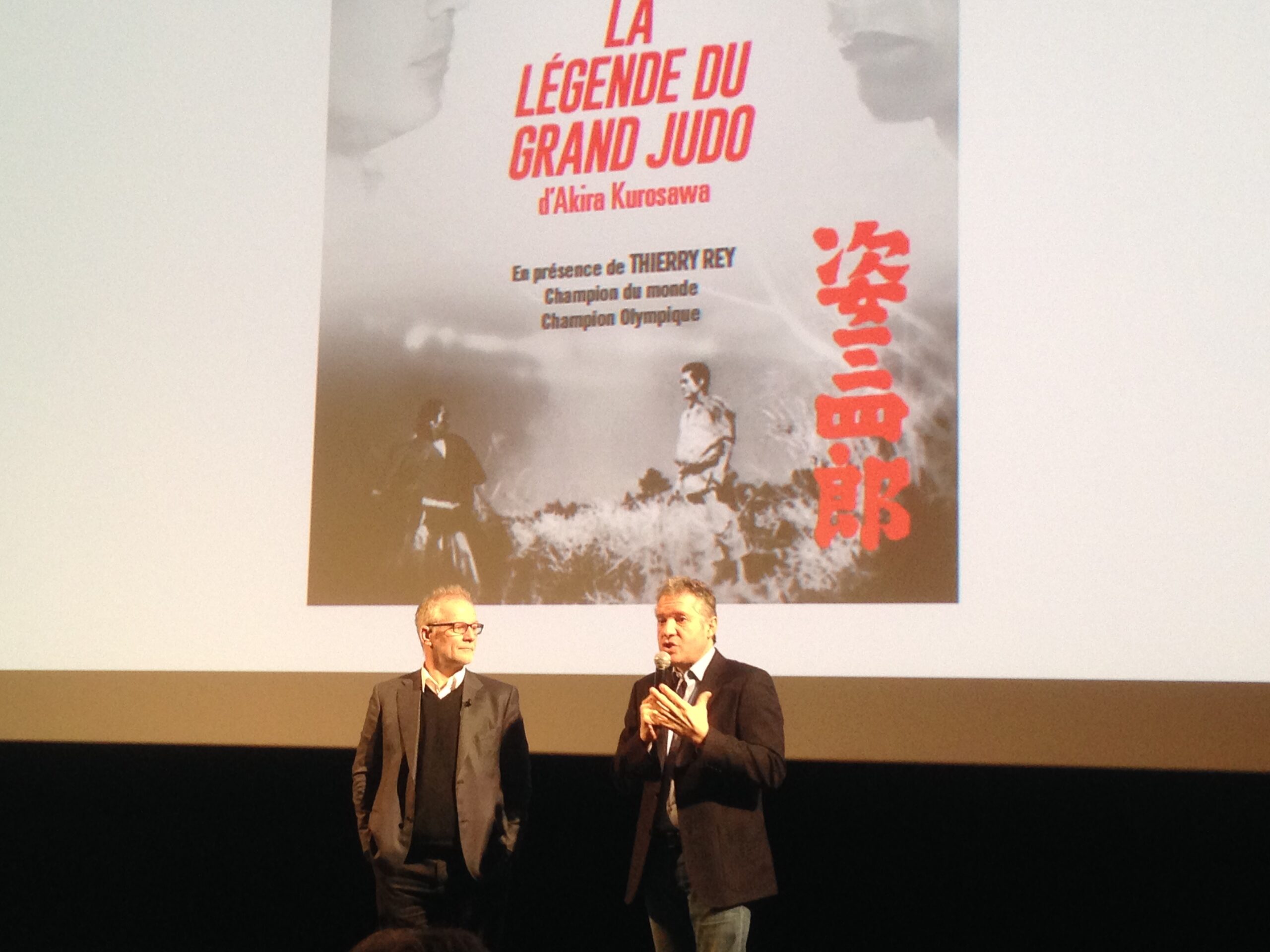
Hosted by Thierry Frémaux, director of this world cradle of cinephilia and Artistic then General Delegate of the Cannes Film Festival since 2001, the screening was commented on by world and Olympic champion Thierry Rey, before the eyes of several high-ranking figures from the region: 8th dan Michel Charrier, 7th dans René Nazaret, Guy Delvingt, Pierre Blanc and Bernard Girerd…
Screened in double reel from a print “as rare as a parchment”, the film pits Jigoro Kano – Shogoro Yano in the film – against Shiro Saigo, his most famous disciple (renamed Sugata Sanshiro in Kurosawa’s version). “Sugata Sanshiro tells the story of a young man, arrogant and wild, who comes to accept in a certain pain the precepts of a mentor who teaches him the beauty of surpassing oneself“, writes Thierry Frémaux on page 56 of issue no. 8 of the journal Desports, currently on newsstands. “The film also illustrates one of the essential foundations of judo: ‘I will teach you to be stronger so that one day you may finally defeat me.'”
In L’Esprit du judo #37, published in spring 2012, Thierry Frémaux shared with us his relationship as a cinephile-judoka – he holds a 4th dan and was vice-champion of France at university level – with this founding work in the career of the future director of Seven Samurai, Rashōmon or Ran… Magneto. – JudoAKDReplay#012.
A French version of this article is available here.
How did The Legend of the Great Judo come to France?
It’s quite an unusual story. First, there is the context of its origins. This is Akira Kurosawa’s first film, and it was made in 1943 – right in the middle of the Second World War, when Japan was fighting alongside Nazi Germany. The film was only released in Japan, and even then barely, and after great difficulties. Then it was completely forgotten. In France and around the world, it only officially received a theatrical release in the late 1990s. This was thanks to one man, Jean-Pierre Jackson, who subsequently released it on video and broadcast it on Arte. It therefore endured a purgatory of nearly sixty years.
What impact did it have on French judo?
The film remained unknown for a long time. Nobody had seen it. For those who were interested, there was a vague awareness of this work’s existence. Then I showed it in Lyon, thanks to the collaboration of Jean-Pierre Jackson, who had retrieved materials in order to strike a fine print. I remember that when we showed it as a preview at the Institut Lumière, everyone was discovering it for the first time. I am a judoka and a cinephile, and I wouldn’t have wanted anyone else to discover it first! As director of the Institut Lumière, I had invited the entire Ligue du Lyonnais and we all watched the film together. The impact was powerful. Extremely powerful.
Under what circumstances was this film made?
It is said that Ozu, one of the greatest filmmakers in history, interceded on behalf of his younger colleague Kurosawa, who had begun his career as an assistant. During production, the film had already had to endure the surveillance of censors who did not consider it sufficiently «Japanese». It must be said that, stylistically, Kurosawa was influenced by John Ford and Jean Renoir! During the shoot, he was young, barely 32 years old. It must also be said that Kurosawa would go on to become such an important filmmaker that today people focus primarily on his celebrated masterpieces: Rashōmon, Seven Samurai, Red Beard, etc. He went on to have a great international career without ever looking back. Today I challenge any judoka not to fall in love with the film! The great regret is that this work was cut by fifteen minutes by the censors, and that those lost elements are apparently gone forever.
What did you think of it?
Honestly, at first, we simply wanted to see this film, which was just one more entry in the filmography of one of the world’s great cinema masters. We didn’t expect to encounter such a fine piece of filmmaking. And yet it was quite the opposite. It is a magnificent work, moving and, especially for us judokas, credible. It is the barely fictionalised portrait of Shiro Saigo, the man who invented yama-arashi, the “mountain storm”! He is called Sugata Sanshiro in the film. The film has a central sequence built around the master-pupil relationship, the spirit of sacrifice and discipline, which has not aged at all. It is clear that Kurosawa had cinema in his blood. And while he would become famous years later with Seven Samurai, his talent shines through in every shot of The Legend of the Great Judo, a title that is at once grandiloquent and magnificent.
Has the film aged well, in your view?
To my eyes it remains a pure Kurosawa film in which one recognizes the great dimensions of his work: the sense of human History intertwined with the depiction of individual destinies, the spare yet effective mise en scène, an extraordinary photographic portrait of an era… If one wishes to go further, one might almost say that the film, while evoking the 1880s – the moment when Kano launched judo – is also an evocation of 1943 and of that Japanese soul tormented by war and years of privation. For a cinephile, there is a unique pleasure in discovering a film and returning it to the public. None of it would have been possible without Jean-Pierre Jackson and his company Alive. But for a judoka, discovering all of this was pure nirvana. I remain very proud of those wonderful screenings organised in Lyon with the Ligue. Since then, a print of the film has joined the collections and archives of the Institut Lumière. – Interview by Anthony Diao, spring 2012. Opening picture : Thierry Frémaux and Thierry Rey at the Institut Lumière 24 January 2016 ©JudoAKD.
A French version of this article is available here.
More Replays in English:
- JudoAKDReplay#001 – Pawel Nastula – The Leftover (2017)
- JudoAKDReplay#002 – Gévrise Emane – Turn Lead into Bronze (2020)
- JudoAKDReplay#003 – Lukas Krpalek – The Best Years of a Life (2019)
- JudoAKDReplay#004 – How Did Ezio Become Gamba? (2015)
- JudoAKDReplay#005 – What’s up… Dimitri Dragin? (2016)
- JudoAKDReplay#006 – Travis Stevens – “People forget about medals, only fighters remain” (2016)
- JudoAKDReplay#007 – Sit and Talk with Tina Trstenjak and Clarisse Agbégnénou (2017)
- JudoAKDReplay#008 – A Summer with Marti Malloy (2014)
- JudoAKDReplay#009 – Hasta Luego María Celia Laborde (2015)
- JudoAKDReplay#010 – What’s Up… Dex Elmont? (2017)
- JudoAKDReplay#011 – Zakopane, or Lives Passing By (2017)
- JudoAKDReplay#013 – Thierry Frémaux (2/2) – Judo in the Light (2021)
More articles in English:
- JudoAKD#001 – Loïc Pietri – Pardon His French
- JudoAKD#002 – Emmanuelle Payet – This Island Within Herself
- JudoAKD#003 – Laure-Cathy Valente – Lyon, Third Generation
- JudoAKD#004 – Back to Celje
- JudoAKD#005 – Kevin Cao – Where Silences Have the Floor
- JudoAKD#006 – Frédéric Lecanu – Voice on Way
- JudoAKD#008 – Annett Böhm – Life is Lives
- JudoAKD#009 – Abderahmane Diao – Infinity of Destinies
- JudoAKD#010 – Paco Lozano – Eye of the Fighters
- JudoAKD#011 – Hans Van Essen – Mister JudoInside
- JudoAKD#021 – Benjamin Axus – Still Standing
- JudoAKD#022 – Romain Valadier-Picard – The Fire Next Time
- JudoAKD#023 – Andreea Chitu – She Remembers
- JudoAKD#024 – Malin Wilson – Come. See. Conquer.
- JudoAKD#025 – Antoine Valois-Fortier – The Constant Gardener
- JudoAKD#026 – Amandine Buchard – Status and Liberty
- JudoAKD#027 – Norbert Littkopf (1944-2024), by Annett Boehm
- JudoAKD#028 – Raffaele Toniolo – Bardonecchia, with Family
- JudoAKD#029 – Riner, Krpalek, Tasoev – More than Three Men
- JudoAKD#030 – Christa Deguchi and Kyle Reyes – A Thin Red and White Line
- JudoAKD#031 – Jimmy Pedro – United State of Mind
- JudoAKD#032 – Christophe Massina – Twenty Years Later
- JudoAKD#033 – Teddy Riner/Valentin Houinato – Two Dojos, Two Moods
- JudoAKD#034 – Anne-Fatoumata M’Baïro – Of Time and a Lifetime
- JudoAKD#035 – Nigel Donohue – “Your Time is Your Greatest Asset”
- JudoAKD#036 – Ahcène Goudjil – In the Beginning was Teaching
- JudoAKD#037 – Toma Nikiforov – The Kalashnikiforov Years
- JudoAKD#038 – Catherine Beauchemin-Pinard – The Rank of Big Sister
- JudoAKD#039 – Vitalie Gligor – “The Road Takes the One Who Walks”
- JudoAKD#040 – Joan-Benjamin Gaba and Inal Tasoev – Mindset Matters
- JudoAKD#041 – Pierre Neyra – About a Corner of France and Judo as It is Taught There
- JudoAKD#042 – Theódoros Tselídis – Between Greater Caucasus and Aegean Sea
- JudoAKD#043 – Kim Polling – This Girl Was on Fire
- JudoAKD#044 – Kevin Cao (II) – In the Footsteps of Adrien Thevenet
- JudoAKD#045 – Nigel Donohue (II) – About the Hajime-Matte Model
- JudoAKD#046 – A History of Violence(s)
- JudoAKD#047 – Jigoro Kano Couldn’t Have Said It Better
- JudoAKD#048 – Lee Chang-soo/Chang Su Li (1967-2026), by Oon Yeoh
- JudoAKD#050 – Hermann Monne – Burkina, a Land Already Peopled
- JudoAKD#051 – Mariana Esteves – A Chronicle of Life Passing By
- JudoAKD#052 – Tiphaine Gingelwein – Chechnya and the Caucasus, a Feminine Perspective in Nuance and Complexity
- JudoAKD#053 – Victor Scvortov – Born Again Under a Lucky Star
- JudoAKD#054 – Eric Gervasoni – From Moves to Movies
- JudoAKD#055 – Mihael Žgank – Coming Home Is Where the Real Journey Starts
- JudoAKD#056 – Patrick Grosperrin – Laterality, a Little-Known Lever of Performance
- JudoAKD#057 – Rest in Peace, René Nazaret (1936-2026)
- JudoAKD#058 – Alexandre Paysan – We Saw Him in the Vercors, Bungee Jumping…
- JudoAKD#059 – Habib Alouache – Teaching Joy
- JudoAKD#060 – Diyora Keldiyorova – Another Giant Leap for (Wo)Mankind
- JudoAKD#061 – Angelika Szymańska – With the Restraint of Those Still on Their Way
- JudoAKD#062 – Valentin Ménard – The Click (That Moment When Champions Just Know)
And also :
- JudoAKDRoadToLA2028#01 – Episode 1/13 – Summer 2025
- JudoAKDRoadToLA2028#02 – Episode 2/13 – Autumn 2025
- JudoAKDRoadToLA2028#03 – Episode 3/13 – Winter 2026
- JudoAKDRoadToLA2028#04 – Episode 4/13 – Spring 2026
- JudoAKDRoadToLA2028#05 – Episode 5/13 – Summer 2026
JudoAKD – Facebook – Instagram – X (Twitter).