[FRA – Cet article est une traduction en anglais d’un article paru à l’hiver 2021 dans le magazine papier et sur le site Internet du bimestriel français L’Esprit du judo.
ENG – This article is an English translation of an article published in winter 2021 in the print version and on the website of the French bimonthly magazine L’Esprit du judo.]
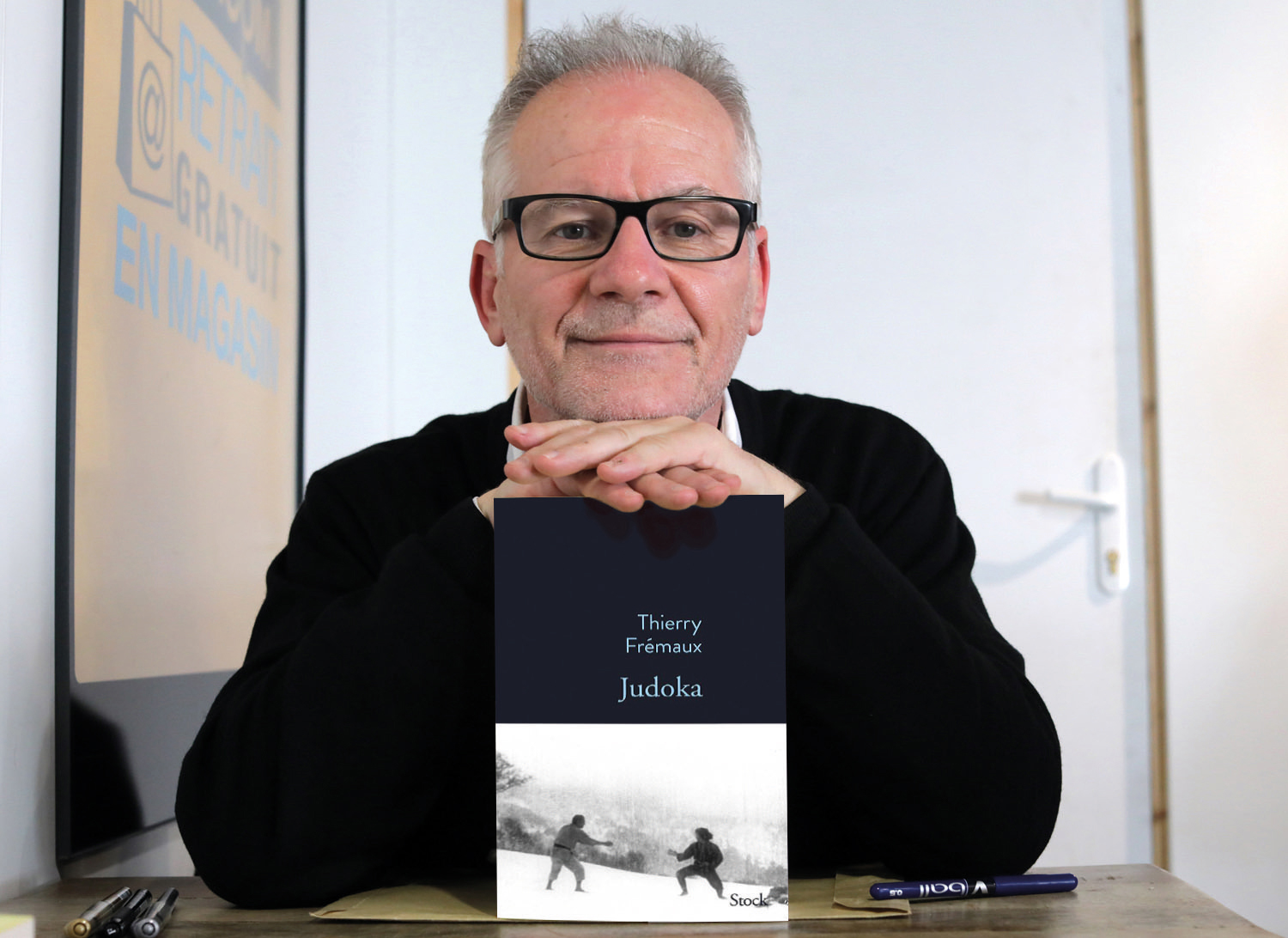
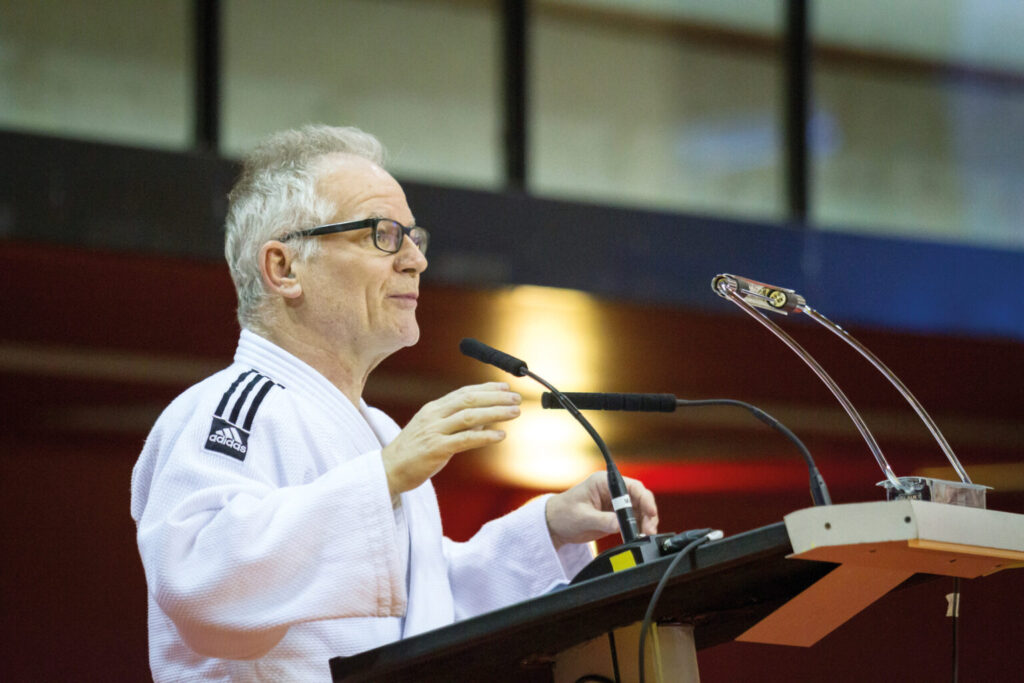
The General Delegate of the Cannes Film Festival and director of the Institut Lumière welcomed us to his Lyon headquarters to discuss the publication of Judoka (Stock éditions), his 319-page tribute to a discipline in which he holds a fourth dan and to which, he insists, he owes everything. – JudoAKDReplay#013.
A French version of this article is available here.
Red carpet and white gi
Judo has never left me. When you are a judoka, you are a judoka, “for life and for death” as Shozo Fujii says. The same goes for footballers, but we all played football. Being a judoka is something else. Black belt is something else. Being a teacher is something else again. Since childhood, I have never felt myself to be anything other than a judoka, and as an adult I have come to realize it is the same. This book says that it is an identity and a culture, a childhood and a destiny. I keep buying judo books and, when I am in Tokyo, making a detour to the Kodokan. I was a judoka who loved the history of his discipline, of Japanese cinema, of Ozu, of Kurosawa… All those years, that too gave me the feeling that I remained something of a judoka.
This book, now
Ten years ago, I didn’t have the mental availability — cinema took everything. But as a young man, I was destined to become a historian, to do research, to produce scholarly works. I was fifty-five when I truly started writing again. I was sixty when this book came out. In the meantime, I wrote that long piece on The Legend of the Great Judo in Desports, then published Sélection officielle with Grasset, which was a literary journal and, no doubt, a kind of warm-up. In Lyon, friends encouraged me. So did my publisher, Stock, when I told him I could bring together Kano and Cadot, Klein and Kurosawa, Tarantino and Killy, the limousines of Cannes and our 125cc motorbikes in Les Minguettes. There was also the idea that judo literature is rich on method and theory, but with few books connected to life in the way you find in boxing, for example… There are things to say, stories to tell. Thierry Rey told me that his youth was the same as mine. I had loved his book, as I had Teddy‘s. A cinephile judoka like Lionel Lacour paraphrases Jean-Luc Godard on the Lumière/Méliès pairing and writes that my book on Cannes had “made extraordinary people ordinary” (film stars), while this one “makes ordinary people extraordinary” — the fighters, the teachers, the referees, the officials. They are legion, the anonymous heroes of judo.
Out loud
If I am credited with a few qualities, it is from judo that I acquired them. Knowing how to speak in public, for example. It was my master Raymond Redon who told me: ‘We can’t hear you! Speak up! Enunciate!’ It was Georges Baudot at the École des cadres who explained that if I wanted to transmit, I had to know how to explain. In cinema, a good film introduction is eight minutes. Not fifteen. Eight minutes. Every field has its techniques, just as in judo, where elocution matters because “you must speak to the black belt in the third row and, above all, they must be able to hear you”, as our masters used to say. When I “hold” the stage at the Palais des festivals or at the halle Tony-Garnier in Lyon, that confidence is something I acquired through judo… Our masters gave us lessons, and those lessons make sense throughout our entire lives, even if we don’t always measure their impact in the moment. At the Institut Lumière, our motto with Bertrand Tavernier comes from Victor Hugo, who says: “I admire like a brute”. You are always right when you act with generosity. That is what I felt watching the careers of Rey, Rougé, Douillet, or Stéphane Nomis, who, once personal success was assured, came back to give himself to judo. Or Djamel Bouras, whom I knew as a child. In my generation, we still had rivalries between towns, with epic battles against Givors — a club full of good judokas and high-calibre officials — and he goes up to Paris, becomes Olympic champion, and shows a formidable personality. A fine destiny for him and a lesson in humility for us! Recently, in an interview with L’Équipe, I was made to express myself negatively about Givors and Djamel — that was not my intention and I have apologized to them. I want to say it again here. These are only fond memories: judo is one and the same family.
Two in one
I am Gemini with Gemini rising. My life has always been double, even in cinema: I love Godard and I love Lautner. Things are complementary: sport and school, cycling and airports, being a judoka and starting a history thesis, growing up in Vénissieux and feeling at ease at dinner parties in town. In short, as Camus thought, “to be on the right with people on the left, and on the left with people on the right”, to balance things out… At Cannes, I do not set what belongs to the red carpet against what belongs to demanding auteur cinema. As the critic Jean Douchet used to say: “What is the intention and what is the result?” This year, the health crisis has struck our cultural and sporting worlds to the core. The collective experience of the dojo, like that of the cinema, is part of a social fabric that is now fragile. I look forward to everything reopening, to coming together again. It is for this idea of a collective foundation that we fight, in culture as in judo.
Bright tomorrows
Would I have found the Institut Lumière in Lyon if my steps had not first led me to the Maison du judo (the two buildings are 800 metres apart, editor’s note)? I only had to cross the road. But everywhere, we are only passing through. A judoka passes through a tatami, just as I pass through Cannes. What can I accomplish so that my successor is even better equipped than I am? This concern for enriching a legacy and raising a pupil higher than oneself comes from judo as it was taught to me. One day, you pass something on to someone. As the playwright George Bernard Shaw said, “one must know how to give back what one has been given”. I was Raymond Redon’s partner — my teacher — for his sixth dan. My first black belt, I wore for a long time and then gave it to one of my first students when she achieved that grade. In cinema too, there is this notion of community and respect for one’s elders. I am known there for watching over them. The recent deaths of Christophe, Jean-Loup Dabadie, Michel Piccoli, or Jean-Pierre Bacri are deeply distressing. As was that of Guy Auffray, whom I admired in my childhood. These are our living treasures. I see the Palme d’or or the honouring of laureates as the awarding of grades. It is a sacred ritual. You must not wait for people to leave before telling them how much they matter. This book is a way for me to feel myself becoming a judoka again. I can no longer do it with my body, so I do it this way. It is my way of saying “thank you”. – Interview by Anthony Diao. Thanks to Leslie Pichot. Opening picture: ©Julien Falsimagne and Éric Gaillard/JudoAKD.
A French version of this article is available here.
More Replays in English:
- JudoAKDReplay#001 – Pawel Nastula – The Leftover (2017)
- JudoAKDReplay#002 – Gévrise Emane – Turn Lead into Bronze (2020)
- JudoAKDReplay#003 – Lukas Krpalek – The Best Years of a Life (2019)
- JudoAKDReplay#004 – How Did Ezio Become Gamba? (2015)
- JudoAKDReplay#005 – What’s up… Dimitri Dragin? (2016)
- JudoAKDReplay#006 – Travis Stevens – “People forget about medals, only fighters remain” (2016)
- JudoAKDReplay#007 – Sit and Talk with Tina Trstenjak and Clarisse Agbégnénou (2017)
- JudoAKDReplay#008 – A Summer with Marti Malloy (2014)
- JudoAKDReplay#009 – Hasta Luego María Celia Laborde (2015)
- JudoAKDReplay#010 – What’s Up… Dex Elmont? (2017)
- JudoAKDReplay#011 – Zakopane, or Lives Passing By (2017)
- JudoAKDReplay#012 – Thierry Frémaux (1/2) – About The Legend of the Great Judo (2016)
More articles in English:
- JudoAKD#001 – Loïc Pietri – Pardon His French
- JudoAKD#002 – Emmanuelle Payet – This Island Within Herself
- JudoAKD#003 – Laure-Cathy Valente – Lyon, Third Generation
- JudoAKD#004 – Back to Celje
- JudoAKD#005 – Kevin Cao – Where Silences Have the Floor
- JudoAKD#006 – Frédéric Lecanu – Voice on Way
- JudoAKD#008 – Annett Böhm – Life is Lives
- JudoAKD#009 – Abderahmane Diao – Infinity of Destinies
- JudoAKD#010 – Paco Lozano – Eye of the Fighters
- JudoAKD#011 – Hans Van Essen – Mister JudoInside
- JudoAKD#021 – Benjamin Axus – Still Standing
- JudoAKD#022 – Romain Valadier-Picard – The Fire Next Time
- JudoAKD#023 – Andreea Chitu – She Remembers
- JudoAKD#024 – Malin Wilson – Come. See. Conquer.
- JudoAKD#025 – Antoine Valois-Fortier – The Constant Gardener
- JudoAKD#026 – Amandine Buchard – Status and Liberty
- JudoAKD#027 – Norbert Littkopf (1944-2024), by Annett Boehm
- JudoAKD#028 – Raffaele Toniolo – Bardonecchia, with Family
- JudoAKD#029 – Riner, Krpalek, Tasoev – More than Three Men
- JudoAKD#030 – Christa Deguchi and Kyle Reyes – A Thin Red and White Line
- JudoAKD#031 – Jimmy Pedro – United State of Mind
- JudoAKD#032 – Christophe Massina – Twenty Years Later
- JudoAKD#033 – Teddy Riner/Valentin Houinato – Two Dojos, Two Moods
- JudoAKD#034 – Anne-Fatoumata M’Baïro – Of Time and a Lifetime
- JudoAKD#035 – Nigel Donohue – “Your Time is Your Greatest Asset”
- JudoAKD#036 – Ahcène Goudjil – In the Beginning was Teaching
- JudoAKD#037 – Toma Nikiforov – The Kalashnikiforov Years
- JudoAKD#038 – Catherine Beauchemin-Pinard – The Rank of Big Sister
- JudoAKD#039 – Vitalie Gligor – “The Road Takes the One Who Walks”
- JudoAKD#040 – Joan-Benjamin Gaba and Inal Tasoev – Mindset Matters
- JudoAKD#041 – Pierre Neyra – About a Corner of France and Judo as It is Taught There
- JudoAKD#042 – Theódoros Tselídis – Between Greater Caucasus and Aegean Sea
- JudoAKD#043 – Kim Polling – This Girl Was on Fire
- JudoAKD#044 – Kevin Cao (II) – In the Footsteps of Adrien Thevenet
- JudoAKD#045 – Nigel Donohue (II) – About the Hajime-Matte Model
- JudoAKD#046 – A History of Violence(s)
- JudoAKD#047 – Jigoro Kano Couldn’t Have Said It Better
- JudoAKD#048 – Lee Chang-soo/Chang Su Li (1967-2026), by Oon Yeoh
- JudoAKD#050 – Hermann Monne – Burkina, a Land Already Peopled
- JudoAKD#051 – Mariana Esteves – A Chronicle of Life Passing By
- JudoAKD#052 – Tiphaine Gingelwein – Chechnya and the Caucasus, a Feminine Perspective in Nuance and Complexity
- JudoAKD#053 – Victor Scvortov – Born Again Under a Lucky Star
- JudoAKD#054 – Eric Gervasoni – From Moves to Movies
- JudoAKD#055 – Mihael Žgank – Coming Home Is Where the Real Journey Starts
- JudoAKD#056 – Patrick Grosperrin – Laterality, a Little-Known Lever of Performance
- JudoAKD#057 – Rest in Peace, René Nazaret (1936-2026)
- JudoAKD#058 – Alexandre Paysan – We Saw Him in the Vercors, Bungee Jumping…
- JudoAKD#059 – Habib Alouache – Teaching Joy
- JudoAKD#060 – Diyora Keldiyorova – Another Giant Leap for (Wo)Mankind
And also :
- JudoAKDRoadToLA2028#01 – Episode 1/13 – Summer 2025
- JudoAKDRoadToLA2028#02 – Episode 2/13 – Autumn 2025
- JudoAKDRoadToLA2028#03 – Episode 3/13 – Winter 2026
- JudoAKDRoadToLA2028#04 – Episode 4/13 – Spring 2026
JudoAKD – Facebook – Instagram – X (Twitter).