Born on 24 September 1981 in Pô (Upper Volta, now Burkina Faso), Hermann Monne represented the land of upright men on the international stage until spring 2016. Seven years earlier, at the end of a winter in 2009 — during which, over the course of an Air Algérie flight, the temperature had gone from 3°C at take-off to 43°C at landing — the U81kg category judoka with the martial bearing had had the simple kindness to transport me helmetless on the back of his “chariot” (his moped) through the streets of Ouagadougou, judogi and belt slung over his shoulder, between a physical training session at the École nationale des douanes and a sunset training session at the far end of the bustling and noisy avenue Bassawarga, at the foot of the Office national des télécommunications antenna, at the AS Onatel club run by the deeply committed Zoungrana family, where he was based.
That reporting trip — which also marked a return to familiar and family territory after several years swept up by a thousand other urgencies that turned out not to be so urgent after all — had taken me from Ouaga to Bobo-Dioulasso, the country’s second city, 360 km further on, where, without knowing it, I was enjoying for the last time the blessings, the warm attentiveness and the gentle voice of my aunt, who was suddenly called to God a few months later… That round trip was followed by screenings across the capital during FESPACO (the Pan-African Film and Television Festival of Ouagadougou), an opening ceremony experienced with family on the grass of the 4-Août stadium, and an end-of-the-world conversation by the poolside of the Azalaï hotel with Mahamat-Saleh Haroun, a refined filmmaker who, a few years later, would courteously apologise by email for having to postpone a coffee we had planned together in Paris because he had just “been appointed Minister of Culture of Chad” (apologies obviously accepted)… The judo sequence became the subject of four pages published the following autumn in the French bimonthly magazine L’Esprit du judo.
“To inhabit the world,” wrote the Senegalese Felwine Sarr in his 2017 essay of the same name, “is to conceive of oneself as belonging to a space larger than one’s ethnic group, one’s nation, the continent that saw one’s birth, those who share the same eye colour, those with whom one shares the same level of wealth, the initial cultural group from which one comes. It is to fully inhabit the histories and cultures of humanity: to take on its multiple faces, to feel oneself heir to the seams of meaning drawn from its plural cultures. No longer to belong to one particular culture, but to set out from it in order to inhabit the multiple, rich and fertile imaginaries of the world’s languages, its myths, the multiple variations of the meaning-making operations that these imaginaries make possible. To inhabit the cultures of the world as one moves through a wardrobe rich in different clothes for every season.”
To invite Hermann Monne to share his news is also an opportunity to take stock of a country where the surname doubles as a first name, and which, despite multiple adversities and a last decade lived on a knife’s edge, has enjoyed a worldwide moral prestige for forty years. The reason? The fleeting Thomas Sankara experiment (1949–1987) — a captain of lofty ideas, clear speech and an almost intact aura, whose most sutemi-like political act was to impose upon himself and his ruling class a reduced salary and a lifestyle stripped down to the essentials. No collective effort demanded from below without radical exemplarity at the top — a parenthesis of decency and dignity for some, an unbearable slide for others, which earned him deadly enemies but has since made many raise an eyebrow when listening to those (numerous, and found at many latitudes) who, having reached an equivalent level of responsibility, take the opposite view that charity begins at home — never mind the millions of others whom Australian journalist John Pilger (1939–2023) bluntly called “The Unpeople”… “Ah, the way of Heaven,” it is written in Lao Tzu’s Tao Te Ching, “is like a drawn bow: the high is brought low and the low is raised up. Excess is reduced, and lack is filled.” A matter of balance, equilibrium and bearing. Of compass, heading and good hope. The business of an entire continent… and perhaps of all the others.
“Why should black heroes die so soon?” sang Ivorian neighbour Alpha Blondy in 1992 in ‘Mystic Night Move’, closing an album, Masada, forever haunted by the introspective ‘Papa Bakoye’. A question that runs through the history of the continent and of many of its charismatic figures of the 20th century, among other contemporary concerns. But a question on which Hermann Monne does not have the luxury of dwelling. Beyond his twelve-year-old daughter and five-year-old son, this descendant of an airline pilot has made other people’s time an extension of his own — he whose obvious potential has constantly had to contend with misunderstandings and obstacles, both those one encounters and those one inherits… “Consequences advise better than advice,” he says near the end of this interview. When you have the world to lift, whether the nights are sweltering or the dawns swept by the harmattan, every day begins like a Monday. – JudoAKD#050.
A French version of this article is available here.
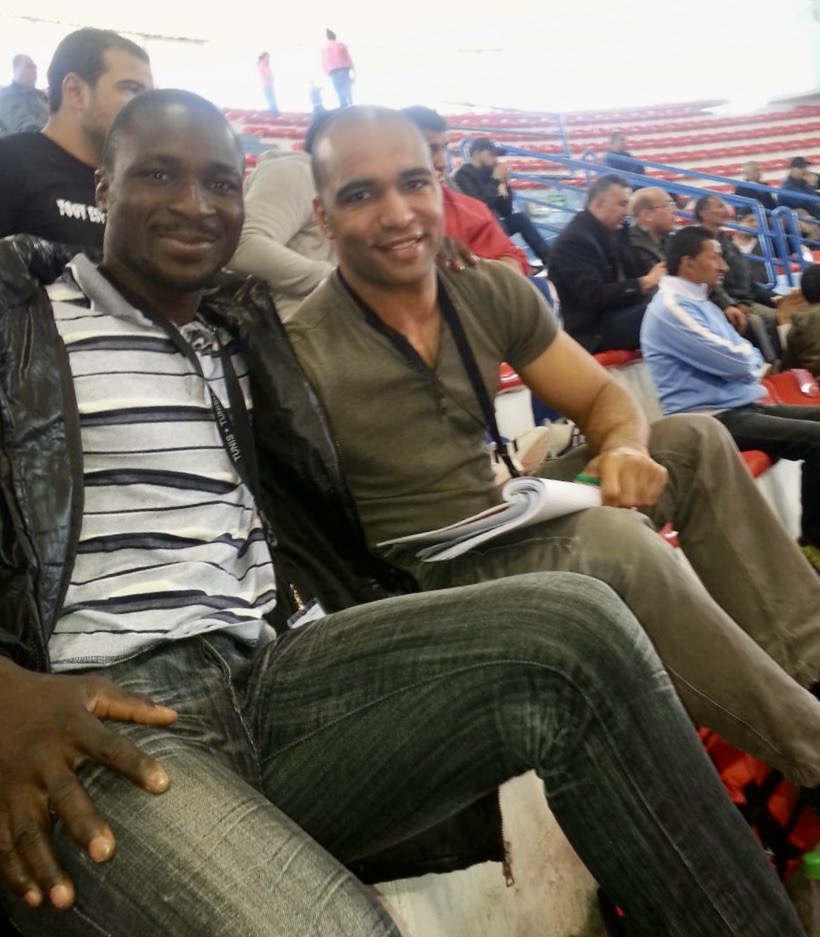
The last time we saw each other was in Tunis, at the 2016 African Championships. What happened for you after that?
After Tunis, I began my transition to become an international judo instructor. I did that with the IJF Academy, completing the theoretical modules (online) and the practical ones (in Yaoundé, Cameroon), which I validated in May 2019. In truth, I had already planned everything. I had decided that after 2016, I was going to stop competing. There were too many small problems here and there with the Federation — it didn’t suit me at all.
At one point, I had asked to go to university. I was told no, that I had to come back the following month, otherwise it was over. And then the family was already there, the children, and so on. All of that pushed me to look ahead, to build a project: creating academies for the training of very young children.
Was it also upon your return that you were entrusted with the national team?
Yes. I already had qualifications, two adult clubs, and a certain amount of experience with the national team, so I was given responsibility from 2016 to 2021. At the same time, I took over two clubs that already existed but were struggling to take off — the founders had got older and there was a lack of coaches. I approached them and offered to take the reins. In the first year, two athletes joined the national team. In the second, there were five or six. The club took off. We became one of the three best clubs in Burkina in terms of performance.
But since I had the project in mind, I told myself it was necessary to go and build from the grassroots. Having adults is fine, but to have a solid foundation, you need to work with young people. When I stopped with the national team in 2021, I launched the first centre — at the Centre sportif Jean Simporé, in the 1,200 Logements neighbourhood. Do you know where that is? That’s where I dropped you off at your cousin’s place back then, near the mosque.
Yes, I remember you were kind enough to make that detour…
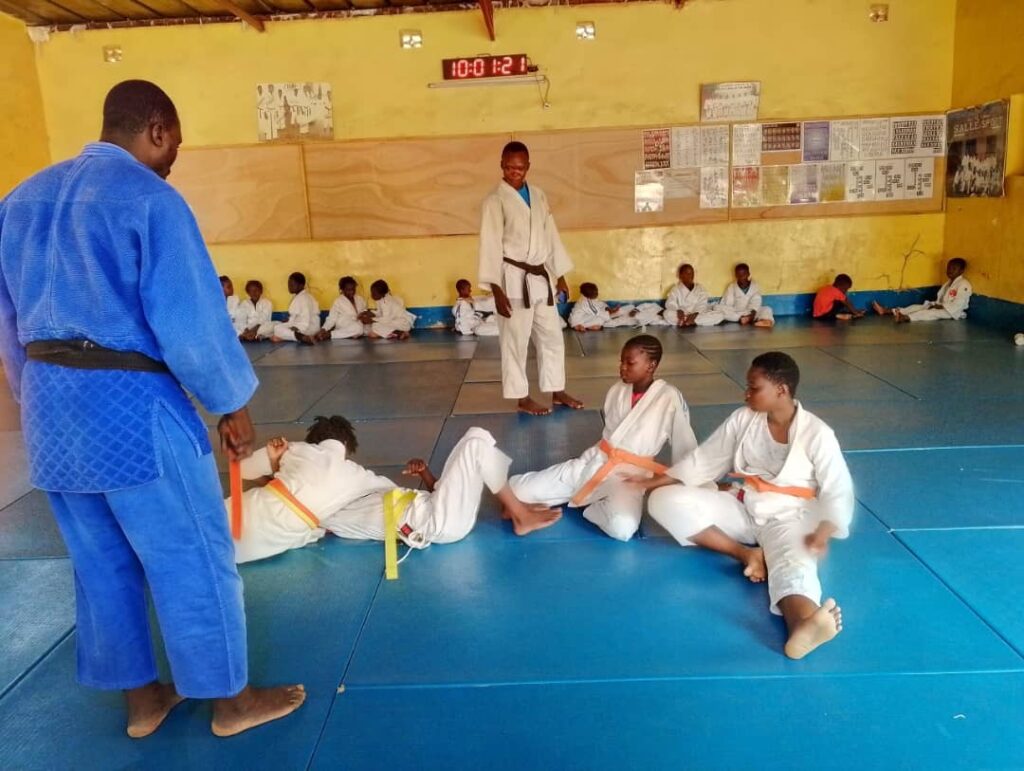
I started with a few children, and that’s where the idea of the judo holiday camp came from. In July, around a hundred children took part. At the start of the new term, at re-enrolment, we had about forty at the club. Since then, every July, I continue to organise this camp. Word of mouth did its work — people who had followed my career saw what I was doing and trusted me. This year, I opened four more centres: in Saaba, in 1,200 Logements, in Tampouy, and in Bassinko, the neighbourhood on the outskirts where I live, fifteen kilometres from the city centre. The first centre now has around sixty children.
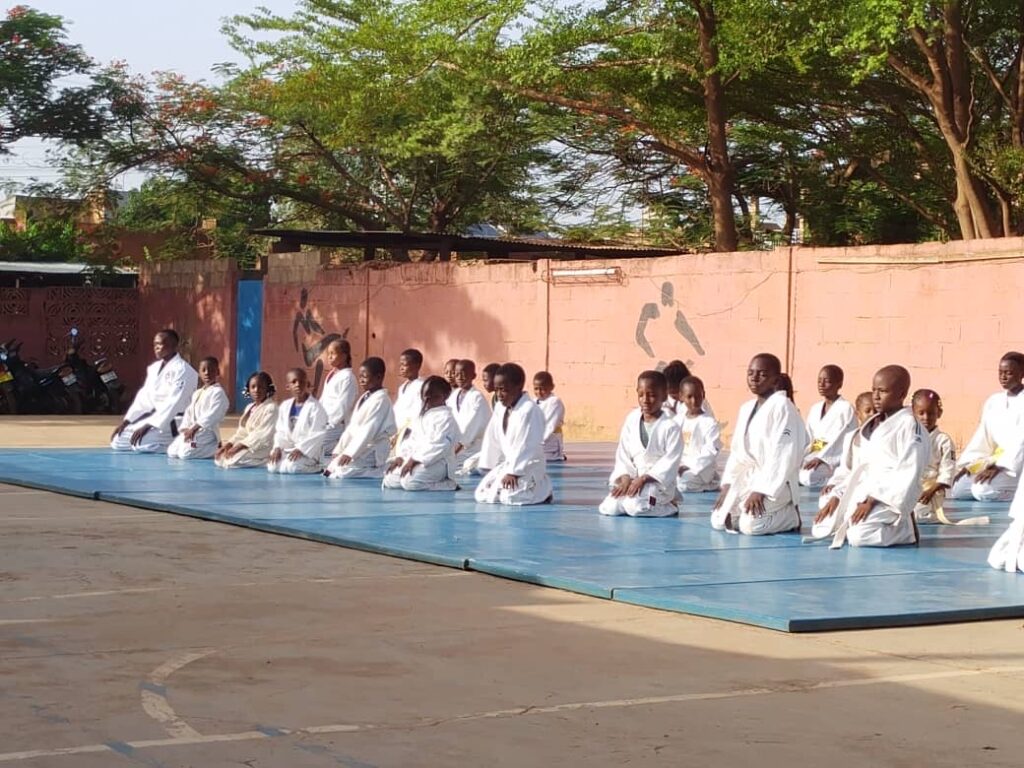
And outside the clubs, do you also teach at training institutes?
Yes. I teach at the ISSDH, the Institut des sciences du sport et du développement humain — the former INJEPS, which trained PE teachers. Since the split between the Ministry of Education and the Ministry of Sports, the school falls under Sports. Physical and sports education moved to the École normale supérieure, which has three institutes, one of which is dedicated to these specialisations. The ISSDH is purely sport.
I started by taking the first-year students — Licence 1 and the second-year teaching track. I quickly understood that this is the level at which you need to anchor the fundamentals: these are the people who will go out into the field. And when several of us are pushing in the same direction, it carries even further.
How do you structure your teaching?
In the first year, a document was drawn up in theory. It covers the history of judo, its evolution, schools of judo teaching, judo in Burkina Faso, and the techniques: ukemi, nage-waza and osaekomi-waza for white belt. In the second year, the teaching focuses on rules and improving the fundamentals. They have three years of training — a bachelor’s degree — with a special sports coaching module for those who opt for judo, to go deeper into what was covered in class. Each practical or theoretical session is assessed. First-year students therefore have two assessments. I also take the professionals, those who come back to obtain their CAPEPS or CAPES teaching qualifications. Two levels, then.
I have been teaching there for several years now. And then five years ago, the school that trains purely in physical education contacted me to reintroduce the judo module. In 2020–2021, I volunteered: I developed the training curricula and syllabuses for first and second years and for the professionals, with a syllabus adapted to each level. I submitted everything, the academic council validated it — they said it was a good progression, that having judo in the curriculum would do a lot of good. We actually started in 2021 with the first years and expanded progressively. That’s five years now.
So to summarise: in the first year, it’s the fundamentals. In the second, we improve and cover the rules. In the third year — the professionals — we go further: the rules in detail, practical cases, competition organisation. And many of them move towards officiating roles, which helps us a great deal during competitions.
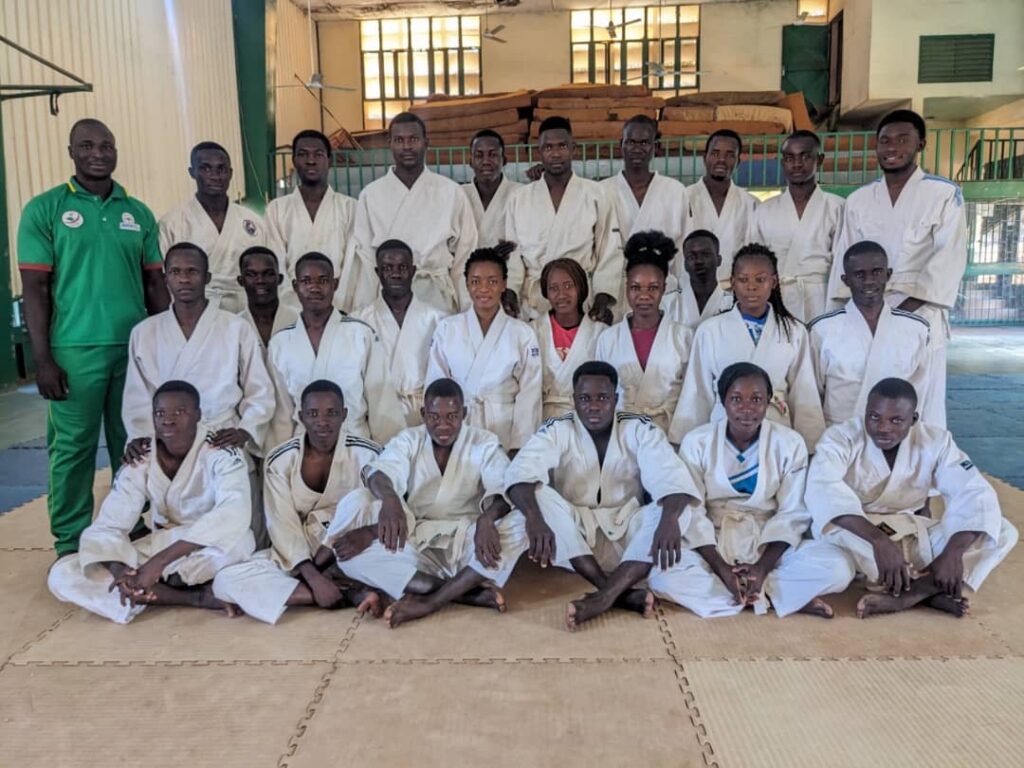
You’re well and truly absorbed by judo, then… What does a typical week look like for you?
I’ve just come back from Koudougou — I had twelve hours of theoretical classes to give to first-year students (CAP-CEG1). There are around three hundred students. For the past three years, instead of giving the theoretical class group by group, I put them all together in a common core. I developed a document for each level: in the first year, twenty-two pages covering the history of judo from 1882 to the present day, its arrival in Burkina Faso, the Burkinabè Federation, white belt techniques, weight categories. The class takes place in person, supported by videos. In the second year, we enrich: training styles, shiai, uchi-komi, nage-komi… And competition formats — pool-to-draw, draw-to-pool — with videos of international competitions, because that is really important. At the professional level, we go even deeper into the rules.
When I finish the class, I hand the assessment over to the academic office. They collect the papers and I mark them. Three hundred first-year students this month — that’s a lot of work.
That’s quite something. And on the tatami, what does the practical class look like?
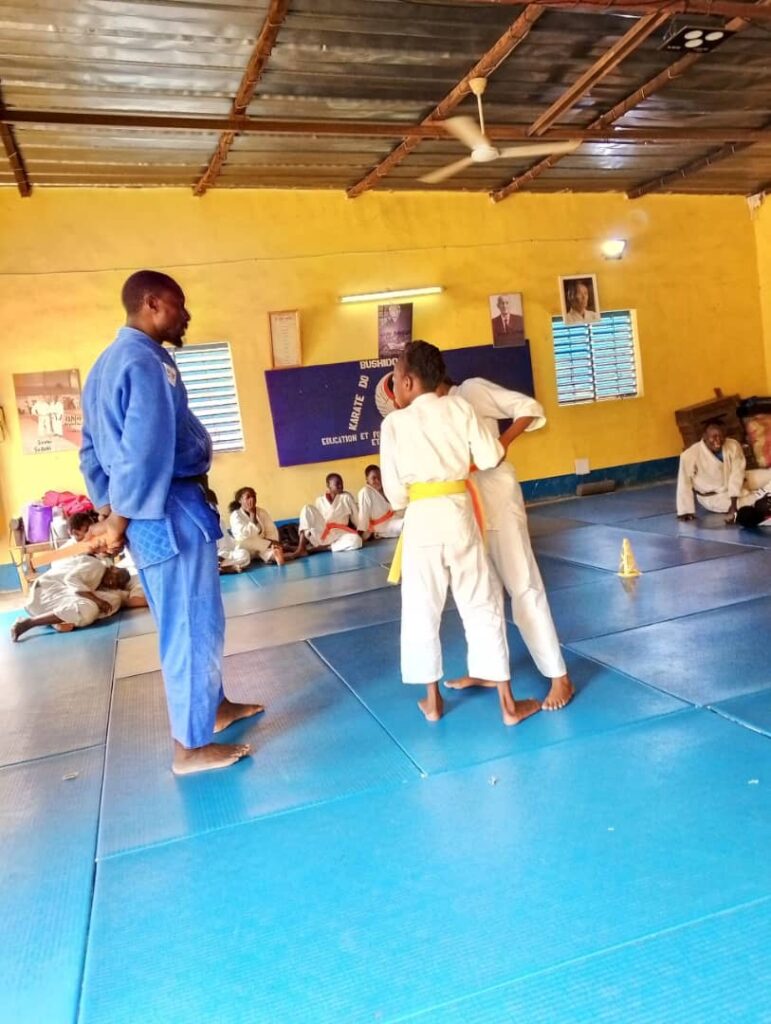
Since there are three hundred of them, we make groups of fifty. Each group has twenty-four hours of practical class. We start with ukemi: mae-ukemi, ushiro-ukemi, yoko-ukemi. Then the first-year nage-waza — white belt level: de-ashi-barai, hiza-guruma, o-goshi, uki-goshi, ippon-seoi-nage, o-soto-gari. For osaekomi-waza: hon-kesa-gatame, kami-shiho-gatame, yoko-shiho-gatame, ushiro-kesa-gatame, tate-shiho-gatame.
In the second year, we step it up: tai-sabaki, ayumi-ashi, suri-ashi, techniques in movement, escapes from osaekomi-waza, reversals into pins, and sensation work with uchi-komi, nage-komi and tachi-waza to ne-waza transitions.
Each practical class is assessed. I’ve put a system in place: we assess both in theory and in practice. From 13/20 upwards, the student moves to the next belt. By the time they finish the three years, they are at a minimum at blue belt. Those who are motivated go into the field to coach, complete their practical year, then take the nage-no-kata and the federation exam.
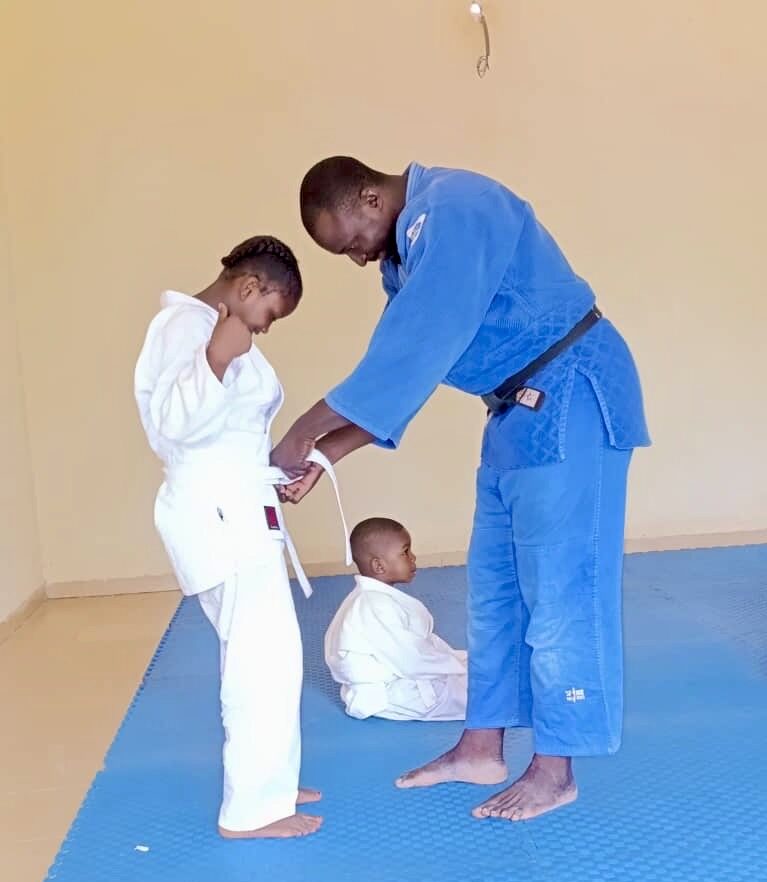
Those who earn their black belt, I train in coaching children — educational judo. I relaunched an entire pedagogical progression for that. They are the ones who run the different centres.
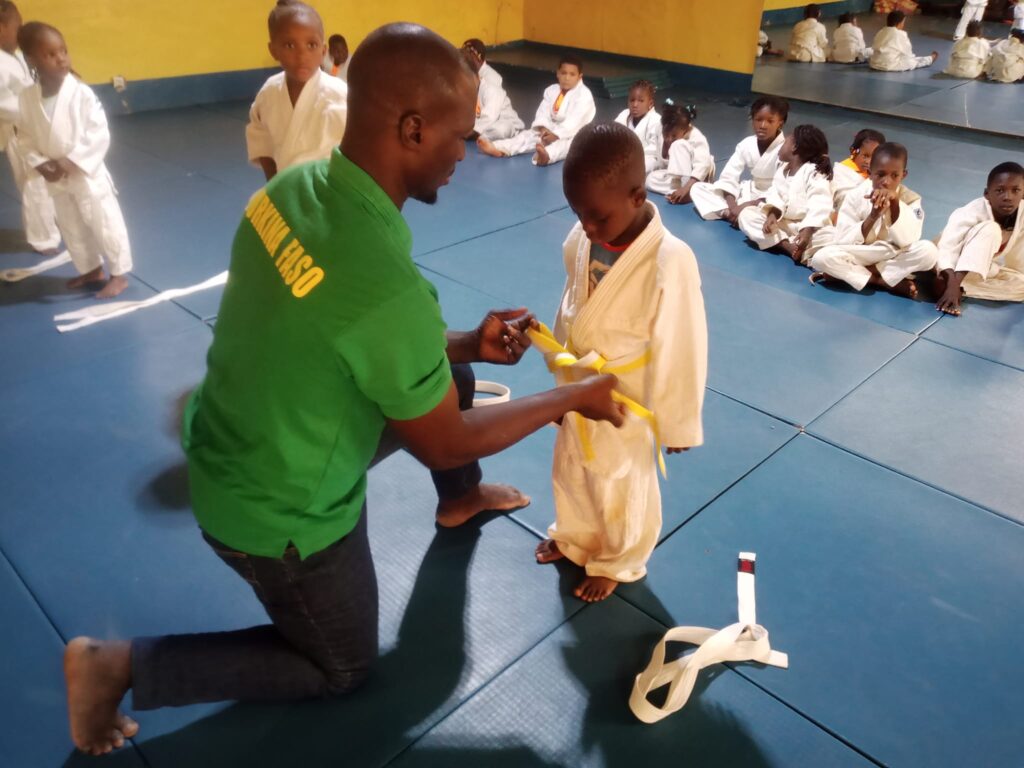
Have primary schools also approached you?
Yes, two schools whose founders contacted me to introduce judo into extracurricular activities. One started in 2022, the other in 2023. The numbers are high: around sixty children in the first, around forty in the second. It’s pure educational judo — developing motor skills, channelling energy, learning ukemi and games that lead towards nage-waza. A truly enriching experience in its own right.
At the moment, I’m also working on personal projects in parallel, because with the Federation things take time. I operate on my own funds — acquiring tatami, judogi. I move forward slowly, according to the means available.
Do you have partners who support you?
A few, yes, but it’s far from easy. It comes largely out of my own pocket. For equipment, there are local suppliers who order directly from China.
And how do you get the word out about the judo holiday camp?
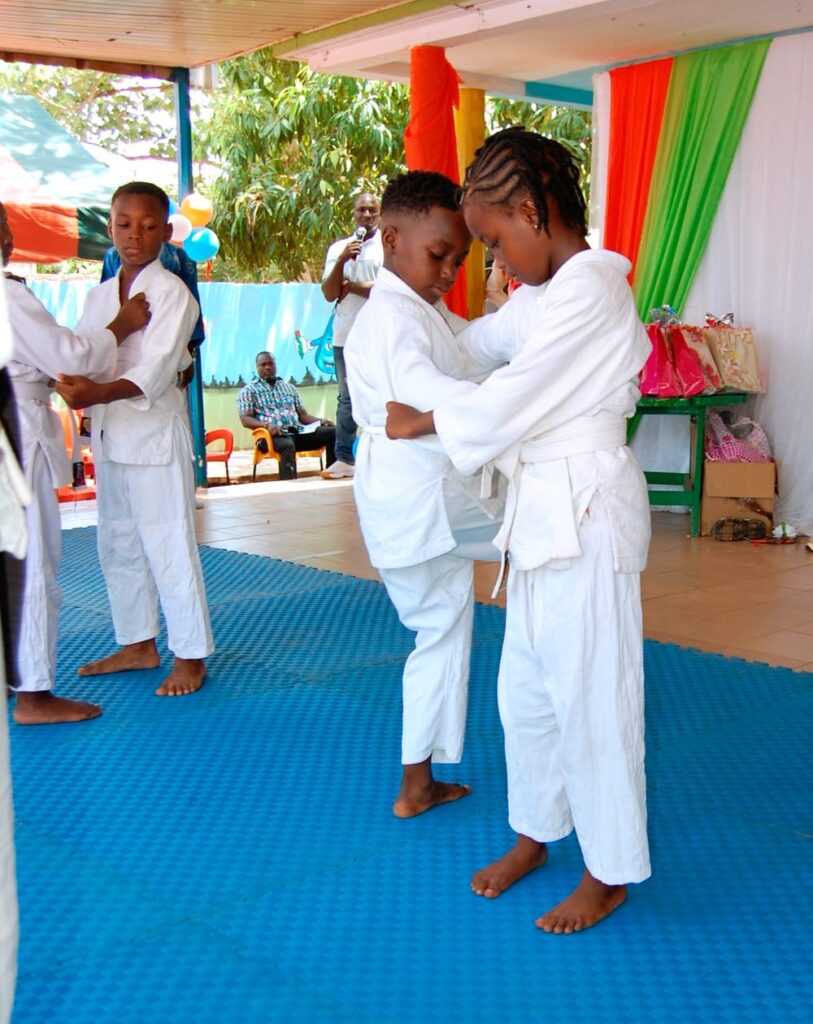
The camp is well established now, people talk about it. I make flyers and distribute them in WhatsApp groups to friends and acquaintances. I also have an official judo page that has good visibility. And above all, as June approaches, we hold closing ceremonies at the different centres. Parents come to watch, we put on a demonstration and organise belt gradings. I take the opportunity to hand out the camp flyers.
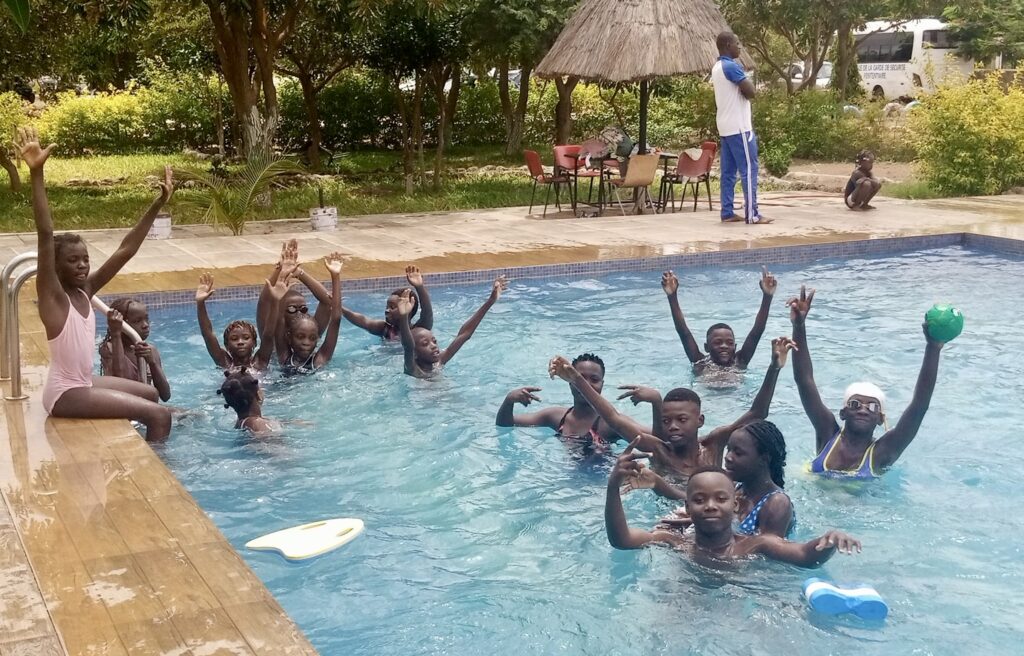
In the last week of the camp, we go on a trip outside Ouaga. We hire a coach to take the children somewhere pleasant, with a swimming pool, lunch on site and a judo demonstration in the afternoon. We get back around 5 or 6 pm. The parents are happy, the children love it. Every year there’s a good turnout — people see the virtues of judo, the educational aspect, the way it channels children. Sometimes I have to turn away registrations, we’re so overwhelmed.
How many children do you have across the different sites?
At the first site, just over fifty, sixty children. At the second, around forty.
How old are they?
We take children from three or four years old up to fourteen or fifteen. Beyond that, we direct them towards the adults, because from a certain age it’s a different progression, a different pedagogy.
You mentioned that with your students, you cover the history of judo in Burkina. Could you say a word about that?
Of course. I start with the history of judo in Japan, then its development in Europe, particularly in France with the pioneers who adopted judo through jujitsu. And since we were colonised by France, it was through a French cooperant — the head of physical education at the Lycée Philippe Zinda Kaboré — that judo was introduced to what was then called Upper Volta. His name was Robert Gaty. The first cohorts were in 1957 and 1959. I have an uncle — my father’s older brother — who started judo in 1959. Real pioneers.
Then we began to take part in competitions: the Solidarity Games, Abidjan, Dakar. Burkina’s first medals were won under the name Upper Volta. In 1965, at the African Games in Brazzaville, we won a silver medal and a bronze medal. And the progression continued right up to our generation, which held on until 2016.
I talk about the various clubs in Burkina — those that once existed and have since disappeared, and those that are still open. The different federation presidents, the evolution of the structure itself: first the Fédération Voltaïque de Judo et Disciplines Associées, then the Fédération Burkinabè de Judo — including wrestling for a time, because the two disciplines were combined. Then came the separation, the creation of leagues and districts. And that is where we stand today.
If we return to your career as an international athlete — what is your overall assessment? What is your greatest source of pride? And your greatest regret?
I am content with where I am, because after all, I started judo on rice straw, wearing a jumper, in December 1993. That was in my home town, in Pô, in the Naouri province.
Yes, and you used to hide the fact that you were doing judo, if I remember correctly…
Exactly. My parents weren’t in agreement. You know, I grew up with my maternal family, and my maternal grandparents didn’t look kindly on sport — my grandfather was a teacher and thought sport would harm my studies. So I was forced to keep a low profile.
In 1999, I followed a maternal uncle to Ouahigouya and continued secondary school there — at the Lycée Yamwaya. At the time, we trained on wood shavings covered with a tarpaulin. I was already a brown belt when I arrived there. From Ouahigouya, I came to AS Onatel — the club where you came to do your report back then. I stayed there from 2000 to 2016.
Your entire career, in fact…
I had my finest days at Onatel, yes. I had already made a name for myself at national level from Ouahigouya — third nationally — and there, I became national champion. I competed in many tournaments, made many trips, and discovered the national team. My international career — I won’t say I’m fully satisfied with it all the time, but it’s there. Because the journey wasn’t always straightforward — being in two different worlds with different divisions meant you sometimes had to negotiate. I was at the Ministry of Sports, and I had the advantage of having good relations there, which helped unblock certain things.
My greatest regret? Missing out on the medal at the African Championships in Yaoundé in 2010. It was against the Angolan Angelo António. I had executed a fine technique on him, but the referee awarded waza-ari to him. I was convinced it should have gone to me. Those 2010 African Championships in Yaoundé still hurt.
I remember that Angolan, yes… He was a solid judoka.
Yes! He even produced the IJF’s best ippon that year — a sweep in five seconds. Against him, I still think it was a scoring error. But there it is, things went differently. Despite that, the experience always brought me a great deal. Judo allowed me to forge myself — not only in terms of performance, but on a human level too. Wisdom, endurance, perseverance, courage, determination: all of that is built on the tatami.
And then judo allowed me to travel, to discover countries, civilisations, different ways of seeing things. Today, when I travel, I never feel out of place. The last time we spoke, I didn’t fail to mention that I was in China for a seminar on martial arts. It’s thanks to my experience and the work I continue to do that I was selected.
If I look at my career as a whole, I had never imagined reaching this level — the travels, the competitions. My contemporaries who started with me back then, when they see me today, say you couldn’t have imagined me going so far. And I always tell them: it was a challenge. Especially since, as I told you, nobody in my family wanted me to do judo.
How did you manage to go the distance?
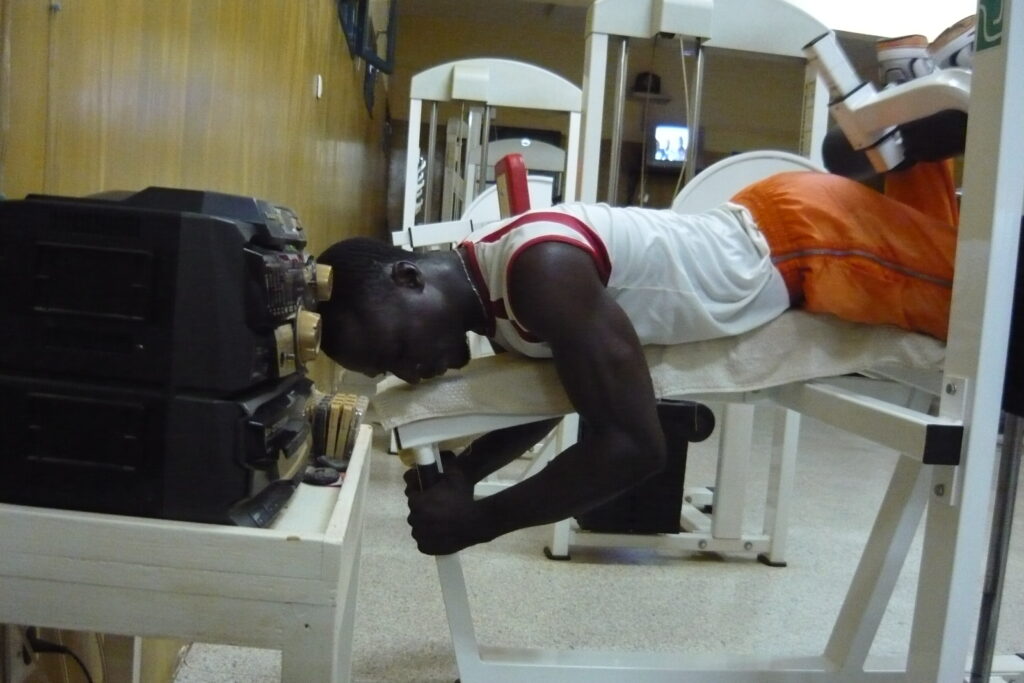
I said to myself: I have to prove that you can do judo and succeed academically at the same time. I passed my baccalaureate and enrolled in a geography degree at university. And in my second year, I decided to sit the Ministry of Sports entrance exam so I could continue doing what I loved. In 2006, I passed that exam. I completed my training while continuing to compete. Today, the family no longer says anything. Better still: uncles and aunts want to enrol their children in judo!
That’s a fine form of vindication…
But not everyone has the same determination. Even to my own children, I say: I’m taking you to judo, but not so you’ll be as involved as your father. What matters is the education that judo brings. If one day they want to do another sport, they’re welcome to… For me, working at the Ministry of Sports, it’s inconceivable that my child doesn’t do sport. Judo first, and if you want to do something else, I’ll support you.
So, Wednesday and Saturday: judo. Sunday: swimming with their mother. After training, we stop at the ice cream parlour — burger or ice cream, everyone chooses — and we go home. Monday to Sunday: busy.
How do you coordinate all of this on a day-to-day basis?
I have a WhatsApp group with all the coaches. Every week we take stock of the numbers, we redirect sessions if needed. And when I have time, I do the rounds of the centres. It’s both to check how the sessions are going and to be able to talk with the parents. It’s important to take the time to listen to their expectations, their concerns, to explain how things work. I also have WhatsApp groups per centre with the parents, where we communicate directly. That’s how it runs.
On the subject of adversity — I can picture you at the Paris Tournament in 2007. You land at Roissy on the very morning of the competition, you make the weigh-in, you compete and, unsurprisingly unfortunately, you lose in the first round. And your federation tells you that, given this result, you cannot stay for the international training camp starting the next day… Yet anyone who takes the slightest interest in all this knows that it is precisely through this type of gathering that you can harden yourself… How did you deal with all these misunderstandings?
I have always said that you have to carve out your own path. When I started competing internationally, I would approach people and try to present my projects. We came to France to prepare for competitions, we went to Germany, to Switzerland. I would ask: can you offer us a preparation space? And it worked — people listened and told us to come.
I had the advantage of having a very attentive head of high-performance sport, who fought to find us plane tickets. She had known me since I was a child. She had followed my career and could see that I never spared my efforts. We were also on the national team with Séverine Nébié, who lived in France and had a great deal of experience. We managed to go on training camps — Paris, Bremen, Hamburg. And through these preparations, the level rose and the results came. The Federation wasn’t always happy that we went over its head, but when the results started coming in, it had to accept it.
With hindsight, what were the limiting factors in that organisation?
The limitation is that the people who run federations often have no experience of high-level competition. As a result, they don’t understand how it works. That is what I experienced when I became national coach. I had built a reputation at the international level, relationships of mutual respect with people abroad — and that is something you can’t understand from the inside if you haven’t lived it yourself. That is why I eventually decided to stop with the national team.
What pushed me over the edge was the African Championships in Dakar in 2021. We had Lucas Diallo and two Olympic scholarship holders, Sidibé Rachid and Kaboré Adjarata — and they hadn’t booked a hotel. I was forced to negotiate on the spot and find a residence next to the official hotel. The federation president told me I had to pay two days in advance. After that, I thought it over and said: no. I have to stop.
I wanted to bring my experience, to draw on the contacts we had built with continental and international leaders… But if people don’t listen to you, if you give guidance and they do as they please… At some point, you have to choose. And I had projects waiting. In eight or ten years, in two or three olympiads, the children I coach today — perhaps some of them will become champions. And even if they don’t go through the Federation, they are athletes we will have trained, who we can accompany at club level. That is my logic.
I had indeed sensed those strong internal tensions, from our very first meeting…
Yes, that is exactly what I mean. I have always pushed through adversity. I don’t play politics — I give technical opinions. And given what I have accomplished internationally, what I have contributed to Burkinabè sport, I don’t think anyone can erase that with the wave of a magic wand. When it comes to the development of national judo, I have a say. And for what I am currently doing to promote judo, no one can stop me from giving an opinion.
I am a pure technician. When I speak, it’s technical, not political. If someone wants to do politics, let them do it. I’m on the tatami on Tuesdays and Saturdays with the children, on Tuesdays, Saturdays and Sundays with the adults, with an additional physical preparation session. And every evening when we have upcoming events, we train. I don’t have time to get caught up in turf wars.
Fairly early on, I believe, we had discussed together the collective levers for progress. I remain convinced, for example, that a continental medallist — whether from the African, European or Oceanian Championships — should as a matter of right be qualified and supported for a year on Grand Slams and at international training camps. Not so much for his or her own sake, but so that a generation gains experience and, when retirement comes, can pass on that lived experience and those contacts to the next generation. The question is: is there the political will for that?
Everything goes through projects. If federations don’t submit projects to the ministry, nothing happens. What often happens is that people come to the federation for the perks — to travel, to be seen — not to build. I want things to be even better than what we experienced. While waiting for that idea to take hold, it’s better to observe. The day people are ready, we’ll be able to put things in place.
A project means a budget. What are the spending items? You present that to the ministry. What they don’t fund, you look for partners. I’ve been at the Ministry of Sports for seventeen years — everything to do with the organisation of sport, I know it. Everything to do with running sports projects, likewise. And I have the network to help identify funding.
What I cannot accept is that when we were on our own, we managed to prepare in Switzerland, Germany, France. Personally, I used to go to Cyril Pagès in Orléans to prepare. That’s where I got to know Alpha Djalo, Pape Doudou Ndiaye, and many athletes who are now on national teams. I also used to come to the Institut du Judo in Paris. I would take the metro to train. I went to Villemomble with Omar Gherram. We went to Germany. Today, with the national team, they don’t even go anywhere to prepare. That is the real waste.
Today, there are Olympic scholarship holders who haven’t done a single training camp worthy of the name. Doing the national championship, the regional, going to Abidjan, to Yaoundé — that’s it. And everyone slots in someone else for their own benefit. I say that’s a waste. Burkina funded me, trusted in me. In return, my experience must benefit the country. And it does benefit it — through my classes at the Institute, through the centres. But it should also feed the national team. That’s why I don’t let go.
If it can offer you any “reassurance”, this problem is unfortunately not unique to Burkina. Champion of the world and double Olympic medallist though he is, a coach as respected as Jimmy Pedro (Kayla Harrison, Marti Malloy, Travis Stevens…) described on this site the glass ceiling he ran into when he tried to build a project for American judo well ahead of the Los Angeles Games… The same goes for someone like the Italian Ezio Gamba, Olympic champion and double world medallist, who had to wait until he left to work with Russia before he could fully demonstrate his managerial abilities…
It’s the same problem everywhere where people have done the international circuit. The people running the structures know that you know. And if they let you lead a project, they know that in the end they won’t be part of it, because they don’t have the mastery. That’s why they resist.
For my part, I work with the Centre Judo League. When we organise a regional championship, I’m on the technical team. I run the technical meeting, the draws — manual draws remain a laborious task that few people master. Every time things go wrong at a competition, they’re forced to call on me. And I tell people: we are not reinventing judo. The rules are there, we apply them. And that goes for me too. My athlete is not above the rules. If he is in breach of the rules, we disqualify him — in my setup, that’s how it is.
At the weigh-in, for example: some arrive a hundred or two hundred grams over. People say: “We need to be flexible.” I say no. At the international level, there is no weight tolerance. In my clubs, at the start of the season, we draw up a list of the categories in which each person wants to compete. And if you arrive at the weigh-in outside your category, you are disqualified. I’m the first to say so. If I am rigorous with myself, I am rigorous with others — no special treatment.
That reminds me of a report in Slovenia, a few years ago. An athlete had arrived one minute late to a six o’clock in the morning training session. Well, he was sent home, regardless of his track record — one minute late, back home.
At my place, it’s the same. When I teach at the Institute, I start at seven o’clock. I live fifteen kilometres away, but at five thirty I’m parked outside in my car. At ten to seven, I get out, go into the gym and get changed. At seven o’clock, I wake my students up. For five years, it’s been like that, without exception. I’d rather wait an hour in my car than arrive late. A latecomer who comes to give me excuses — I don’t listen. You have to be on time. Same rule at the club.
For the Monday morning session in Koudougou — a hundred kilometres from Ouaga — in theory I should arrive the evening before. But since I have training sessions to manage in Ouaga until eight o’clock in the evening, I hit the road at four thirty. By six o’clock, I’m in Koudougou. At half past six, I have my coffee. At quarter to seven, I’m in front of the lecture hall. Nobody sees that, but that’s how it’s done. And I told the administration: if they schedule a class for me, and I arrive and it’s not happening, twice like that and I stop. Those are my terms. I don’t work by halves.
And when you’re sitting in your car at five thirty or six in the morning, do you wait in silence or do you listen to the radio?
I sit there and catch the news while waiting for everyone to arrive.
How do your students react?
When the students have the chance to chat, they say: “Mr Monne, you never rest.” It doesn’t bother me. When I give my class, silence is the rule. Nobody talks.
The schedule runs over a month and a half, with four groups, twenty-four hours per group, three times a week — morning, afternoon, evening. In five years of teaching, not one student can say they arrived before me. It’s not possible.
How many hours a night do you sleep?
Four hours, five at most. I have always told people: you need to sleep less when you want to accomplish great things. You can’t sleep like a log and wake up having achieved everything. It’s not possible.
That gives us something in common, these short nights…
My wife often asks me: “Do you actually sleep?” Sometimes she wakes up at midnight to go to the bathroom — I’m still at the computer. She says: “You’re not sleeping?” I tell her: “I’m working.” And at five o’clock, I’m the one waking her up. Last night, I started sleeping at two in the morning. At five o’clock, I was up. My eyes are always red [smiles].
Do you take naps?
No. If it’s not at night, I don’t sleep. I’m wired that way. That’s how I function. And I’ve told people: seriousness is built in the small things — being on time, finishing what you start, not wasting your energy on pointless battles. There’s no point.
That’s a judo mentality.
Exactly. Save your energy to be efficient — less energy for more productivity. I don’t tire myself out for people who aren’t on the same wavelength. If you talk to someone about qualifying for the Olympic Games and they’ve never experienced it, they don’t understand. Today, when you talk to me about Olympic qualification, it’s an entire process. You don’t just take someone and ask them for a medal. There’s groundwork to be done, a whole package: training camps, the maximum number of competitions, assessing the level through competition, and then you remodel the training based on the weaknesses identified. And if an athlete trains one way at his club and another way with the national team — if when he comes to the national team he’s bored, going round in circles — what are you going to bring him?
I said: we don’t have the means to work with a full team of fourteen people, but we can identify the five or six best and switch them onto the circuit. A well-structured project, with the right arguments, can be funded. Plane tickets and accommodation costs aren’t that enormous either. And there are tricks — even the major nations play with hotel bookings to save money and fund other trips. We did that with Séverine. That’s why we were able to keep going over the long term.
But if you push aside those who gave Burkinabè judo its finest days — Séverine has moved towards jujitsu, Zoungrana is sidelined, I’m sidelined — everyone in their corner, who carries the torch? Young people need to think. Instead of fighting among themselves and saying that Monne doesn’t want the Federation to progress, they should work. And always think about the consequences. Consequences advise better than advice. Today, the ministry itself refuses to fund certain trips because there are no results. Little by little, people will redirect themselves or not. We are here.
Have the political upheavals the country has experienced in recent years had any positive effects on sport?
There have been changes, but sport is a question of vision. Often, the people placed at the head of a domain don’t necessarily know it well. But that is precisely the role of federations: to convince those authorities with solid projects, documents, supporting arguments. You don’t go and sit in front of someone and say “we have problems.” You go in with a project on paper: objectives, budget lines, expected results. That’s how it works today.
And I, with seventeen years at the Ministry of Sports — in the directorate for the Promotion of the Sports and Leisure Economy — have solid experience in everything related to the organisation of sport and the management of projects. I helped several federations draft their statutes and regulations, including the Burkinabè Rugby Federation when it was set up. Many clubs also approach me for that. As long as it’s for the development of sport, I’m there, no problem.
Last December, I organised a level-assessment camp for coaches from the different centres. With my counterpart Zoungrana Hermann and Davy Christian, we organise a training cycle. Because being an athlete or a competitor doesn’t mean you know how to coach children. Educational judo is a different world — it requires a specific pedagogy. The goal: at least fifteen hundred children benefiting. If other clubs are interested, the doors are open.
You were twelve years old when you started judo. If the Hermann of today could speak to the one who, in December 1993, was tying his first white belt, what advice would you give him?
I have no regrets. If I were to speak to him, I would say: you are on the right path. Arm yourself with courage, determination, and above all strategy. Because we learned on the job — we were thrown into the jungle without any guidance. It was courage and determination that made all the difference.
There were moments of doubt, moments when I told myself: is it worth carrying on? And every time, when I looked at the ground already covered, I said to myself: keep going. Because today’s young people can’t imagine what we went through. We started on rice straw. Today, children start judo with a judogi, on a tatami — it’s taken for granted. In six or seven years with good coaches and a well-structured progression, you can set your sights on international travel. Before, it took well over ten years.
Today, they have all the tools to succeed: experienced coaches, progression plans, sports projects. They have parental support — I myself drive my children to and from training. Before, that didn’t exist. They have everything going for them. Only one thing is missing: work. Only work pays off. [He repeats] Only work pays off. — Interview by Anthony Diao, autumn 2025 – winter 2026. Opening picture: ©Archives Hermann Monne/JudoAKD.
A French version of this article is available here.
More articles in English:
-
- JudoAKD#001 – Loïc Pietri – Pardon His French
- JudoAKD#002 – Emmanuelle Payet – This Island Within Herself
- JudoAKD#003 – Laure-Cathy Valente – Lyon, Third Generation
- JudoAKD#004 – Back to Celje
- JudoAKD#005 – Kevin Cao – Where Silences Have the Floor
- JudoAKD#006 – Frédéric Lecanu – Voice on Way
- JudoAKD#008 – Annett Böhm – Life is Lives
- JudoAKD#009 – Abderahmane Diao – Infinity of Destinies
- JudoAKD#010 – Paco Lozano – Eye of the Fighters
- JudoAKD#011 – Hans Van Essen – Mister JudoInside
- JudoAKD#021 – Benjamin Axus – Still Standing
- JudoAKD#022 – Romain Valadier-Picard – The Fire Next Time
- JudoAKD#023 – Andreea Chitu – She Remembers
- JudoAKD#024 – Malin Wilson – Come. See. Conquer.
- JudoAKD#025 – Antoine Valois-Fortier – The Constant Gardener
- JudoAKD#026 – Amandine Buchard – Status and Liberty
- JudoAKD#027 – Norbert Littkopf (1944-2024), by Annett Boehm
- JudoAKD#028 – Raffaele Toniolo – Bardonecchia, with Family
- JudoAKD#029 – Riner, Krpalek, Tasoev – More than Three Men
- JudoAKD#030 – Christa Deguchi and Kyle Reyes – A Thin Red and White Line
- JudoAKD#031 – Jimmy Pedro – United State of Mind
- JudoAKD#032 – Christophe Massina – Twenty Years Later
- JudoAKD#033 – Teddy Riner/Valentin Houinato – Two Dojos, Two Moods
- JudoAKD#034 – Anne-Fatoumata M’Baïro – Of Time and a Lifetime
- JudoAKD#035 – Nigel Donohue – « Your Time is Your Greatest Asset »
- JudoAKD#036 – Ahcène Goudjil – In the Beginning was Teaching
- JudoAKD#037 – Toma Nikiforov – The Kalashnikiforov Years
- JudoAKD#038 – Catherine Beauchemin-Pinard – The Rank of Big Sister
- JudoAKD#039 – Vitalie Gligor – « The Road Takes the One Who Walks »
- JudoAKD#040 – Joan-Benjamin Gaba and Inal Tasoev – Mindset Matters
- JudoAKD#041 – Pierre Neyra – About a Corner of France and Judo as It is Taught There
- JudoAKD#042 – Theódoros Tselídis – Between Greater Caucasus and Aegean Sea
- JudoAKD#043 – Kim Polling – This Girl Was on Fire
- JudoAKD#044 – Kevin Cao (II) – In the Footsteps of Adrien Thevenet
- JudoAKD#045 – Nigel Donohue (II) – About the Hajime-Matte Model
- JudoAKD#046 – A History of Violence(s)
- JudoAKD#047 – Jigoro Kano Couldn’t Have Said It Better
- JudoAKD#048 – Lee Chang-soo/Chang Su Li (1967-2026), by Oon Yeoh
- JudoAKD#051 – Mariana Esteves – A Chronicle of Life Passing By
Also in English:
- JudoAKDReplay#001 – Pawel Nastula – The Leftover (2017)
- JudoAKDReplay#002 – Gévrise Emane – Turn Lead into Bronze (2020)
- JudoAKDReplay#003 – Lukas Krpalek – The Best Years of a Life (2019)
- JudoAKDReplay#004 – How Did Ezio Become Gamba? (2015)
- JudoAKDReplay#005 – What’s up… Dimitri Dragin? (2016)
- JudoAKDReplay#006 – Travis Stevens – « People forget about medals, only fighters remain » (2016)
- JudoAKDReplay#007 – Sit and Talk with Tina Trstenjak and Clarisse Agbégnénou (2017)
- JudoAKDReplay#008 – A Summer with Marti Malloy (2014)
- JudoAKDReplay#009 – Hasta Luego María Celia Laborde (2015)
- JudoAKDReplay#010 – What’s Up… Dex Elmont? (2017)
And also :
- JudoAKDRoadToLA2028#01 – Episode 1/13 – Summer 2025
- JudoAKDRoadToLA2028#02 – Episode 2/13 – Autumn 2025
- JudoAKDRoadToLA2028#03 – Episode 3/13 – Winter 2026
JudoAKD – Instagram – X (Twitter).