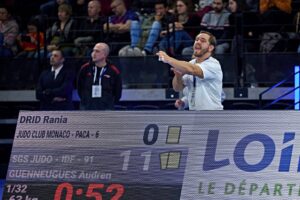
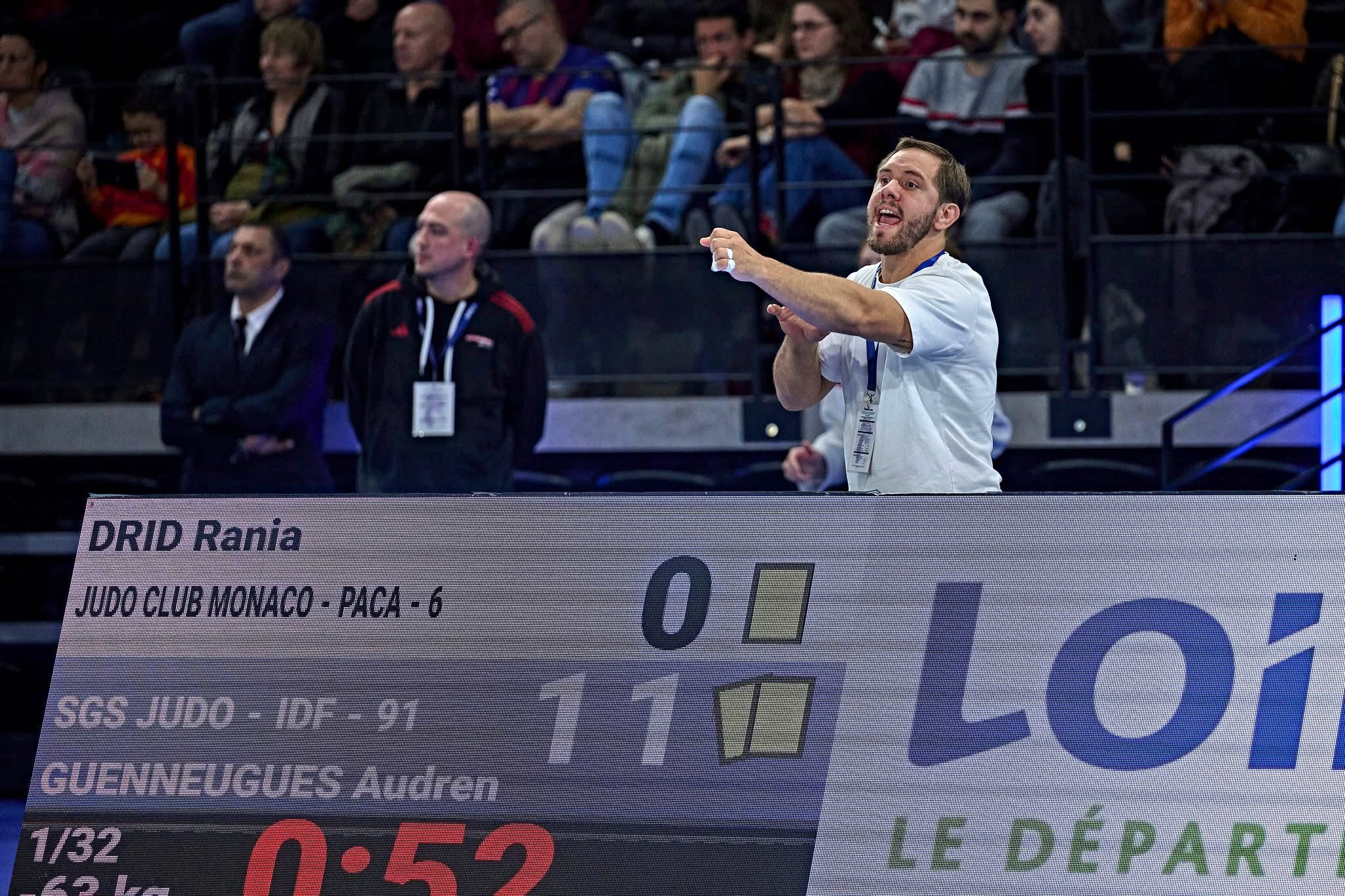
The anecdote is funny. From our family visit to Loïc Pietri in May 2025, my children mostly remember one detail: our host’s frequent “conversations” with his Alexa smart speaker. “Alexa, tell me what the weather will be this afternoon,” “Alexa, what’s the fastest way to get from my place to the Nice stadium by public transport,” and so on.
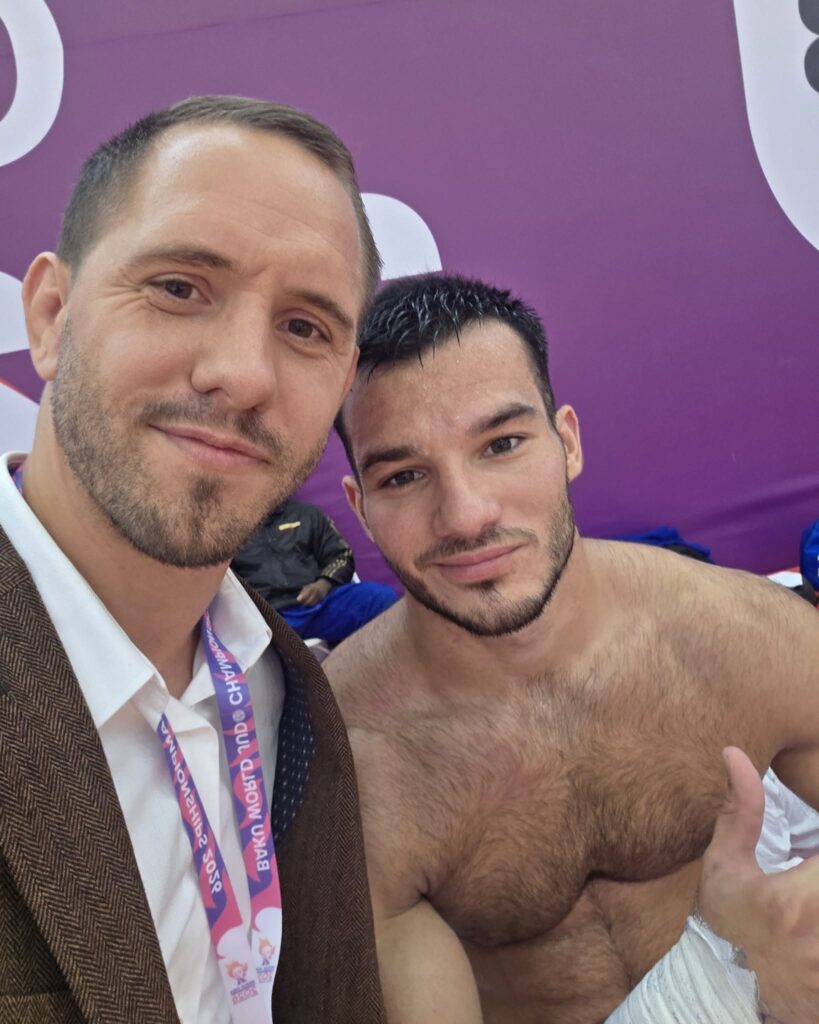
A year and a half later, a surprise. It is through another Aleksa, Mitrovic this time, that the 2009 junior and 2013 senior double world champion makes his big comeback on the world stage. This time he wears the coach’s hat, since the 2022 junior world medallist, selected at the last minute to represent France at the U90kg category at the senior World Championships in Baku, has been one of his protégés at JC Monaco for two seasons.
The Baku deadline is also an opportunity to catch up with JudoAKD’s very first interviewee. Back then, the six-time world and European medallist was in the middle of a transition after fifteen seasons at the highest level, half of them at the top, the other half in that in-between space where misunderstanding and resentment compete, and from which the risk of ending up bitter is real.
How have his very sharp ideas on training evolved through the practice of a judo far from INSEP, which his strong family roots fortunately kept him from ever forgetting? What new ideas have sprouted in the meantime in his fertile mind? A mind that can hold forth for hours on Korean Jeon’s reverse seoi as easily as on pre-Columbian Amazonia or the gradient of the slope of the Roche de Solutré. A mind that is anything but slow, and that it is always stimulating to hear speak. – JudoAKD#063.
A French version of this interview is available here.
When did you know you’d be making the trip to Baku?
At first, I thought I’d let Aleksa sort things out with the French team. But he asked me to come: he likes it when we all work together, he likes having me there. So I came.
How does it feel to be back on the circuit after all these years?
I was focused on Aleksa’s competition. I can’t say it did anything to me. Or rather, yes, one thing felt a bit strange: it’s a small world, a bubble. You always see the same people in the same place. Everybody gets older, but we’re all still here… Basically, it doesn’t change much. And here I am again at a World Championships, without pressure and without being impressed, because I’ve been there before and I’ve spent a good part of my life on this circuit…
If I remember correctly, the last time you were at a World Championships was in 2017 in Budapest, for the team event. You were even rooming with your direct rival Axel Clerget, if memory serves. And before that, in the individual event, it was the Rio Games.
Maybe, I don’t remember. It all looks the same anyway. It neither marked me nor did I miss it.
Did you arrive well in advance?
No, I did a round trip. I wanted to get home quickly. I think I actually slept in a brothel: I’d booked a hotel at random, and there was a woman in the room above mine who screamed all night. In the morning I left for the competition and went back the same evening, at two in the morning.
You didn’t stay for the team event?
No.
What’s it like seeing everyone again? I imagine some people were glad to run into you, especially among the foreigners.
I saw Stéphane Frémont and Franck Chambilly, who are still on the staff. But honestly, in terms of emotion, I was there for my student. The only emotions I had were tied to Aleksa’s day. The atmosphere, the place, all that, I didn’t care, and I already didn’t care much back then. I’m like that, as you know [smiles].
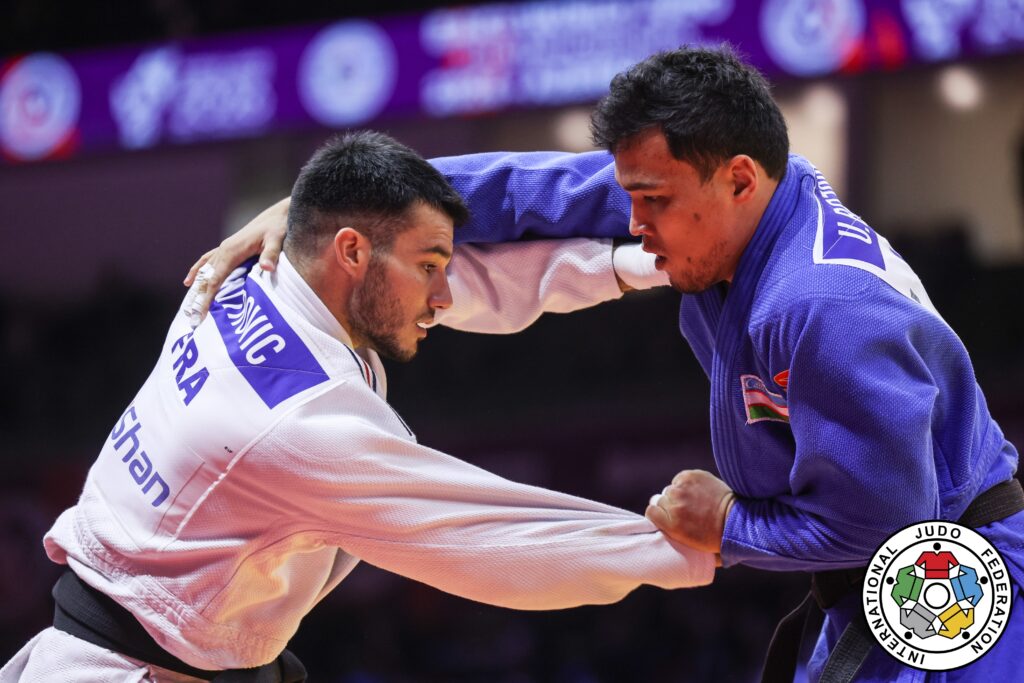
Franck Chambilly is the one who follows Aleksa with the French team, actually. Had you talked beforehand to coordinate?
No. I arrived with the preparatory work I always do in the days before: I look at the profiles in his quarter of the draw, who they run into, and what strategy we can set up. I’d taken screenshots of the videos I wanted. I explained to him what I thought of the strategy to adopt against the opponents he would face.
I was rather happy with his quarter, because there were profiles that suited him. I wasn’t wrong, since he went far. But it was still a big quarter: he took out well-ranked opponents. On paper he came in around sixtieth, I don’t remember exactly [world no. 65, Ed.], but I knew he’s actually worth much more than that. I thought he sat somewhere between tenth and twenty-fifth in the world, without knowing exactly, because until you’ve seen the guys fight, you don’t really know. But I’d seen him throw the Moldovan, have close matches against world top-tens, beat twelfth-ranked and sixteenth-ranked guys. So I knew he could beat those guys.
Then I wanted to see him against the top-10 guys, the heavyweights of the circuit. That he beat the Korean is already good. When he’s well prepared and in form, I think he can reach a world top-10 level. Now he has to go and beat the favourites. Little by little, he’s becoming a real outsider. We saw that he could get on the podium.
Do you think there was a surprise effect, because the others had perhaps forgotten him a bit on the circuit?
It always helps a little when nobody knows you. But the first two fights, we review them and he wins them again. The first round, it’s the second time he’s won it. You still have to be careful, because opponents adapt. But the world no. 13 couldn’t say he hadn’t been warned: he had already lost to him once. Against the Korean, we’d set up a precise strategy. I won’t go into details, but it worked very well: the guy had big weaknesses.
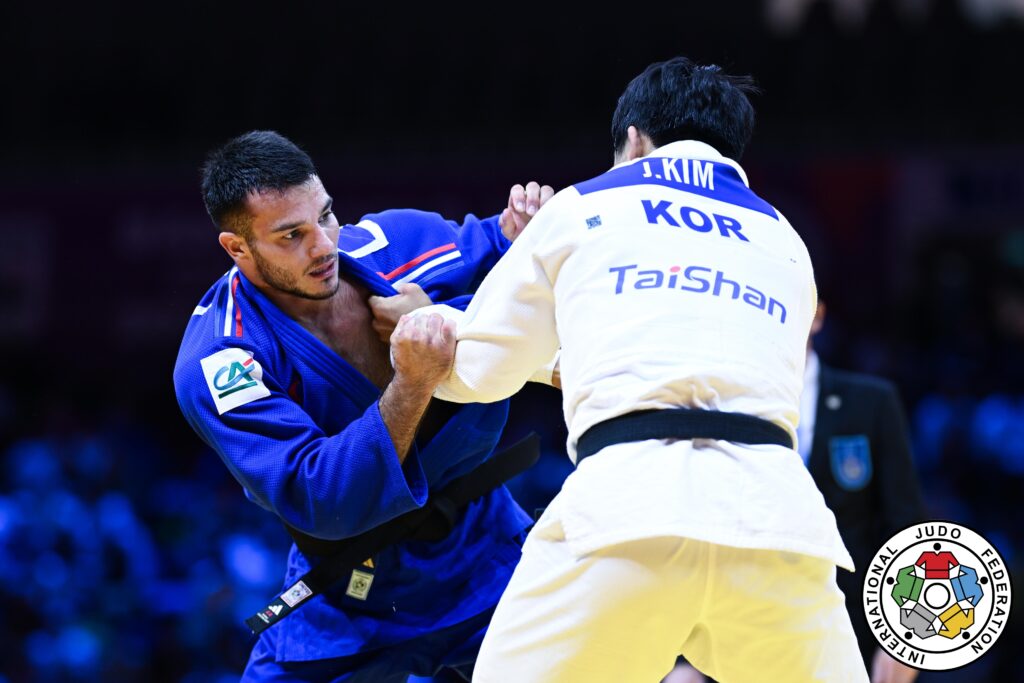
Any regrets, especially about the repechage match where Aleksa gave way on the buzzer against Serbia’s Boris Rutovic while leading by a waza-ari?
No regrets. He has progressed so much this season, so much work has been done… Yes, he could have got on the podium that very day. But he keeps a slightly crazy side, and he needs to gain maturity in his judo. You have to keep that craziness without restraining it. It’s up to us to find the balance. There, there was a lack of lucidity. But in his defence, we had one month to prepare for these Worlds, with competitions back to back.
What’s next, at this stage of the Olympic cycle?
I’d like us to now take a break and do real groundwork. Take the time to breathe, and go back over technically everything that isn’t up to standard. Imposing the movement on the opponent, keeping the centre, avoiding going out of the area. Even if there are fewer penalties, you have to stay in control of movement. There are also attacks to deepen, others to do less. We’ll see in the upcoming tournaments and championships whether it was luck or not. Me, I don’t believe in luck. I’m rather optimistic.
You left the same evening. Did you follow the team competition on Sunday?
No, I went home. I’m not a big fan of team events. But I watched his fights afterwards: he fought very badly. It happens, he was tired. He still scored an ippon on the double Olympic champion. It was counted as waza-ari, but we know how it is: when you score a small ippon on an Olympic champion, it turns into a waza-ari [smiles].
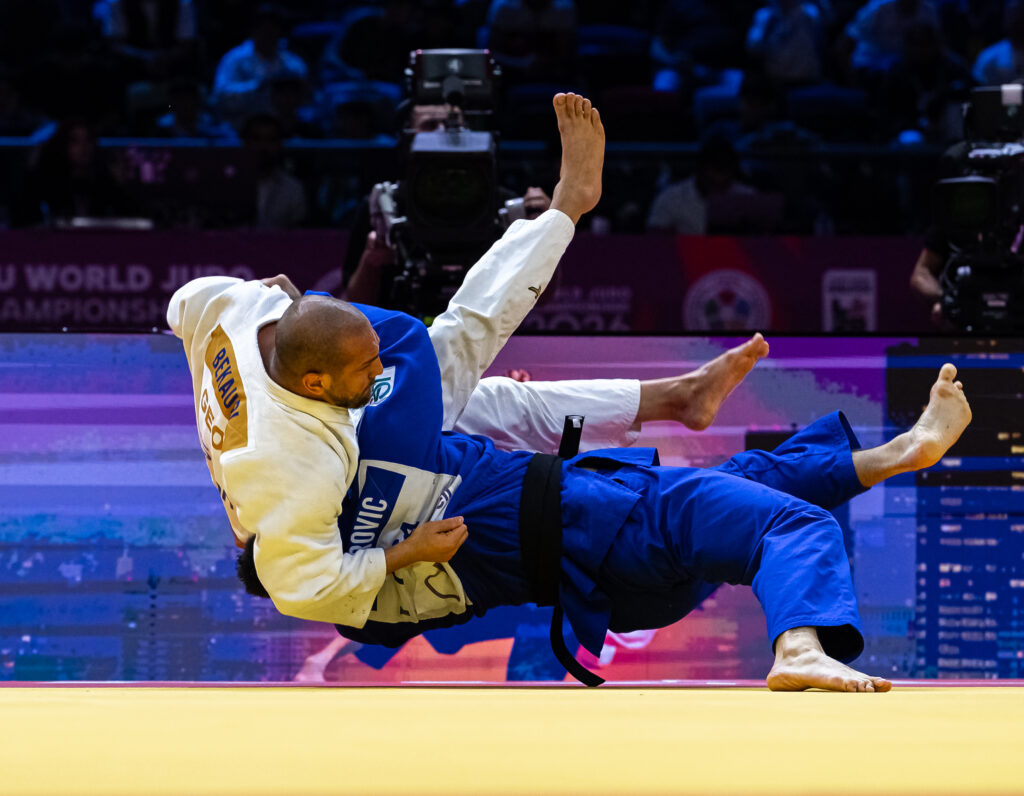
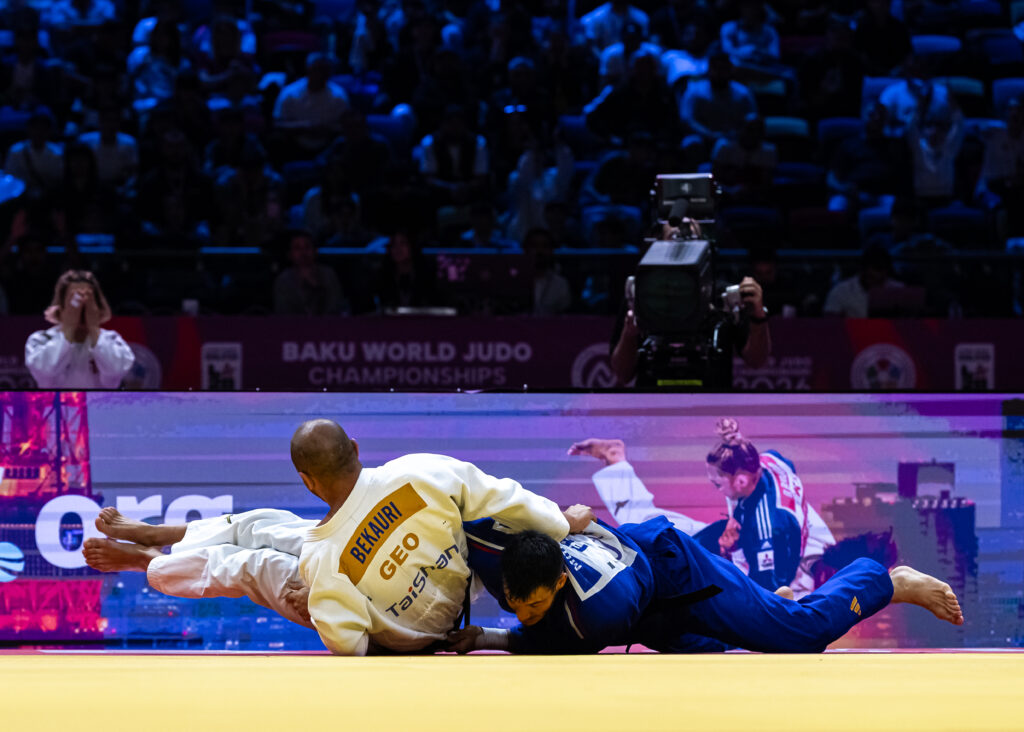
What happened against Lasha Bekauri, who injured his knee during their bout, yet managed to beat him despite that waza-ari, and then beat him again when, at 3-3 between the two teams, the draw picked their U90kg category as the decider, reminded me of the 2015 Worlds in Astana, when Cyrille Maret found himself in the same situation against Belgium’s Toma Nikiforov for third place at U100kg. Nikiforov had cramps, Cyrille couldn’t “kill” him, and Nikiforov finally came out ahead, through courage.
Perhaps compassion played a part. I think they had already trained together at camps. But would the other guy have had the same attitude if he had been the one injured? I don’t know, and they themselves probably don’t know either. I told him: on the mat, your buddies come second. Here it’s your job, it’s your dream, you’ve worked for this, and you don’t know how many opportunities you’ll have to fight at this level again. Don’t get sentimental… Then again, I’m not the guy who says to kick the injured leg, eh. But you speed up, you carry on the same fight as if you were behind. There, you could feel he went gently, that it took him a while to get back into the fight.
That said, he had already put in a fine competition, ten fights in three days with forty-eight hours of recovery. He was drained, you could see it. I saw a guy who had delivered a fine performance at the Worlds, who wanted to do well, but who no longer had any structure, no rigour at all on his grips. People who’ve never done it perhaps don’t realise. People like to criticise the team events, but overall, I’m not worried.
Let’s now get to the heart of your thinking on training and performance. Did you start working together when you came back to Monaco?
Actually, Aleksa is from Nice. He was at the Levens club, with a teacher named Franck Perez. Then he went to OJN, then Nice Judo, then Paris… He came once to train at the club with a guy from Nice. I thought he was just looking for a place to train. Then he told me he’d like us to work together. He was a bit in the mindset of: “I don’t know if I’ll keep going for long, but I feel like I can still do something.” I explained to him that we weren’t a professional club: we could make efforts, but we weren’t at that stage of development. I made my favourite joke: we weren’t semi-pro, but one-third pro [smiles].
I expected to find someone a bit damaged, because three cruciate ligament ruptures in two years, psychologically, must be a nightmare. In fact he was quite jovial, so it went well. I asked him to start again from the basics, to do small competitions again to show he had the level, and so I could gauge his real level. We started with national competitions, maybe even a Label A. At the start he wasn’t winning right away: he finished second or third, there were a few small setbacks. And then he started winning the Excellences. We moved up to European Cups, then European Opens, stepping up gradually and taking stock each time.
What was that looking like at that point?
What I liked working with him is that if you show him factually, through video work, that he lost because of this or that detail, he corrects quickly. Many athletes lose the same way for six months while you keep repeating the same thing. He had huge potential, sure, but his speed of adaptation is very pleasant: when you tell him something, he tries it right away. He’s someone I enjoy working with.
Honestly, I didn’t think I’d have someone of this level to handle so soon. So much the better: it leaves me a foot in the high level. I thought I wouldn’t be much there anymore by going to Monaco, I thought I’d coach guys for the first divisions, not head back out on the circuit.
Had you already had him in training when you were at INSEP, or at the French championships?
I think I trained with him a bit when he arrived, because all the Nice guys, I’d go see them, talk to them. We crossed paths briefly. He didn’t train much at INSEP in the end: he spent two years there and must have stayed three months on the mat.
Did it regenerate him to step down, to change setting?
Yes. He was a guy who needed to be coached, actually. I think INSEP wasn’t suited to him, and it’s not made for everyone anyway. There’s a model there with a big dose of training. If a kid who trained in Nice goes up and trains all the time with big, physically rough guys, with a higher training load, it goes badly. That’s exactly what happened to him, and he’s not the only one. I’ve seen many, especially in the south of France. In the south, there’s often a judo with lots of attacks, wastage, risk-taking. If you arrive at INSEP with that judo, without someone to calm you down or smart management, it doesn’t go well.
He’s a judoka with attacks in every direction, he likes to throw, he has a good judo foundation. Where he was weak was grips and movement. For me that’s the easiest part: kumi kata, you can become good in two years if you apply yourself seriously. Learning to do judo is more complicated.
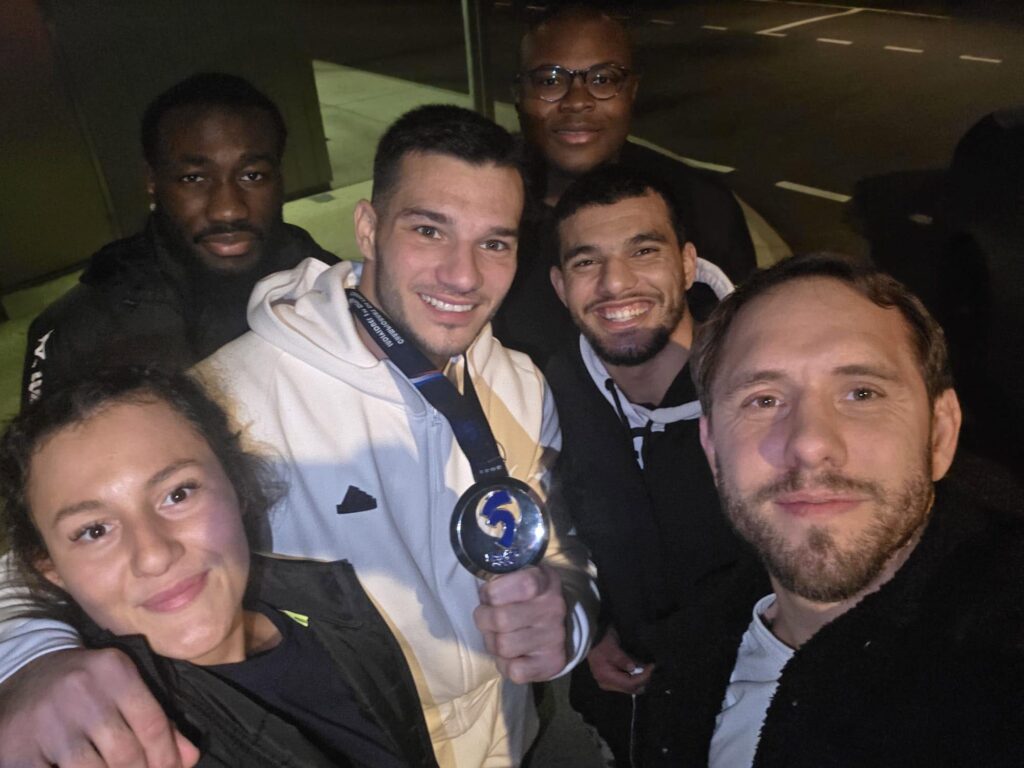
What you’re describing supports your theory about the folly of centralising everything in Paris. Isn’t it an interesting in-between, actually: burning out, demystifying INSEP, then returning to where one’s roots are and finding a second wind, even a cruising speed, there?
We always have a personal bias toward confirming our theories. So yes, it confirms them. In any case, we manage to do more than decent work. He trains at a pôle, and at the Nice pôle, we know it isn’t a real Espoirs pôle: there are lots of juniors, lots of seniors. That bothered people for a long time, but whatever. We still manage to have people like Gaya Sonntag, who has just become a junior world medallist, or like Aleksa, who competes internationally.
I’d like to create that dynamic: that one day there are seniors winning European, world and Olympic medals while based in Nice. With Aleksa, we’re not far. But once you’ve proved it, it’s not the same.
Why?
Many people lie to themselves: they’re at INSEP so they think they’re doing high-level sport, when they don’t have such a high level. They’re proud to tell their families they train at INSEP, but it’s a bit of smoke and they gain nothing from it: in the end they sometimes even struggle in their professional lives.
Aleksa, for his part, does his studies, trains in the evening, and manages his physical preparation between noon and two or in the morning. He has a rather balanced life. Having adapted studies generates less fatigue, but having a balanced life and thinking about the future is also important. I think we have a good balance. Thanks to the evening training at the Nice pôle, people can train and prepare for the first divisions while also coaching high-level seniors.
It’s a bit of an ideal combo: neither of you has fantasies about INSEP, and you move forward speaking the same language, as a result.
Honestly, I think he lived hell at INSEP. He’s very people-oriented, and there, it’s the lion’s den: you throw lots of ambitious youngsters into the arena. I think he didn’t get along with some people, that he didn’t like the atmosphere. You’d have to talk to him about it, it’s his business. He was a determined kid, and all he did was get injured. I tried to restore some ties, to tell him he could do camps from time to time. But he came back saying he no longer wanted to. It makes for a very, very kumi kata judo, very strategic, and when you take risks, I think there’s also a small trauma.
In my project to prove it can be done from Nice, I have a guy who is totally in. I come from the south and I believe in a decentralised model. And I don’t think there’s resistance from the Federation: the proof is that they selected him even though they hadn’t seen him all year. It’s a good sign, showing a federation that is evolving on certain subjects and looks only at level. I’m not asking for favourable treatment for southern structures: I’m just asking that selections be made solely on level.
In Baku, did you feel comfortable?
Yes. The feeling is good with Nomis and Jossinet. With another generation of leaders, it might have been different. I sense it bothers some people that others get results without going through INSEP, but not the current leadership of the Federation, and that’s what matters most. I find it cool that they dared to take someone like Aleksa. We’ve seen it can be done elsewhere, while remaining an amateur sport.
At your club, which age group do you work with?
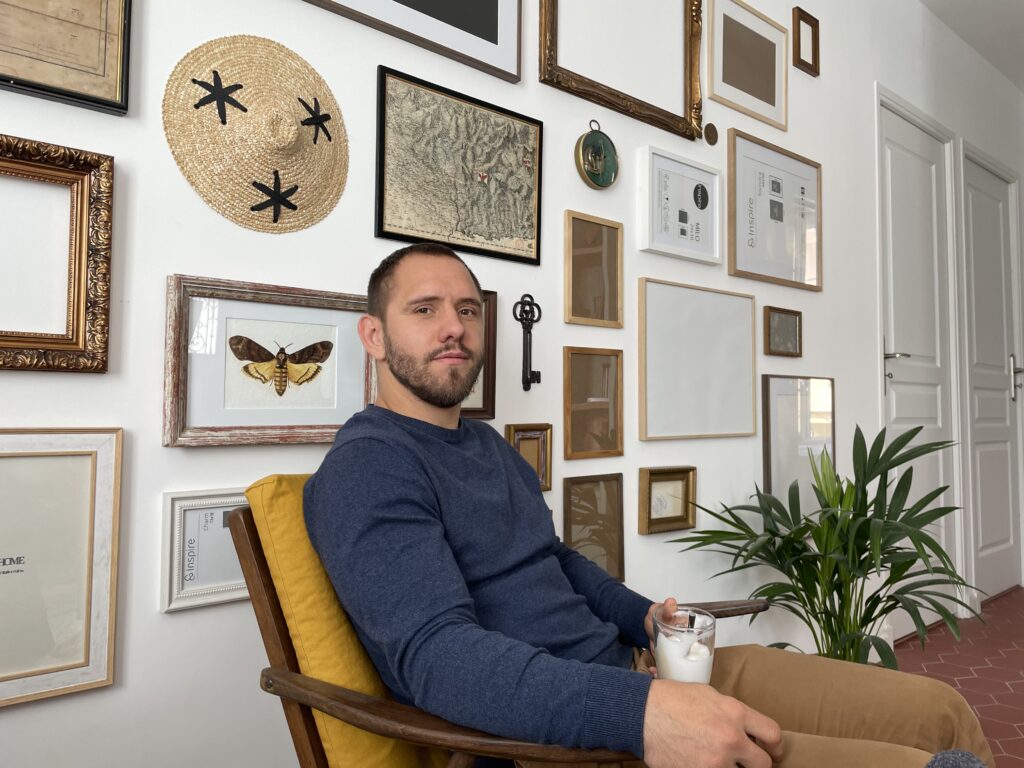
All age groups. I’m a judo teacher, and seventy per cent of my time is judo classes. On the side, I coach the competitors, on weekends. I do a bit of everything: I’m at the oven and the mill.
Two years ago, in our first interview for JudoAKD, you said it was time for you to leave Paris, that you needed a change of air. Do you feel calmer now?
Yes. I just do my job. Someone once told me: “Talking is for laughs. Doing shuts people up.” What’s happening now proves I wasn’t just talking hot air. I grumbled, but today, when I coach, I have guys who had been literally wrecked by INSEP and, against all odds, are progressing again. When I say wrecked, it’s not a figure of speech. I’ve often said that attacking judokas were very badly coached at INSEP. Maybe it’s changed since, I don’t know, and I don’t want to criticise other people’s work, but when I was there, it was a disaster.
When I started coaching Aleksa, lots of Parisian coaches told me: “Meh, he doesn’t have the engine.” Me, when I saw him, I thought on the contrary that he was a machine. In the same competition, standing, he hit me with a morote on the right, an uchi mata on the left, a morote on the left. To me he really stood out. Guys who do judo this well, there aren’t thirty-six thousand per generation. At INSEP, one comes along now and then, one or two a year. He was one of those, and it didn’t surprise me that he won a junior world medal: he had huge potential.
What I didn’t know, however, was how damaged he was, because there are things you can no longer do with a knee like that. The doctors had warned him: if he pushed too hard on a knee damaged like that, he risked a prosthesis at forty. He knew it, and he was at ease with it.
Anyway: they sent me a guy they hadn’t managed to do anything with, and we manage to do very good work. He finishes seventh at the World Championships, he could have been on the podium, he loses one second from the end. We brought him back into the world elite, and I was always convinced of it. Each to their own method, but we did something lighter: fewer fights, more technique, a bit more physical preparation and cardio, because he had a small deficit there.
And a new variety of partners, I imagine.
Above all, his judo needed framing, so that there’d be fewer mistakes, so that he’d have a solution for every situation. He did a bit of instinctive judo. That’s good when you’re young: instinctive judokas find solutions you can’t imagine. But it has its limits: sometimes they do things that make them lose without realising, and they repeat them. For example, he kept going for the back. I went back over all his fights: “Look, here you lost, you had your hand on the back.” Just with video work and a bit of logic, we sorted things out. Other coaches were doing it too in Paris, I’m not saying otherwise.
He told me he didn’t really have the engine. I answered that he first had to stop spending energy for nothing: if you throw three morote standing in the first thirty seconds, of course you’ve got no engine left. So we did cardio work, base work, we eased off the weights at first. Above all, he had to learn to place his hands, to wait for the other to place his, to put tension in the kimono, without spending all his energy in ten seconds to escape the opponent’s grip. Lots of small details like that.
In the south, we have other problems: we can’t come up with salaries so that people can train full time, so we’re really in amateurism. I try to adapt, and the Nice pôle is well suited to it. We train in the evening, with sessions that fit the schedules of real amateurs. Anyway, it’s an amateur sport. We have a nice tatami, and we manage to raise the level.
Which remains a balance: some lose themselves by being one hundred per cent focused and need to cultivate something else.
Take Sylvain Goulet, a guy from my generation. He was doing a maths degree and made several national podiums at the U60kg category. These are serious guys: with two runs in the morning before classes, a weights session on Saturday and training every evening at eight-thirty or nine, they can perhaps have an international career. But if you eliminate them because they have another project, of course they don’t make it. In amateur sports, having evening training is a big issue.
You also need structures with several ages. Having compartmentalised the Espoirs pôle, the France pôle and the national centre is a bad thing. In a centre, you should have all ages: cadets should take juniors from time to time, juniors should take seniors. Otherwise, who do you have as an opponent to keep progressing? In terms of sparring partners, you’re quickly limited.
In these provincial structures there’s also an element of chance: people passing through come one evening, surprise the regulars with a different judo, then don’t come back because they have a life outside.
Yes, sometimes there are outside guys, sometimes a passing Japanese. That’s the whole point of an open centre: not having a structure that’s too institutionalised, too closed. I believe a lot in dynamics. But here we’re still in theory, and just talking about it saturates me. I spent so many years wanting to redo the system that today, I don’t care. I may be in a small structure, but I’m the head of the fish, I can take directions, and I’m having a blast. The results confirm my feeling that I wasn’t only talking nonsense, but I’m tired of talking: now, I do.
What’s next, ideally?
I’d like the Nice pôle to become a France pôle one day. For me it’s a scandal that everything is in Marseille. It makes no sense to put so much money there when Nice works very well. We still have only one person to manage Nice, with First Division clubs, world junior medallists, guys in the quarter-finals of the senior Worlds. The clubs come to the pôle and the evening training system works. This model must be encouraged!
Should the pôle France labels be regularly re-evaluated, based on dynamics?
Re-evaluate the labels, or simply create training centres where people train in the evening, and put the money where there are skills and results. If you don’t reward performance, you reward mediocrity. But these are political subjects that are beyond me, I have no hold over them. I focus on my work, hoping that over time it will show: when you do good work and take the right directions, you manage to do some nice things.
All this reinforces my belief that there are other ways to coach, and that good work can be done in small structures. I already knew it, in fact. I’ve travelled quite a bit with judo, and I’ve seen Olympic champions training with youngsters in centres that looked nothing like INSEP. For me, level is a demand, a rigour. Not a place. I hope we’ll manage to prove it. – Interview by Anthony Diao, autumn 2026. Opening photo: at the 2025 French championships. ©Jean-Bernard Dalleau – L’Oeil du margouillat/JudoAKD.
A French version or his interview is available here.
More articles in English:
-
- JudoAKD#001 – Loïc Pietri – Pardon His French
- JudoAKD#002 – Emmanuelle Payet – This Island Within Herself
- JudoAKD#003 – Laure-Cathy Valente – Lyon, Third Generation
- JudoAKD#004 – Back to Celje
- JudoAKD#005 – Kevin Cao – Where Silences Have the Floor
- JudoAKD#006 – Frédéric Lecanu – Voice on Way
- JudoAKD#009 – Abderahmane Diao – Infinity of Destinies
- JudoAKD#008 – Annett Böhm – Life is Lives
- JudoAKD#010 – Paco Lozano – Eye of the Fighters
- JudoAKD#011 – Hans Van Essen – Mister JudoInside
- JudoAKD#021 – Benjamin Axus – Still Standing
- JudoAKD#022 – Romain Valadier-Picard – The Fire Next Time
- JudoAKD#023 – Andreea Chitu – She Remembers
- JudoAKD#024 – Malin Wilson – Come. See. Conquer.
- JudoAKD#025 – Antoine Valois-Fortier – The Constant Gardener
- JudoAKD#026 – Amandine Buchard – Status and Liberty
- JudoAKD#027 – Norbert Littkopf (1944-2024), by Annett Boehm
- JudoAKD#028 – Raffaele Toniolo – Bardonecchia, with Family
- JudoAKD#029 – Riner, Krpalek, Tasoev – More than Three Men
- JudoAKD#030 – Christa Deguchi and Kyle Reyes – A Thin Red and White Line
- JudoAKD#031 – Jimmy Pedro – United State of Mind
- JudoAKD#032 – Christophe Massina – Twenty Years Later
- JudoAKD#033 – Teddy Riner/Valentin Houinato – Two Dojos, Two Moods
- JudoAKD#034 – Anne-Fatoumata M’Baïro – Of Time and a Lifetime
- JudoAKD#035 – Nigel Donohue – « Your Time is Your Greatest Asset »
- JudoAKD#036 – Ahcène Goudjil – In the Beginning was Teaching
- JudoAKD#037 – Toma Nikiforov – The Kalashnikiforov Years
- JudoAKD#038 – Catherine Beauchemin-Pinard – The Rank of Big Sister
- JudoAKD#039 – Vitalie Gligor – « The Road Takes the One Who Walks »
- JudoAKD#040 – Joan-Benjamin Gaba and Inal Tasoev – Mindset Matters
- JudoAKD#041 – Pierre Neyra – About a Corner of France and Judo as It is Taught There
- JudoAKD#042 – Theódoros Tselídis – Between Greater Caucasus and Aegean Sea
- JudoAKD#043 – Kim Polling – This Girl Was on Fire
- JudoAKD#044 – Kevin Cao (II) – In the Footsteps of Adrien Thevenet
- JudoAKD#045 – Nigel Donohue (II) – About the Hajime-Matte Model
- JudoAKD#046 – A History of Violence(s)
- JudoAKD#047 – Jigoro Kano Couldn’t Have Said It Better
- JudoAKD#048 – Lee Chang-soo/Chang Su Li (1967-2026), by Oon Yeoh
- JudoAKD#050 – Hermann Monne – Burkina, a Land Already Peopled
- JudoAKD#051 – Mariana Esteves – A Chronicle of Life Passing By
- JudoAKD#052 – Tiphaine Gingelwein – Chechnya and the Caucasus, a Feminine Perspective in Nuance and Complexity
- JudoAKD#053 – Victor Scvortov – Born Again Under a Lucky Star
- JudoAKD#054 – Eric Gervasoni – From Moves to Movies
- JudoAKD#055 – Mihael Žgank – Coming Home Is Where the Real Journey Starts
- JudoAKD#056 – Patrick Grosperrin – Laterality, a Little-Known Lever of Performance
- JudoAKD#057 – Rest in Peace, René Nazaret (1936-2026)
- JudoAKD#058 – Alexandre Paysan – We Saw Him in the Vercors, Bungee Jumping…
- JudoAKD#059 – Habib Alouache – Teaching Joy
- JudoAKD#060 – Diyora Keldiyorova – Another Giant Leap for (Wo)Mankind
- JudoAKD#061 – Angelika Szymańska – With the Restraint of Those Still on Their Way
- JudoAKD#062 – Valentin Ménard – The Click (That Moment When Champions Just Know)
Also in English:
- JudoAKDReplay#001 – Pawel Nastula – The Leftover (2017)
- JudoAKDReplay#002 – Gévrise Emane – Turn Lead into Bronze (2020)
- JudoAKDReplay#003 – Lukas Krpalek – The Best Years of a Life (2019)
- JudoAKDReplay#004 – How Did Ezio Become Gamba? (2015)
- JudoAKDReplay#005 – What’s up… Dimitri Dragin? (2016)
- JudoAKDReplay#006 – Travis Stevens – « People forget about medals, only fighters remain » (2016)
- JudoAKDReplay#007 – Sit and Talk with Tina Trstenjak and Clarisse Agbégnénou (2017)
- JudoAKDReplay#008 – A Summer with Marti Malloy (2014)
- JudoAKDReplay#009 – Hasta Luego María Celia Laborde (2015)
- JudoAKDReplay#010 – What’s Up… Dex Elmont? (2017)
- JudoAKDReplay#011 – Zakopane, or Lives Passing By (2017)
- JudoAKDReplay#012 – Thierry Frémaux (1/2) – About The Legend of the Great Judo(2016)
- JudoAKDReplay#013 – Thierry Frémaux (2/2) – Judo in the Light (2021)
And also :
- JudoAKDRoadToLA2028#01 – Episode 1/13 – Summer 2025
- JudoAKDRoadToLA2028#02 – Episode 2/13 – Autumn 2025
- JudoAKDRoadToLA2028#03 – Episode 3/13 – Winter 2026
- JudoAKDRoadToLA2028#04 – Episode 4/13 – Spring 2026
- JudoAKDRoadToLA2028#05 – Episode 5/13 – Summer 2026
JudoAKD – Facebook – Instagram – X (Twitter).