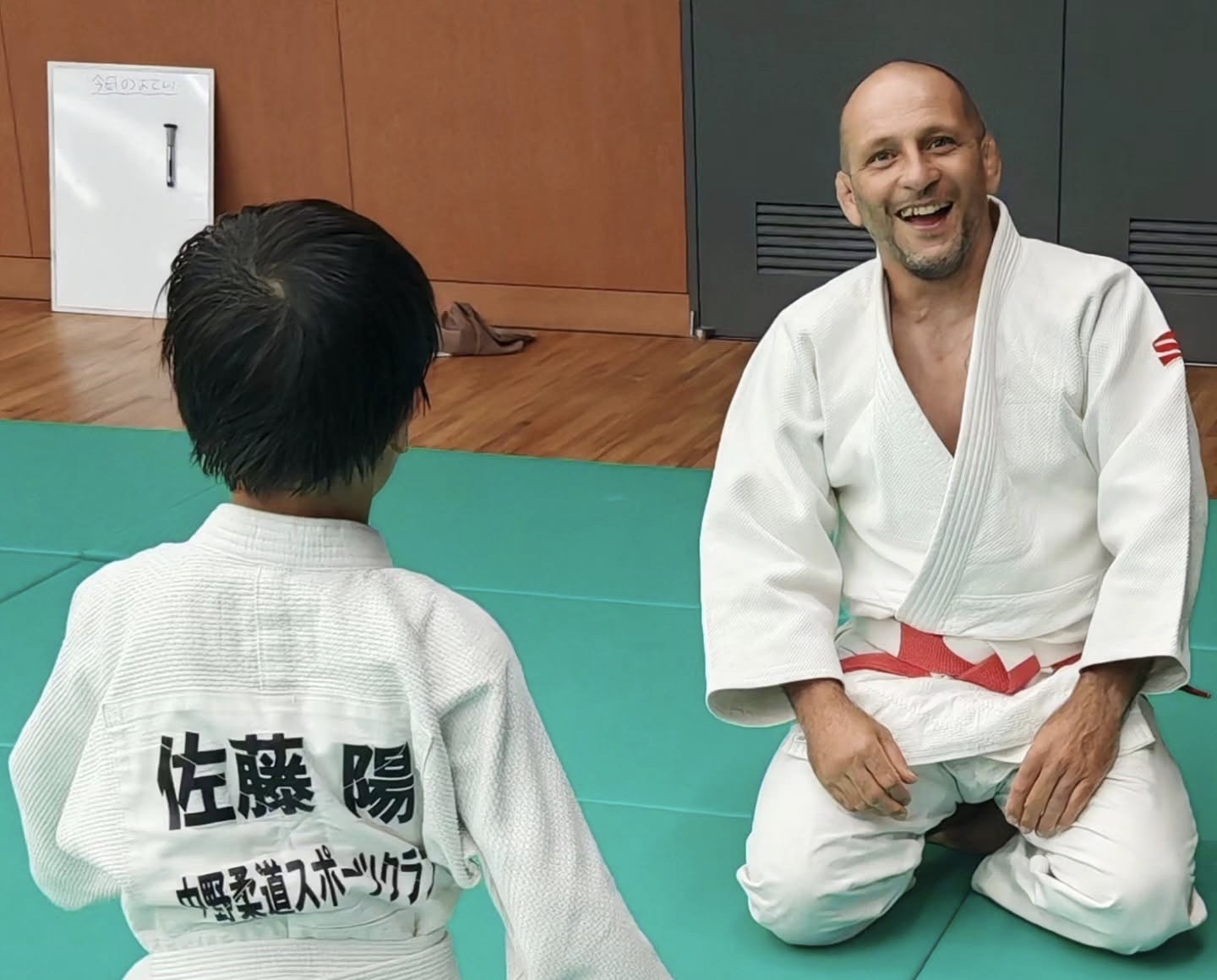
Born on November 26, 1973 in Nice (France), Habib Alouache belongs to that category of teachers who make it a point of honor to stay (almost) as physically sharp as their students. A leadership ethic born of a mindset constantly on a razor’s edge, and of the conviction that credibility may only exist through embodiment.
Our paths first crossed in December 2009 at the Monaco Tournament. That weekend, competing individually with my teammates from Dojo Gessien, I got to know this shaven-headed bundle of muscle – a needler, but a unifier – who, though beaten without shame in the U66kg category by a tough competitor named Baptiste Leroy, came to cheer very loudly at the edge of my tatami during my golden score in the round of sixteen against the Japanese fighter Takaaki Hagimoto, and then in the quarterfinals against the Frenchman Romann Wolska. Through his post-fight advice, I had the impression of talking to someone who had seen a lot of the world, even if only from within. “Habib’s going to wear me out,” Florent Martelet – one of our road captains, along with ‘the two Freds’, Frédéric Buzon and Frédéric Bourru – had warned me the day before as we landed in Nice. “He’s pushing forty, he’s got five kids, and he’s still going full throttle!”.
Where does that fire come from, and what becomes of it once a competitor of this caliber becomes a coach? Seventeen years later, having crossed paths with him again and again, and knowing him now behind the crescendo of momentum at his Alliance Genevois Judo club, it felt like the right time to sit down and, for once, turn the spotlight not on those he illuminates, but on the Illuminator himself. – JudoAKD#059.
A French version of this interview is available here.
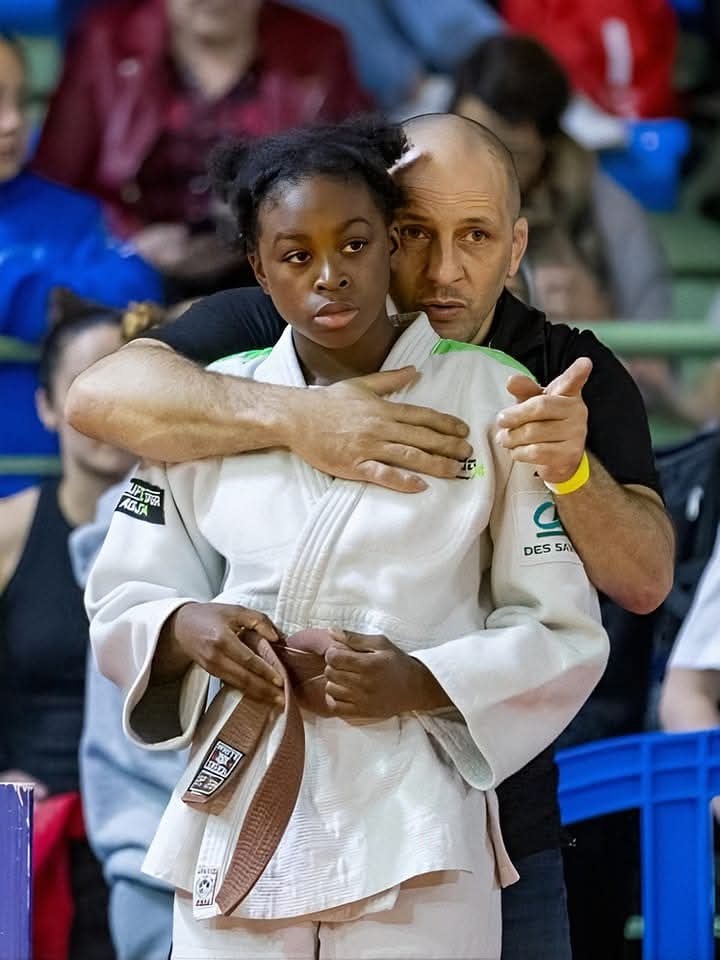
You wear several hats: teacher, coach, educator, dad – you yourself have a daughter on the French junior national team, among other children. Where do you rank all of that?
Whew [smiles]… Family remains the priority. Being a dad. Then, above all, I’m a judo teacher – and that’s how I’ll end my career. Only after that comes the small hat of coach, because I have a feel for competition, which isn’t the case for every teacher. I like trying to give young people who want to perform the means to do so. Some clubs don’t want that, others can’t manage it. I have colleagues who don’t live off judo alone, who have another job on the side, and who simply don’t have the time to get involved the way I do. I live one hundred percent off this.
The first time we spoke was at the 2009 Monaco Tournament, where we were both competing in different categories. Our mutual friend Florent Martelet told me you were already thirty-six and the father of five children. Despite that, you were still very solidly built. What’s your background?
My path is unusual. I started judo at age five with Michel Carrière. It was at the Judo Club du Port, a small sixty-square-meter neighborhood dojo. It was located behind the church at the port of Nice, and that entity would later become Nice Judo. Then, from age nine to fifteen, I continued at the CCCF in Nice with Henri Sassone. It was with him that I earned my black belt, at fifteen. He was a very good teacher and someone who mattered a great deal to me. He managed to guide me and keep me in judo through a rather complicated childhood, with parents who weren’t always available for me.
To what extent did that family life affect your practice?
It changed everything. I often tell my students that to succeed in sport, you need a triangle: the young person’s own personal drive, a supportive club, and a family core behind them. For me, that last piece was missing. At fourteen, I had to stop school, and I started working the following year.
Had you risen high in terms of results?
Judge for yourself: I was PACA regional champion in the cadet category, selected for national team training camps at the regional level…
Indeed… especially since the regional level was very strong in those age categories…
The problem was that neither the club nor my parents could keep up with the pace in terms of travel. So I was never able to take part in the French championships during that period, even though the level in the PACA region was very dense at the time. For me, everything stopped there. I quit judo at black belt, at fifteen, and took it up again five years later, coming back from the army.
Is that when you arrived in Monaco?
Yes, my professional path led me to Monaco at twenty. One day at lunchtime, I ran into Marcel Pietri and asked him if I could come train. His club was a hundred meters from my workplace. I stayed there for more than twenty-five years… He’s the one who got me back into competition, at twenty-four, more for pleasure than for any real goal – I was already the father of a little girl by then. I trained twice a week in Monaco, sometimes at the Nice sports academy [Pôle espoir], without really aiming for the very top level. I ended up moving up to the first division, individually and as part of a team, until I was forty.
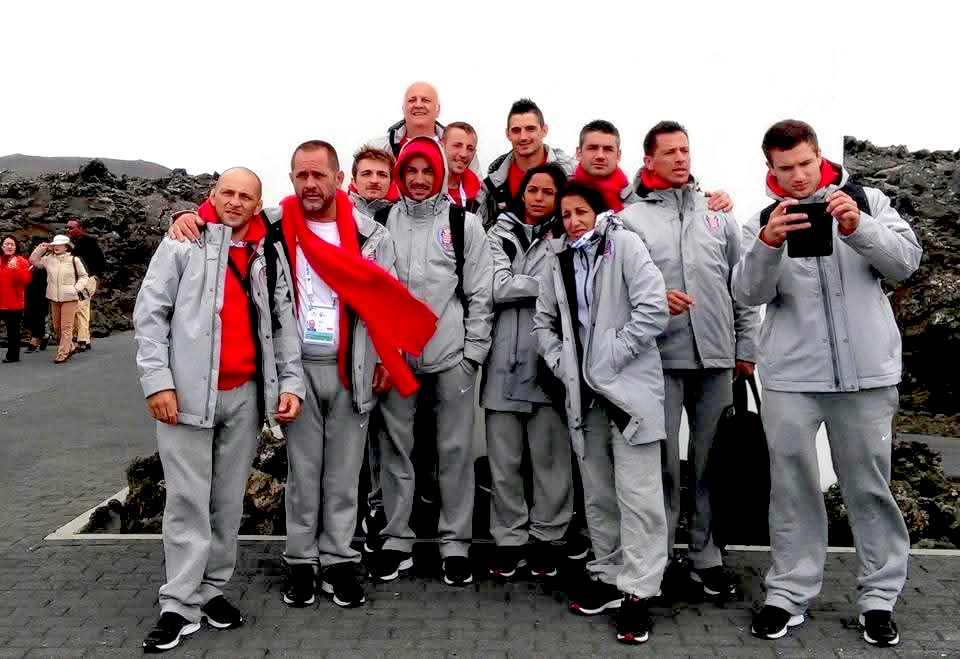
Did you train to become a teacher in parallel, or did that come later?
That came later, again shaped by the twists of my family life. After my separation, my best friend suggested I come work in Switzerland. I moved up to Haute-Savoie, where I worked for five years in the watchmaking industry. That’s where I got to know the Dojo Gessien club, Florent Martelet, and that whole dynamic. In 2008, a layoff linked to the financial crisis gave me some free time: I used it to get my coaching certification [brevet d’État], partly funded. Since I was a competitor and well known in many clubs across Haute-Savoie and the Ain, several of them asked me to teach. I decided to do it, but full-time.
Marcel Pietri seems to have counted for a great deal in shaping your approach to teaching. What is the “Marcel touch”?
Marcel gave me a taste for teaching, by showing me the human relationships he built with his students… Marcel is above all a great man, and that goes well beyond judo. In human relationships first: he’s someone straightforward, who genuinely loves people and takes a real interest in them – even if he has that slightly gruff side that Corsicans sometimes have. On the phone he always seems rushed, never available, almost like he’s not listening – when in reality he retains everything. We shared a great deal beyond judo: my family problems, my separation from my first wife, my father’s illness, who died of multiple sclerosis… He’s someone I’ve shared far more than just judo with.
Yes, his house up in the hills of Valdeblore, where he was kind enough to receive me and my children, is surprising for someone so involved in judo – the décor evokes hunting, archaeology, but almost nothing that recalls the tatami…
He’s an extraordinary person, who made me want to live a life like his. It’s the encounters and the moments shared, far more than the mat itself, that make me love this profession.
How did you come to lead Alliance Genevois Judo?
I started working there in 2011, alongside Kevin Gourgues, a former first-division fighter from US Orléans, who brought me in as his second. At the time I was at another club, UDJ74, which I had taken over and reorganized over seven years. It was a club spread across five dojos, quite complicated to manage. It was running well, but relational issues with the president pushed me to accept the offer to take over Alliance, alone, in 2014.
With some clear success, it seems!
Indeed, the club has gone from a hundred and sixty members on a single dojo to three dojos and five hundred members today. I remain the head teacher, backed up by two other salaried instructors – including Robin Pras, one of my former students who earned his professional qualification [CQP] and teaches at the second dojo. Recently, a fourth dojo joined us, following a political decision by the local municipal association to bring local structures together under a single entity.
You seem to be constantly on the go. What does a typical week look like for you?
I have classes almost every day. Only since last year have I had a day off – Tuesday – after more than twenty years without a break. Mondays are school visits: for more than twenty years we’ve had a partnership with a private school for judo taster sessions with fourth- and fifth-graders in the afternoon, followed by club sessions in the evening. On Tuesdays, my “day off,” I take the opportunity to bring my competitors to train at the Judo Club de Carouge in Switzerland – no obligation, but I almost always go. That’s where I follow my cadets outside the regular structure, those who haven’t joined a sports academy but still want to progress, within a more elite training setup. Wednesdays and Thursdays are big club days, and on Fridays I go back through the schools before the evening classes.
Some Thursdays I travel as far as Lyon or Grenoble to see my young athletes at the sports academies [Pôle espoir] – I try to go once or twice per school holiday period, alternating between the two structures, often in a minibus with parents.
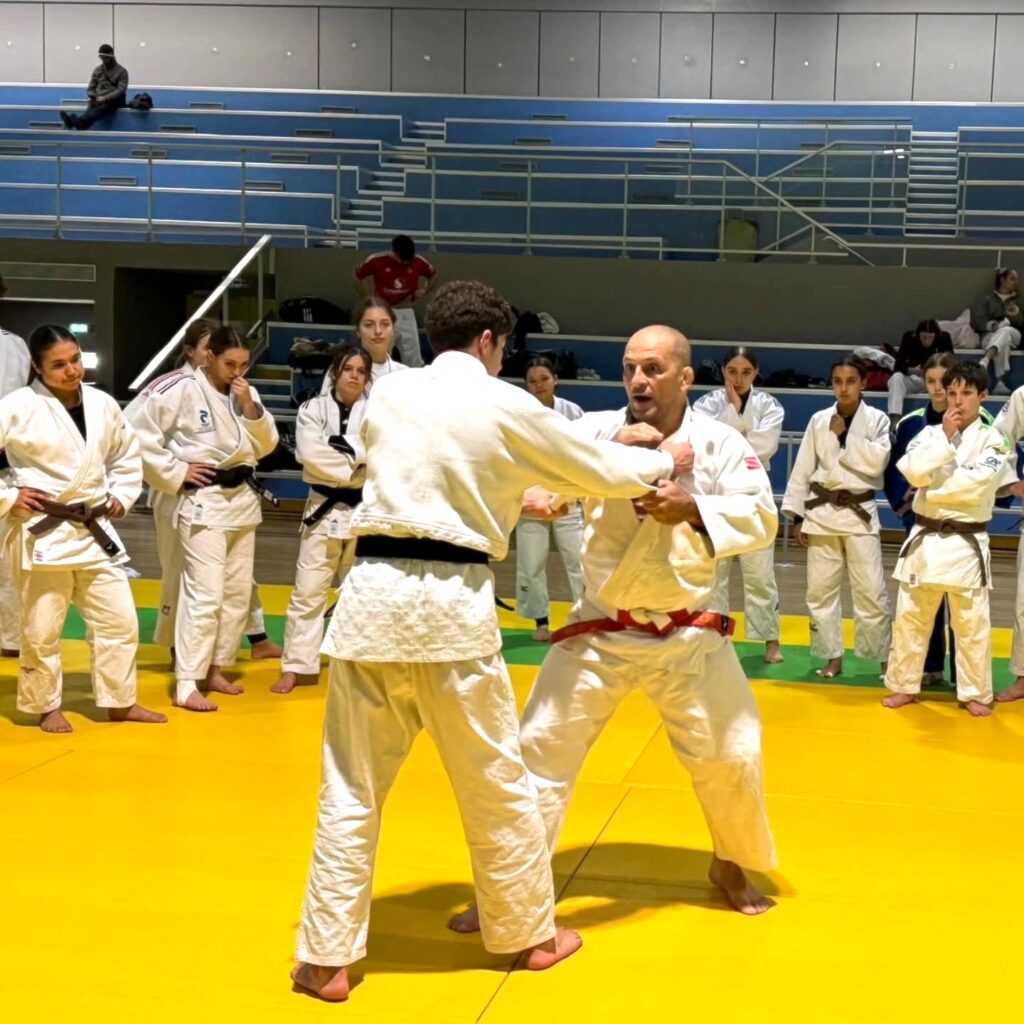
Where does this itinerant streak come from? Many clubs stay quite sedentary…
We move around a great deal, especially in Switzerland, with whom we exchange a lot. A few years back, I even launched the “judo globe-trotter”: a coach bus with fifty to sixty people, going no more than an hour and a half from the club – La Motte-Servolex, the Maurienne area, Dojo Gessien, Switzerland. We did four or five trips a year, with around forty benjamins-minimes, competitors or not, just to go see other dojos, other ways of training. I’d love to relaunch it; it’s simply a matter of time. This season, with two more instructors having earned their CQP at the club, I’ll be able to rely on them to pick this project back up.
What drives you to organize all of this, when you could just settle for your classes and weekend competitions?
There’s a phrase of Marcel’s that sums it all up: he used to tell me that while he felt he knew ninety-nine percent of his own judo, he also knew he only knew five percent of judo overall – because judo is infinite.
Beautiful!
To keep progressing, even as a teacher, you need an outside perspective, you have to constantly seek to evaluate yourself, sometimes put yourself back in the role of the student, open yourself to new teaching methods. Otherwise you just go in circles. I’ve seen clubs where, ten years after going back, nothing had changed – the exact same training, identical. Those are teachers who’ve settled into a routine and no longer try to innovate. Even at my age, I keep trying new things, new ways of demonstrating a movement. A teacher must never forget to remain a student.
We also cross paths every winter, right after Christmas, at the Italian training camp in Bardonecchia, and I see you on social media, always on the move with your students…
If you really want to help students perform, to go after a national title, it has to go through constant training camps. At the regional level I run the training camps for the minimes category, then I stay on-site with the cadets and juniors. I also go regularly to see Johnny Potet, at the Judo Club du Creusot, or Mathieu Corneloup, at Yzeure Judo – guys who are hugely active, full of ideas, with whom I share a lot on a human level and in the same spirit of constant self-questioning. We exchange, they come to us, we go to them. In summer, there are training camps in Croatia, judo-surf in Biscarrosse… I feed off their way of teaching, their philosophy, their relationship with their athletes – it’s almost a cliché to say it, but yes, you learn enormously from others.
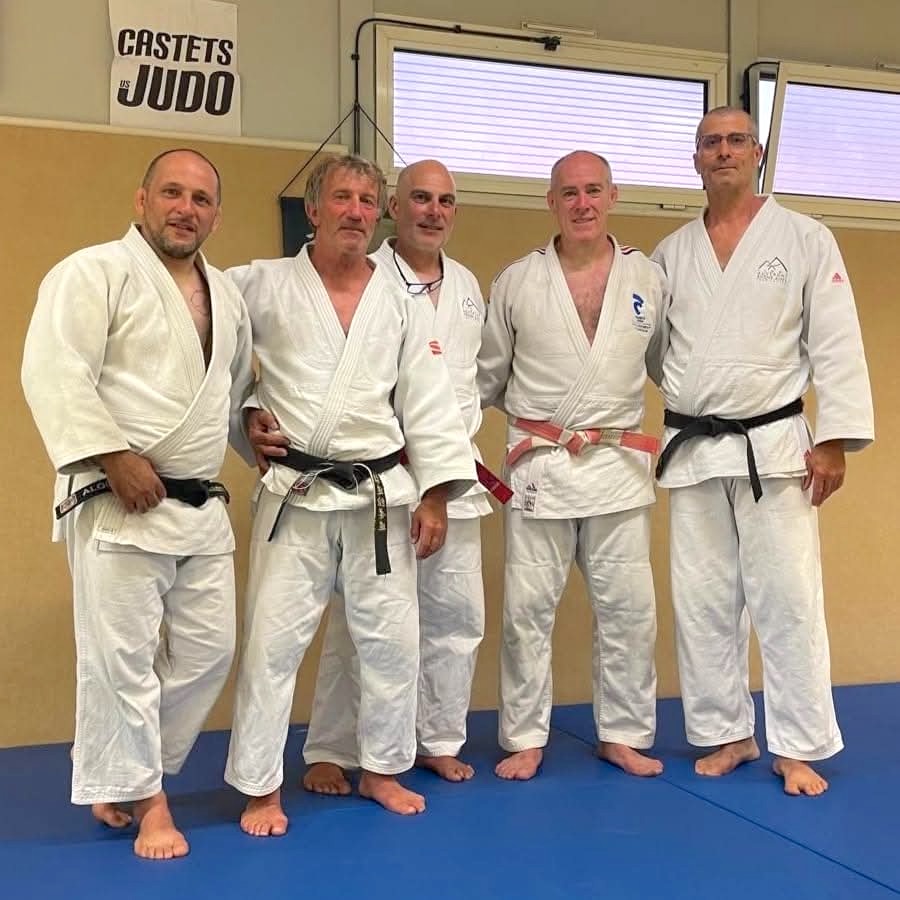
Marcel Pietri, again, made a remark to me after the Paris Games, which I slipped into a joint interview a few months later for Libération with the two medalists Joan-Benjamin Gaba and Maxime-Gaël Ngayap Hambou: almost the entire French judo team competing at the Paris Olympics came from the Île-de-France region and its surroundings. I know it’s one of his long-standing pet issues, and the facts seem, season after season, to keep proving him right. Is this a sign of a system too centralized around Paris?
Listen, I’ve been watching the recent European athletics championships. I notice that, proportionally, Switzerland – a much smaller country in size – gets better results than France, notably because it managed to build several national performance centers spread across the country, rather than a single site. The idea would be to have a kind of mini-INSEP [national sports institute] at the regional scale, to avoid uprooting sixteen- or seventeen-year-olds by sending them far from home. I don’t have the recipe, but Marcel isn’t wrong: those who succeed often come from Parisian clubs, or else they’re the children of coaches – meaning families who know the ropes and know where to take their kids.
I’m thinking right now of a junior who competed at the cadet world championships alongside my daughter in Lima. She was completely losing momentum because she’d given up joining the national training centers in Strasbourg or Orléans: her club couldn’t fund the boarding costs, and she didn’t want it to cost her parents anything. Without support or a good network, she stagnated at the regional level even though she had the ability. This year, I helped her sign with Nicolas Chansseaume, then join the national training center in Grenoble through Bruno Mure. Without that effort, she would probably have given it all up.
Has having lived outside the system yourself as a teenager given you some perspective?
Yes, I was outside the system, I had to manage on my own – and that gives you a different outlook than someone who went through the regional academy and then the national one. It comes back to the triangle: in the case of the junior I mentioned, the motivation was there, so was the club, but the financial piece – on both the club’s side and the family’s side – was missing. Without all three pillars together, it doesn’t work.
That’s also what the former -73 kg fighter Gilles Bonhomme told me, now at the national training center in Grenoble. He was deeply grateful for the dozens of kilometers his parents drove several evenings a week so he could train with José Allari, in Saint-Laurent-du-Var. Without them, he’d never have gotten there.
At the club, we try to find levers: sponsors, a partner association called Arc-en-ciel, which for example funded training camps for Karine N’Gosso, a former athlete of the club. When I got my daughter signed with Flam91, the boarding, the train tickets for the trips between Grenoble and Essonne, the housing were all covered – and we owe an enormous amount to Kilian Le Blouch, who hosted her in his family for a long time. Without that kind of support, it’s extremely difficult.
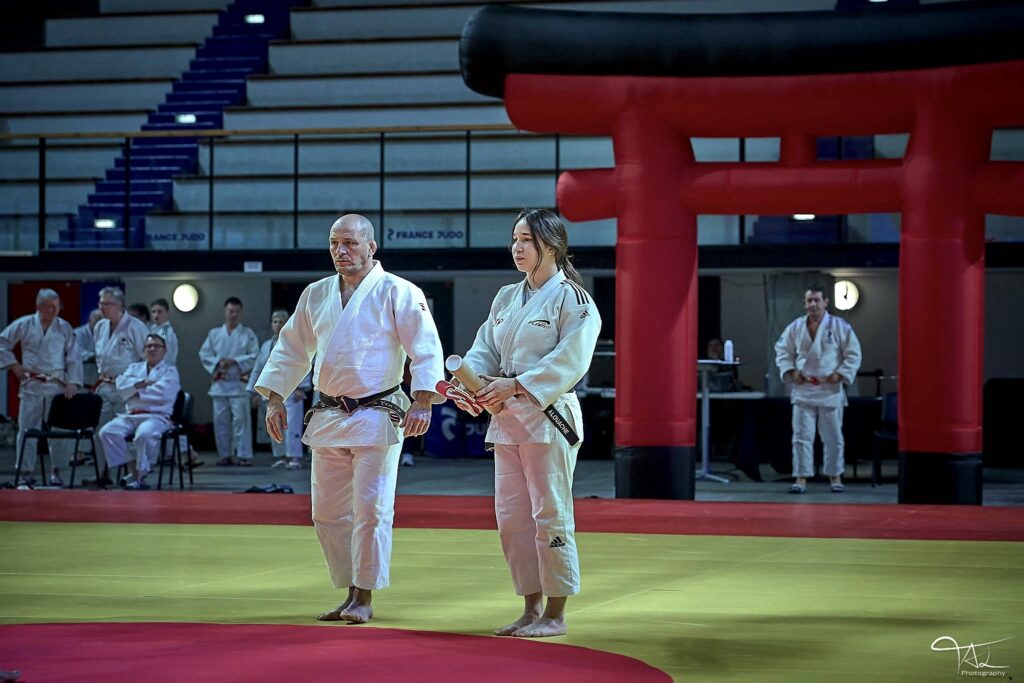
Let’s talk about your daughter Manon. It’s never easy to have one foot in judo yourself and manage to pass on the same fire to your kids. What made it “take” with her?
I owe a lot to the fact that we move around so much. From the introductory age group through poussins, kids need play – without that, there’s no interest in the activity. We can no longer teach judo the way we practiced it. This summer in Japan, we visited a dojo, and I expected an old-school, very austere kind of judo… In fact it was the exact opposite! A joyful, organized chaos, with mini-poussins, poussins, and benjamins all in the same session, very free but with clear boundaries. What struck me most was that these kids were happy to be there. That’s exactly the approach I try to apply at the club: kids should leave with a smile. You can absolutely learn seriously while having fun – I’ve spent years racking my brain trying to make teaching playful for the youngest ones.
That reminds me of an interview with the Korean Jeon Ki-young a few years ago in Bardonecchia. He’d asked to push it back a few minutes so he could watch the children’s group warm-up, led that afternoon by the Pole Robert Krawczyk. When I asked him why, he simply told me that hearing the children laugh during the exercises had struck him. It’s something he’s not used to and, Olympic champion and three-time world champion though he is, he just wanted to understand how Krawczyk did it…
Once you’re past the benjamin-minime stage, what keeps young people around is the group effect, the sense of identity, the collective. That’s why we organize “athlete days” – rafting, canyoning, karting – for all the minimes, cadets, and juniors at the club. They experience things together, meet up during the holidays, go to the lake, sleep over at each other’s places. They’ve gotten to know each other outside the tatami. And we happily mix generations: as a little girl, Manon was already going to training camps with the older kids, in Cambrils, Spain – she was even the one asking to go along. That also lets the younger ones picture what their own judo will look like as benjamins, minimes, seniors.
I believe a great deal in that emotional dimension: I put together video montages of every training camp, shown on a screen in front of the dojo. This summer, a mother told me that after replaying the Biscarrosse video for her daughter, the girl started crying in the back seat – she already missed her friends, just from hearing the montage’s music. It’s also a chance for the kids to see their teacher differently than in a judogi, a little less rigid: we laugh, we joke around, we share barbecues on top of the Dune du Pilat. Those are life moments that stay in the memory a long time.
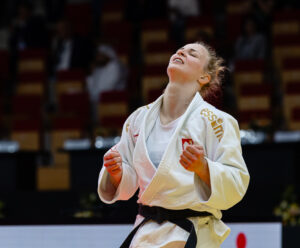
Where does Manon stand today, having strung together a national title, a European podium, and a world final in the U57kg category as a cadet in 2024?
She’s starting her second season at PSG Judo, on a three-year contract, and preparing for the junior European championships after being selected for the national team. This summer of 2026, she took part in training camps in Vichy and then in Valencia, Spain, before a final camp at INSEP and her departure for the Europeans in Podgorica in early September. She’s coached by Priscilla Gneto, in a large, well-stocked group of fighters that includes Alicia Marques, Clarisse Carillon, Manon Deketer, Léonie Minkada-Caquineau… Almost the entire junior team competing at the Europeans is now at PSG.
I’ve heard very good things about Priscilla Gneto’s contribution as a coach alongside Baptiste Leroy…
Yes, Manon was worried that such a large group would dilute individual attention, but Gneto ended her career as an athlete to move fully into coaching, which should actually free up more time for her. The club’s physical trainer is now the former international fighter Christophe Besnard. Manon has also become friendly with Clarisse Agbégnénou. They’re now in the same weight category, U63kg, and, back from the birth of her second child, Clarisse asked her to be a training partner for next season – quite an honor.
What’s the “ideal recipe” for an ambitious young athlete “moving up” to Paris?
Experience has taught me that above all they need to feel good, to be happy. Too much sacrifice takes too high a human toll. You need the right balance, to keep social ties outside of judo. I’ve seen some who eat, sleep, and live only for judo – at some point, it snaps. If it’s working for Manon today, it’s because she’s happy where she lives, happy in that group, happy to go to training without dragging her feet.
There have also been harder periods, with eating issues linked to weight management. PSG chose to move her up to -63 kg to take off that pressure – she’s 1.63 m for a fighting weight of 59 kg, with a weight fluctuation now down to one or two kilos. It’s a risk-benefit trade-off: she’s light for her category, but happy day to day. She no longer worries about food and performs despite carrying a few kilos less. A happy athlete gives everything, in training as in everything else.
How often does she manage to come home on weekends?
She manages to come back once or twice a month, sometimes every other week when the schedule allows. Otherwise, with my own travels, we sometimes go a month or two without seeing each other. That’s the path life takes.
What kind of advice do you give her, at this point in her career… and in yours?
I try to make her aware of the potential she has. I keep telling her that I believe in her and that I know she can go very far. But I also tell her that I can’t do it in her place. I give her advice, whether she listens or not, and life will decide who was right… And it’s not limited to the mat at all! One concrete example: at nineteen, she still struggles to see the point of being active on social media, the way a Joan-Benjamin Gaba or other athletes who share their daily lives do. Yet the day we’re looking for a sponsor to fund housing in Paris, this question of visibility comes into play – that’s simply how this world works now. She already spends time on Snapchat or TikTok with her friends, so why not do the same, applied to her life as an athlete? She feels like putting herself forward would mean “playing at being a star,” when for many it’s really just the diary of her life as a junior at INSEP. I understand her reserve, and at the same time I know that if she doesn’t take the spot, someone else will take it before her… That’s part of our dilemmas as dads too [smiles].
You mentioned Marcel Pietri. Have there been other decisive encounters that helped shape your way of teaching?
I exchange a lot with Nicolas Chansseaume, as well as with the teachers at the Dojo Romanais. Nicolas Chansseaume shares a philosophy close to mine: he’s constantly questioning himself, picking up ideas from what he observes, staying very open and curious. He doesn’t, for instance, send his students into competition before they reach the benjamin category. It’s a question I ask myself too, because facing competition early is also a way of learning to manage your emotions, your stress, the frustration of defeat. I tell my students: at that age, performance is random, refereeing is often shaky, sometimes handled by young club volunteers – you really shouldn’t let it shape you. Some parents get carried away watching a video when their child is only six. At that stage, I think all that matters is that they have fun.
About twenty years ago, at a training camp in Sophia-Antipolis with Patrick De Menech, I watched a session led by Daniel Pinatel, eighth dan, founder of the Judo Club de Cannes and mentor to many champions. His way of teaching judo to very young children, telling stories, working on coordination through music, left me truly amazed. It remains a model: you have to constantly search for that same freshness. In Japan this summer, I again drew inspiration from dozens of details, games, approaches I’d never seen anywhere else. Judo is infinite.
Do you ever spot potential “mini-Habibs” among some of your students?
Yes, some. Right now I have a little girl from a single-parent family, with no father around, whose mother does her best in a difficult situation. I try to help her more than the others – because I feel that if I don’t, no one will, and she’ll miss out on what she could accomplish… In those cases, we look for funding, the club covers what it can, but always on one condition: that the young person is fully committed on their own side.
It’s never simple: I remember a car ride with Marcel Pietri, at Valdeblore actually, where he made countless phone calls trying to unlock a young Monegasque girl’s path to INSEP, her family situation making things more complicated than for others.
It’s clear that without a club or parents able to financially carry a high-level project, it’s very hard to live one hundred percent off your sport. That’s the famous triangle I was telling you about at the start.
Looking back over the years, if the Habib of 2026 could give a few life pieces of advice to the little Habib who started out at age five in Nice, what would he say?
[He takes a moment to think] Deep down, there isn’t really much to change. I wasn’t the one shaping what happened to me. I mostly went through what my parents’ life imposed on me. Thinking about it carefully, other things would have needed to change, much further upstream. I was a lively little boy, I loved judo. After Michel Carrière left, I had a teacher, Henri Sassone, who mattered enormously: after training, we’d sometimes spend as much time talking about life as training. He’s someone I shared a great deal with, and who kept me in judo… Looking back, I could have followed a path through the regional and national academies like my daughter or my students today, but life decided otherwise. What would I tell that little boy? Don’t change anything, keep going and, above all, do your best. – Interview by Anthony Diao, summer 2026. Opening picture: ©Archives Habib Alouache/JudoAKD.