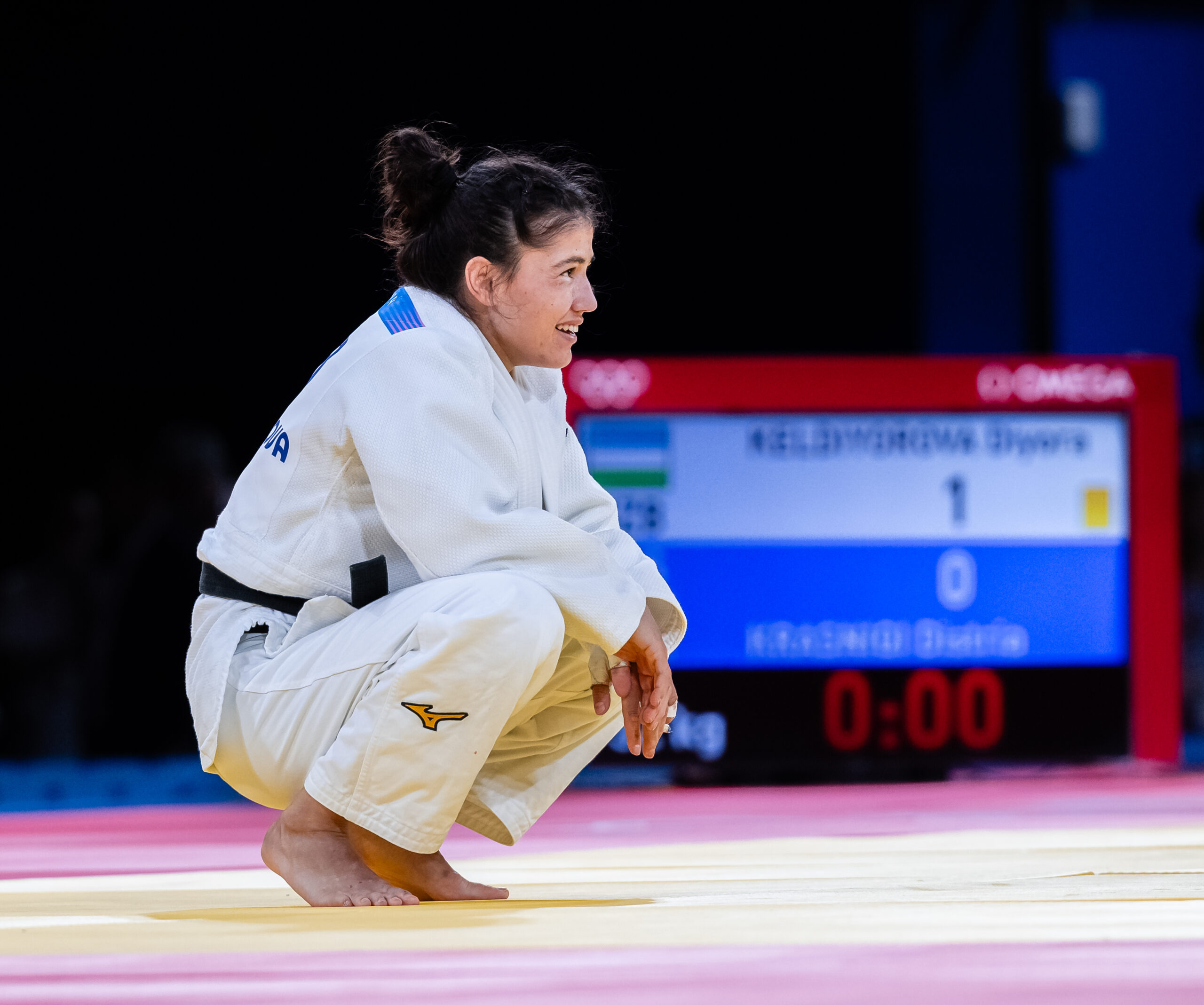
Born on July 13, 1998, in Samarkand, Uzbekistan, Diyora Keldiyorova is the 2024 Olympic champion in the U52kg category. A recent documentary by the International Judo Federation produced with the support of Fighting Films in collaboration with the International Olympic Committee, looks back at this pivotal achievement as the woman who was also world silver medallist in 2023 and 2024 prepares to – perhaps – return to the circuit, one year after giving birth to her first child. A pioneering attitude reaching far beyond her own latitudes. – JudoAKD#060.
A French version of this article is available here.
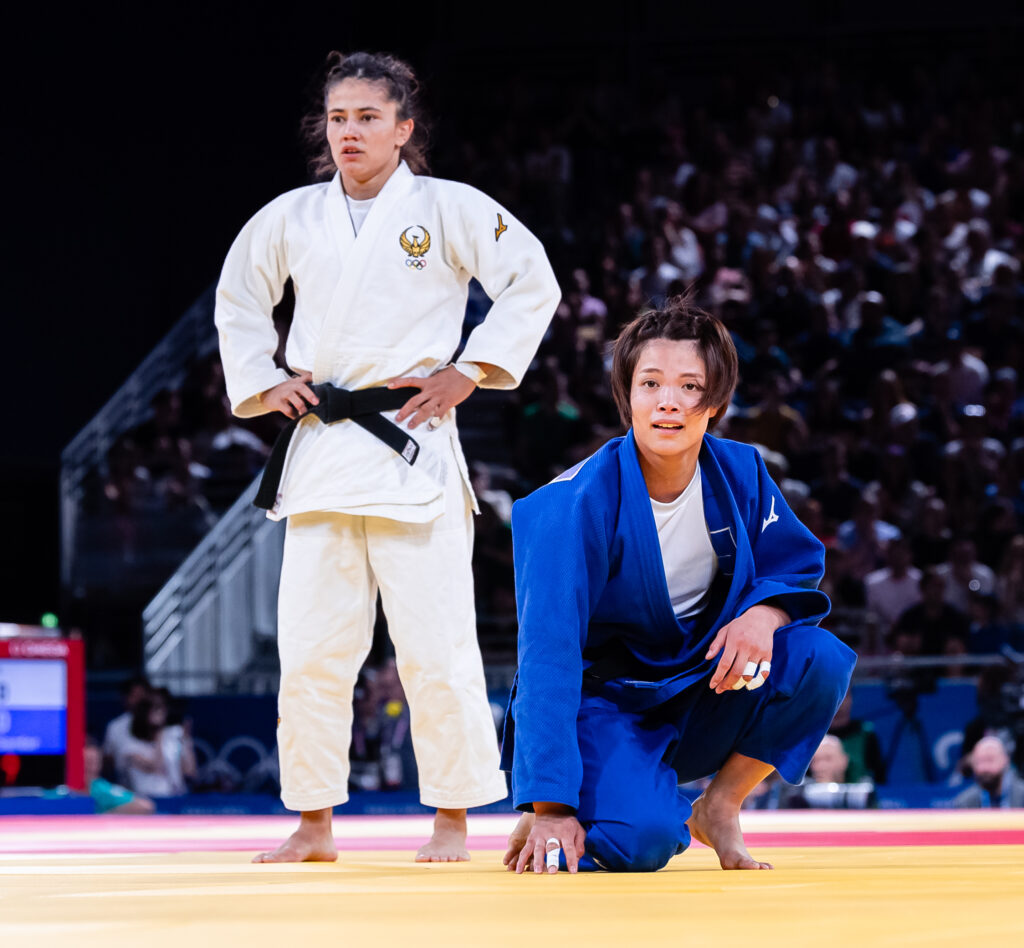
On Sunday, July 28, 2024, at the Paris Olympic Games, the judo world will chiefly remember the heartbreaking tears of Japan’s Uta Abe, eliminated in her second bout despite an almost immaculate résumé: reigning Olympic champion, four-time world champion, and only one individual defeat over her previous eight international seasons. It will also remember the pout at the end of the day from France’s Amandine Buchard, runner-up to that same Abe three years earlier in Tokyo. Seeing the draw, for once, cleared of the ever-present Japanese glass ceiling – the last person to have beaten her individually, back in 2019 in the final of the Osaka Grand Slam – she would once again have to settle for a “mere” bronze medal.
Of the woman who had sent both of them back to their boxes of Kleenex, the Uzbek Diyora Keldiyorova, we knew very little until then. At most, there had been a few confidences gathered a few months later while taking stock of the career of the Frenchwoman “whose eyes were bigger than the world.” They came from Marko Spittka, the experienced German coach with his perpetually worn sleeveless vests, the man whispering into Uzbek ears that Sunday at the Champ-de-Mars Arena.
Very early in the preparation, Spittka had warned the former cadet world champion of one thing: however much of a world #1 she was, Keldiyorova could draw Abe in her very first bout. The Japanese fighter had kept a low profile during the Olympic cycle, and her ranking therefore did not allow her to be seeded. Much like her compatriot Shohei Ono during the previous Olympic cycle, she knew the size of her advantage over the competition and made no apologies for it. Betting on an intimidating aura to keep even the best awake at night, after all, is a trick as old as sawdust tatami mats.
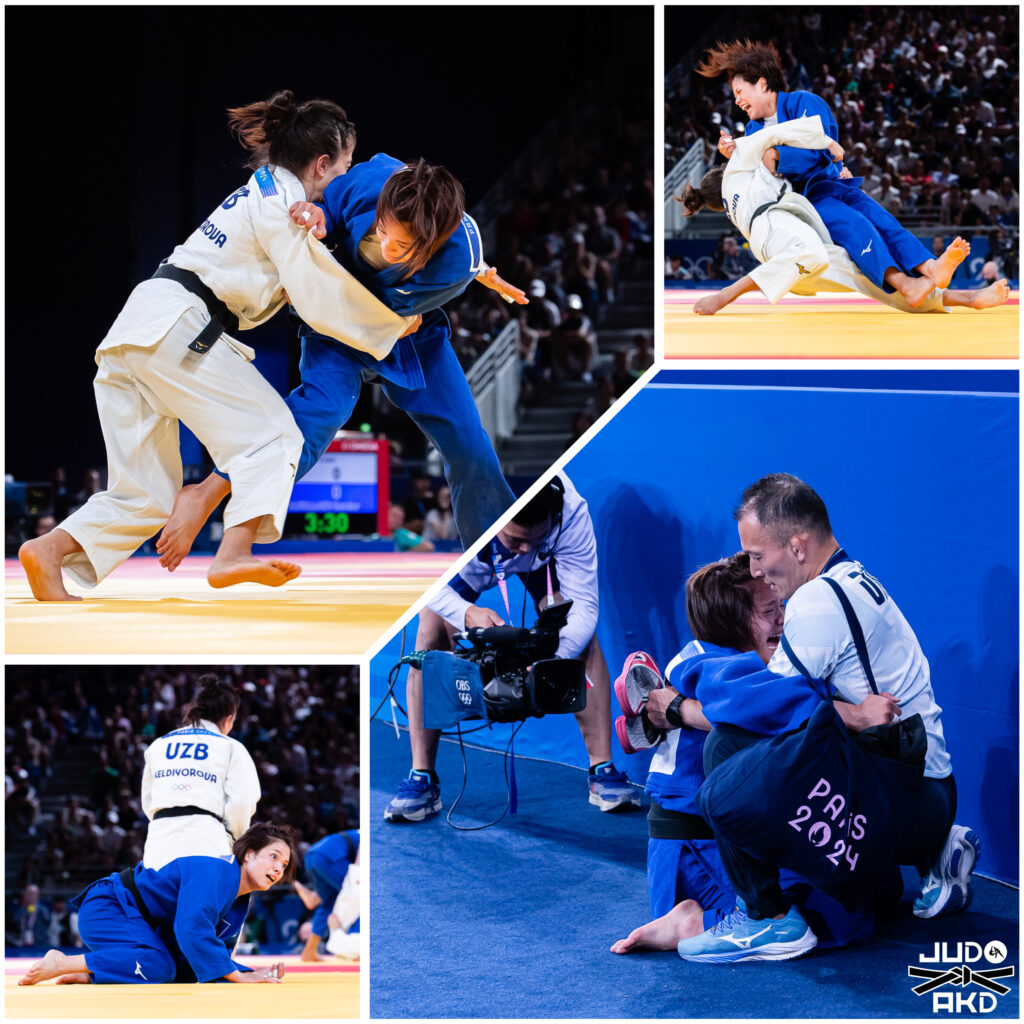
Watching that bout again two years later is a lesson in mental management… Absorb a waza-ari right from the start, yet decide to accept it. Breathe. Do not fall apart or lose motivation. Breathe. Remember the work done beforehand. The combinations devised in the studious silence of dojos sometimes deserted by ordinary practitioners. Breathe. Believe. Try, try and try again. Breathe. Keep trying until you bring her down. Hear the two rival shoulder blades strike the floor and, in the same instant, make out two cries that intertwine and two trajectories that reverse. One rises, the other collapses… A brief silence. A moment suspended in time and for eternity. Collective disbelief. For the audience. For Keldiyorova. For Abe. For Marko Spittka and Yukihide Hirano, the two coaches on the chair. Orlando Cruz, the referee, does not hesitate. For once, there is nothing convoluted here. Nothing to nitpick frame by frame on the screen at the central table. The tani-otoshi is clinically pure. The timing, perfect. The impact, deadly for the one receiving it, immortal for the legend of great judo. The Dominican referee’s arm rises as Abe’s eyes widen in horror. Ippon.
Unlike a discipline such as tennis, where defeat takes time to take shape and often allows the mind to prepare for an outcome that has become inevitable, in judo there are few instances that have provoked such widespread disbelief. Over the past three decades, they can practically be counted on one hand. Those present on a famous Monday in September 2010 at Tokyo’s Yoyogi Gymnasium remember the murmur that swept through the stands when, at the very end of the men’s Open-weight final, the refereeing panel decided by flags to award the title not to the overwhelming favorite, France’s Teddy Riner, but to his Japanese rival Daikii Kamikawa, who until then had been regarded merely as a second-stringer within his country’s O100kg hierarchy… Others remember Majlinda Kelmendi’s astonishment in 2012 at the London Games, the great hope of Kosovo competing under the Albanian flag at the time, overturned in the second round by Mauritius’s Christianne Legentil… Or Israel’s Golan Pollack, 2015 world medallist in the U66kg category, pinned in his opening bout at the Rio Olympics by Zambia’s Matthews Punza, ranked #112… Or finally France’s Lucie Décosse, reigning double world champion and Olympic title-holder in the U70kg category, lifted clean off the ground like a straw in the quarter-finals of the 2013 Paris Grand Slam by Kim Polling, a Dutchwoman ten years her junior.
But if there is one thunderclap that recalls even more strongly what happened on July 28, 2024, in Paris, it is the one that struck almost twenty years earlier, on August 20, 2004, at the Athens Olympic Games. In the U100kg quarter-finals, Japan’s Kosei Inoue, then riding a run of three consecutive world titles and the reigning Olympic champion, ran headlong into the Dutch wall that was Elco van der Geest. A profound personal wound was inflicted that day, and several years later we discussed it in detail with the man himself.
But let us return to 2024, and to the winner. What immediately strikes you is the Uzbek’s Olympian calm… However colossal the day’s achievement, it remains only a second-round victory. The day is not over, and she knows it. Like a Pete Sampras in his greatest years, she barely smiles, remains composed and in control, and simply resets for the next point – here, the next bout. “If I win, I have next. If I lose, I don’t have”, she sums up with the pragmatic sobriety characteristic of champions whose minds are clear.
Everything is Possible, the documentary that gives pride of place to this slice of contemporary sporting history, alternates a chronological account of that day with an exploration of a form of social conditioning to which the champion has never been willing to submit. “Being a woman means first being a wife and then being a mother” is sometimes used to sum up certain centuries-old customs – and never mind that the local sociological landscape is in reality often a little more complex. Pursuing a career, particularly in sport, remains an incongruity there.
French literature has explored this in great detail, notably in Un parrain de cendres (An Ash Godfather), a short, luminous yet painful novel by Jean Anglade (1915-2017), published in 1991 by Presses de la Cité. In its final pages, the heroine comes across a few photographs from her childhood at the bottom of a keepsake box. With the benefit of several decades’ hindsight, she wonders what her life might have been like if, at the age of nine, she had continued an education that promised so much, instead of – as was customary at the time in rural Auvergne in the 1920s abandoning it for good in the first days of June that year to help her family in the fields.
Diyora Keldiyorova, certainly, will never have to brood over that kind of retrospective melancholy. A succession of decisive encounters allowed her to play Neil Armstrong on the moon of Uzbek judo: Nellya Kiyamova, her lifelong coach; Armen Bagdasarov, the influential head of refereeing at the International Judo Federation – 1996 Olympic finalist against Korea’s Jeon Ki-young, who had defeated a German named Marko Spittka in the semi-finals; judo really is a circle -; Azizjin Kamilov, the ambitious president of the Uzbek Judo Federation…
Keldiyorova’s good fortune lies at the intersection of her own abilities and the good fairies she encountered along the way. Marko Spittka, her coach, made his mark on the 2010s alongside Austria’s Kathrin Unterwurzacher, one of the few U63kg fighters of her generation to have beaten France’s Clarisse Agbégnénou twice, and her lifelong partner in crime Bernadette Graf, a multiple European medallist like her but never able to reproduce that level of performance at senior world championships or the Olympics. “For once, I would like to be able to polish a diamond,” the coach admits in the documentary. The confession is moving. Sports stories often give pride of place to athletes’ regrets. But what about those of their coaches? One person’s failure is also the other’s, sternly reminded us by Japan’s Kosei Inoue a few years ago. By symmetry, the light also has at least two sources, and Robin Willingham’s twenty-two-minute hagiographic documentary deserves credit for reminding us of this between the lines.
The U66kg fighter Azamat Matyakubov, Diyora’s husband, for his part points to the founding turning point that was the Tokyo Olympic Games. The depression born of an early defeat also became a wake-up call. Three days later, his compatriot Davlat Bobonov won bronze in the U90 kg category. Fifteen months later, Bobonov went one better, claiming the world title at home – imitated the following day by U100 kg fighter Muzaffarbek Turoboyev, even though the refereeing of his final would leave his runner-up, Canada’s Kyle Reyes, with regrets forever.
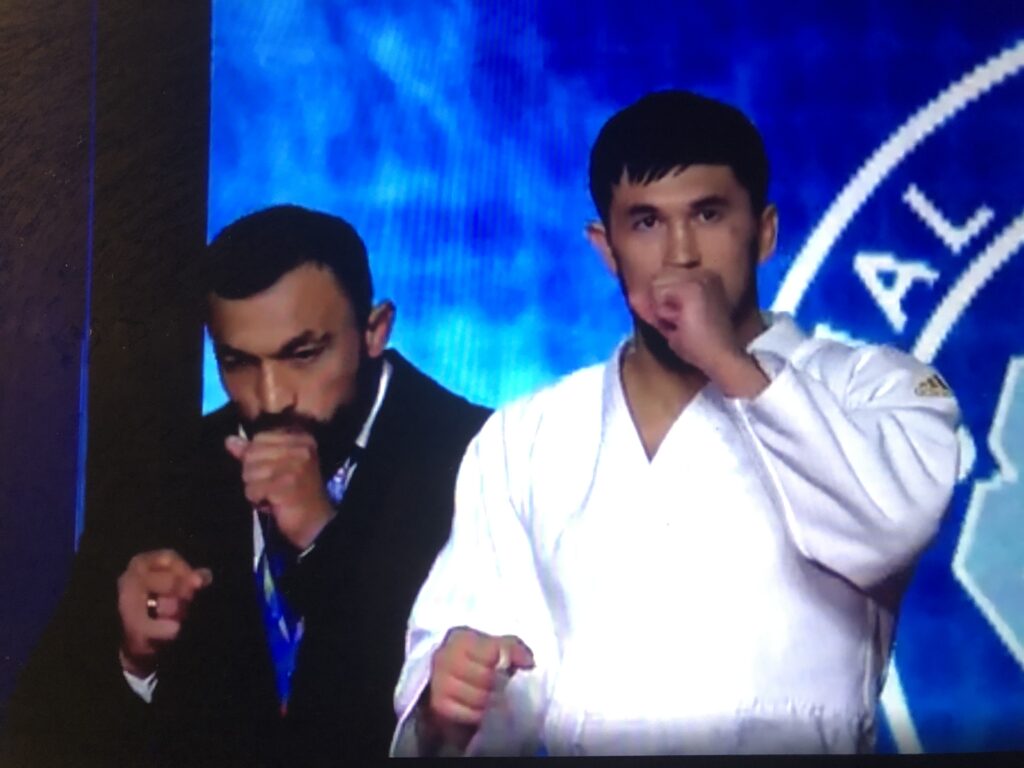
Spittka, then. Like Iliadis among the Uzbek men, the arrival of a foreign coach is always a turning point for a group, the individuals within it and – often – the local coaches who thought their time had come and now sometimes have to bite their tongues and wait through another Olympic cycle. Runner-up at the Antalya Grand Slam in April 2022 at her first competition alongside him, Keldiyorova endorses the German to Nellya Kiyamova, the linchpin of the system that had shaped her up to that point. A decisive validation, the starting point of a choral and coordinated collaboration. “You have the potential for an Olympic medal, but if you work harder you can even go for gold”, the coach whispers to her. Two and a half years to build an ambition, polish that famous diamond and move toward that complete form of judo made of shin, of gi and tai : Paris 2024 would be anything but a fluke.
“Emotions, emotional resilience and maintaining inner energy are the most important skills,” sports psychologist Agzamova Lola Saidabbasovna reminds us in the documentary. “Because technically, Marko had prepared her very well – her reactions, her technique, her breathing. Everything concerning judo, she was prepared a thousand percent. When an athlete is not emotionally or energetically prepared, they lose. Their energy, their calm, their here and now: that is where victory is decided.”
The puzzle falls into place. During a training camp in Croatia, Spittka watches a Georgian woman throw Abe twice with the same technique. His photographic memory captures the sequence. “This is the key, I’m certain of it.” What follows is a year of training on that technique in the greatest secrecy, never revealing it in competition. On the day, the right technique emerges at exactly the right moment because the athlete knows, right down to her toes, that it is the right technique and that it is the right moment. “That’s judo,” the German simply concludes.
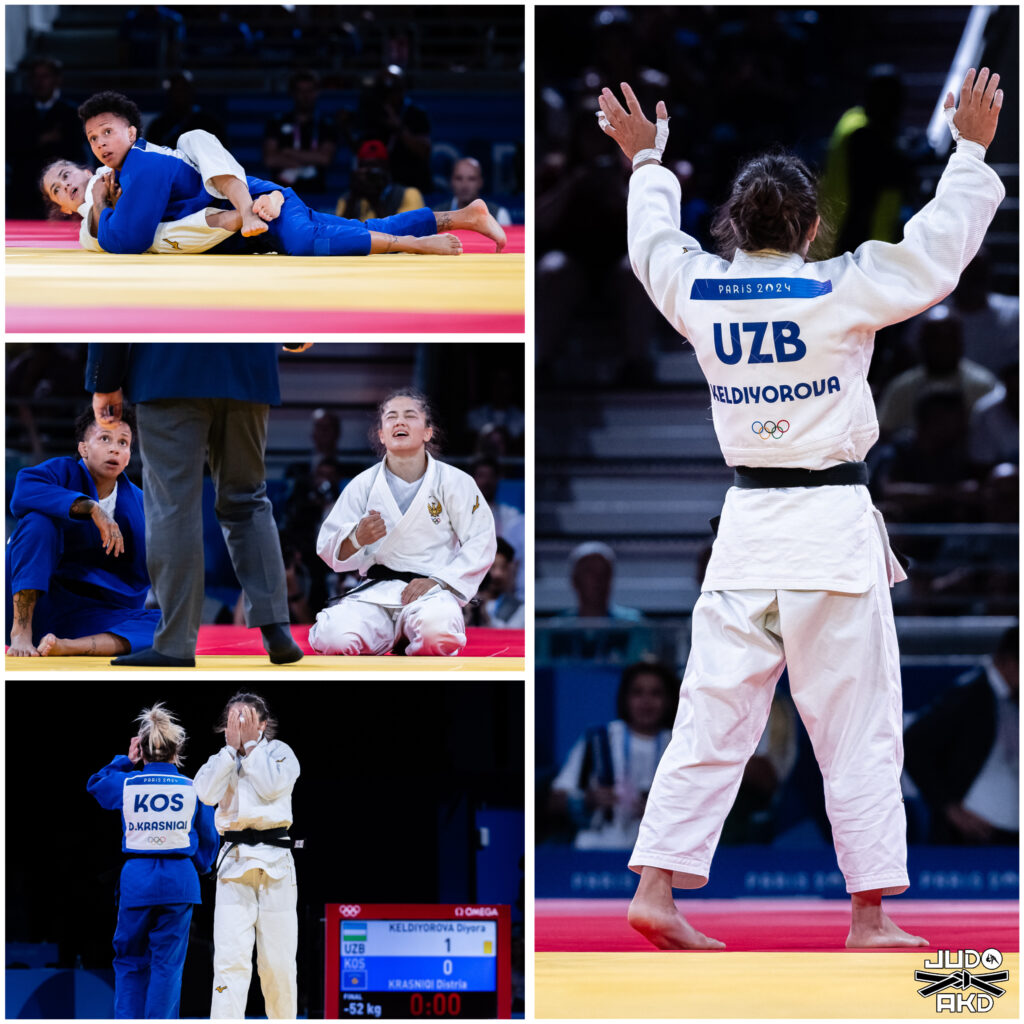
Every competitor knows it: the hardest thing after an achievement is the bout that follows. Fortunately, Germany’s Masha Ballhaus, who stands in Keldiyorova’s path in the quarter-finals, has never found the solution against her in three encounters. That makes four now, before Keldiyorova faces the other favorite in the category in the semi-finals: France’s Amandine Buchard, on home soil, whom she has never beaten and who is now only two steps away from the Olympic title that slipped through her fingers in 2021 (beaten in the final by Uta Abe) and became a nightmare in 2016 when she failed to make weight… Her rival, however, is ready. The crowd? “I could only hear Marko’s voice.” One waza-ari later, following a clever attack within the attack that had evidently also been worked on well in advance, she is in the final against Kosovo’s Distria Krasniqi, the reigning Olympic champion at U48kg and now chasing a double in the higher category – a serious client, then.
The two women had already faced each other a year earlier in the Tbilisi Grand Slam final, with the Uzbek coming out on top. This time, a seoi at the end of the bout is enough to secure victory, the Olympic title and, in the weeks that follow, public appearances alongside President Shavkat Mirziyoyev, his daughter Shahnoza Mirziyoyeva, the influential deputy director of the National Agency for Social Protection, and Otabek Muhammadalievich Umarov, an indispensable architect of Uzbek sporting influence. Forever etched into the history of Uzbekistan, with this question that is no longer really a question on the lips of all young female athletes: “If Diyora could do it, why couldn’t I?” – Anthony Diao, summer 2026. Opening photo: ©Paco Lozano/JudoAKD.
A French version of this article is available here.
More articles in English:
-
- JudoAKD#001 – Loïc Pietri – Pardon His French
- JudoAKD#002 – Emmanuelle Payet – This Island Within Herself
- JudoAKD#003 – Laure-Cathy Valente – Lyon, Third Generation
- JudoAKD#004 – Back to Celje
- JudoAKD#005 – Kevin Cao – Where Silences Have the Floor
- JudoAKD#006 – Frédéric Lecanu – Voice on Way
- JudoAKD#009 – Abderahmane Diao – Infinity of Destinies
- JudoAKD#008 – Annett Böhm – Life is Lives
- JudoAKD#010 – Paco Lozano – Eye of the Fighters
- JudoAKD#011 – Hans Van Essen – Mister JudoInside
- JudoAKD#021 – Benjamin Axus – Still Standing
- JudoAKD#022 – Romain Valadier-Picard – The Fire Next Time
- JudoAKD#023 – Andreea Chitu – She Remembers
- JudoAKD#024 – Malin Wilson – Come. See. Conquer.
- JudoAKD#025 – Antoine Valois-Fortier – The Constant Gardener
- JudoAKD#026 – Amandine Buchard – Status and Liberty
- JudoAKD#027 – Norbert Littkopf (1944-2024), by Annett Boehm
- JudoAKD#028 – Raffaele Toniolo – Bardonecchia, with Family
- JudoAKD#029 – Riner, Krpalek, Tasoev – More than Three Men
- JudoAKD#030 – Christa Deguchi and Kyle Reyes – A Thin Red and White Line
- JudoAKD#031 – Jimmy Pedro – United State of Mind
- JudoAKD#032 – Christophe Massina – Twenty Years Later
- JudoAKD#033 – Teddy Riner/Valentin Houinato – Two Dojos, Two Moods
- JudoAKD#034 – Anne-Fatoumata M’Baïro – Of Time and a Lifetime
- JudoAKD#035 – Nigel Donohue – « Your Time is Your Greatest Asset »
- JudoAKD#036 – Ahcène Goudjil – In the Beginning was Teaching
- JudoAKD#037 – Toma Nikiforov – The Kalashnikiforov Years
- JudoAKD#038 – Catherine Beauchemin-Pinard – The Rank of Big Sister
- JudoAKD#039 – Vitalie Gligor – « The Road Takes the One Who Walks »
- JudoAKD#040 – Joan-Benjamin Gaba and Inal Tasoev – Mindset Matters
- JudoAKD#041 – Pierre Neyra – About a Corner of France and Judo as It is Taught There
- JudoAKD#042 – Theódoros Tselídis – Between Greater Caucasus and Aegean Sea
- JudoAKD#043 – Kim Polling – This Girl Was on Fire
- JudoAKD#044 – Kevin Cao (II) – In the Footsteps of Adrien Thevenet
- JudoAKD#045 – Nigel Donohue (II) – About the Hajime-Matte Model
- JudoAKD#046 – A History of Violence(s)
- JudoAKD#047 – Jigoro Kano Couldn’t Have Said It Better
- JudoAKD#048 – Lee Chang-soo/Chang Su Li (1967-2026), by Oon Yeoh
- JudoAKD#050 – Hermann Monne – Burkina, a Land Already Peopled
- JudoAKD#051 – Mariana Esteves – A Chronicle of Life Passing By
- JudoAKD#052 – Tiphaine Gingelwein – Chechnya and the Caucasus, a Feminine Perspective in Nuance and Complexity
- JudoAKD#053 – Victor Scvortov – Born Again Under a Lucky Star
- JudoAKD#054 – Eric Gervasoni – From Moves to Movies
- JudoAKD#055 – Mihael Žgank – Coming Home Is Where the Real Journey Starts
- JudoAKD#056 – Patrick Grosperrin – Laterality, a Little-Known Lever of Performance
- JudoAKD#057 – Rest in Peace, René Nazaret (1936-2026)
- JudoAKD#058 – Alexandre Paysan – We Saw Him in the Vercors, Bungee Jumping…
- JudoAKD#059 – Habib Alouache – Teaching Joy
- JudoAKD#061 – Angelika Szymańska – With the Restraint of Those Still on Their Way
- JudoAKD#062 – Valentin Ménard – The Click (That Moment When Champions Just Know)
Also in English:
- JudoAKDReplay#001 – Pawel Nastula – The Leftover (2017)
- JudoAKDReplay#002 – Gévrise Emane – Turn Lead into Bronze (2020)
- JudoAKDReplay#003 – Lukas Krpalek – The Best Years of a Life (2019)
- JudoAKDReplay#004 – How Did Ezio Become Gamba? (2015)
- JudoAKDReplay#005 – What’s up… Dimitri Dragin? (2016)
- JudoAKDReplay#006 – Travis Stevens – « People forget about medals, only fighters remain » (2016)
- JudoAKDReplay#007 – Sit and Talk with Tina Trstenjak and Clarisse Agbégnénou (2017)
- JudoAKDReplay#008 – A Summer with Marti Malloy (2014)
- JudoAKDReplay#009 – Hasta Luego María Celia Laborde (2015)
- JudoAKDReplay#010 – What’s Up… Dex Elmont? (2017)
- JudoAKDReplay#011 – Zakopane, or Lives Passing By (2017)
- JudoAKDReplay#012 – Thierry Frémaux (1/2) – About The Legend of the Great Judo(2016)
- JudoAKDReplay#013 – Thierry Frémaux (2/2) – Judo in the Light (2021)
And also :
- JudoAKDRoadToLA2028#01 – Episode 1/13 – Summer 2025
- JudoAKDRoadToLA2028#02 – Episode 2/13 – Autumn 2025
- JudoAKDRoadToLA2028#03 – Episode 3/13 – Winter 2026
- JudoAKDRoadToLA2028#04 – Episode 4/13 – Spring 2026
- JudoAKDRoadToLA2028#05 – Episode 5/13 – Summer 2026
JudoAKD – Facebook – Instagram – X (Twitter).