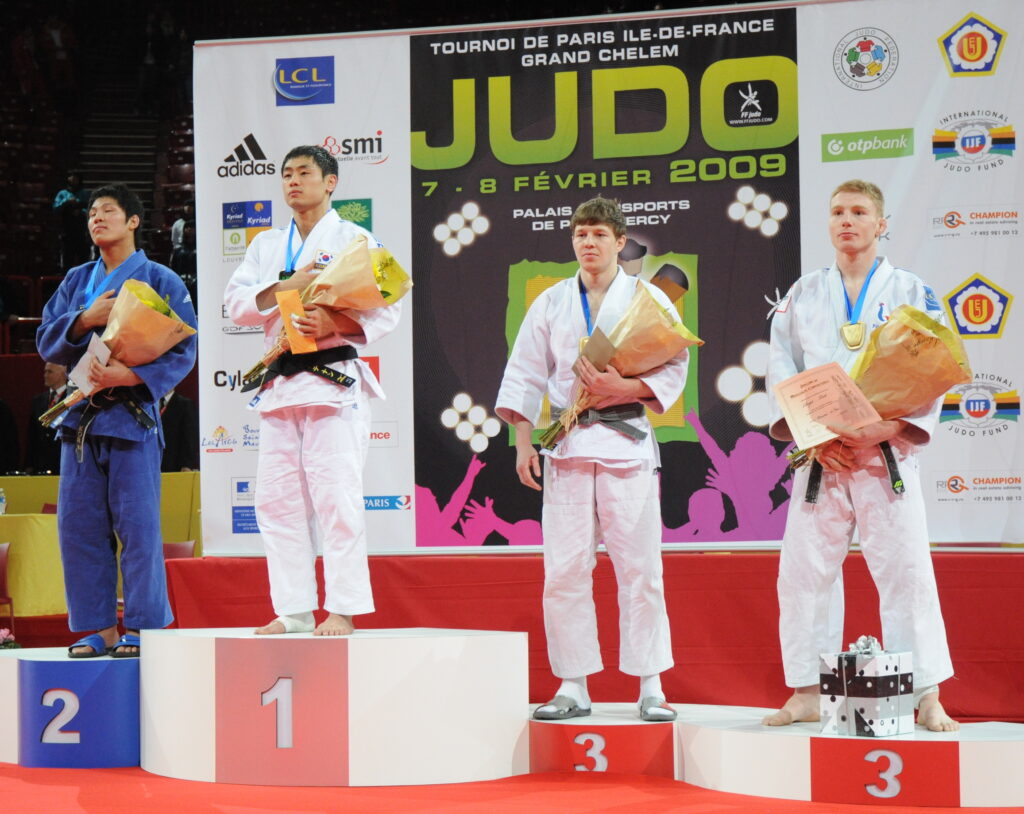
Born on 28 February 1987 in Saint-Dizier (France), Axel Clerget is, and will remain, a whirlwind of French judo. With Teddy Riner, Cyrille Maret, Mickaël Rémilien and Hervé Fichot, he belongs to the famous golden generation that swept the men’s podiums at the World Junior Championships in Santo Domingo in October 2006: gold for the first three, silver for Fichot and bronze for Clerget. Three years later, on the back of another thrilling bronze, this time at the Paris Grand Slam, the French bimonthly L’Esprit du judo offered me the chance to make him, all the way to the London Games, one of the eight protagonists of a serial entitled Judo Académie, alongside strong-willed characters named Lucile Duport, Morgane Ribout, Emmanuelle Payet, Audrey Tcheuméo, Florent Urani, Ugo Legrand and Nicolas Brisson.
Nearly twenty years have passed. The young firebrand of the early days has had his share of joys and sorrows, medals and injuries. In early 2026, he produced and co-directed with Lucas Hauchard The 174th Fight (Le 174e combat), a 52-minute film dedicated to his son Liam, to set in stone what would remain of his fourth and final Olympic quest. It was a last straight begun at thirty-six with the cautious hope of someone who has learned in his own flesh that every destiny is a matter of millimetres, and which ended a few months later with the first days of the rest of his life. – JudoAKD#068.
A French version of this article is available here.
It is one of those formats every documentary maker secretly dreams of pulling off. An Olympic year. A countdown. Catching the champion at dawn, when nobody is watching him yet. And hoping to accompany him to the end of his quest of the moment, which is often, given how very narrow the scale of a top-level career turns out to be, the quest of a lifetime. In 1998, on the occasion of the French football team’s victory in “its” home World Cup, Stéphane Meunier’s Les Yeux dans les Bleus cut a pivotal furrow in the immersive sports genre, adding a new elegiac dimension to a gaze traditionally raised on the static shots of a Raymond Depardon or a William Klein in the manner of The French. The model has often been copied since, rarely equalled, yet surpassed at least twice by the diptych Chasing the Sun part 1 (2020) and part 2 (2024) by Gareth Whittaker and Greg Lomas, raw-nerved chronicles of South Africa’s two Rugby World Cup victories in 2019 and 2023, with all the emotional charge tied to its status as a rainbow nation and the internal as well as external knots that follow from it.
On the judo side, Cédric Balaguier’s recent Louves closely followed the French women’s ascent towards Paris 2024, and the more low-profile St. Petersburg Vibes by Georgy Kokoev set out to tell the story of the O100kg category’s Inal Tasoev through the prism of his country’s cultural heritage, and vice versa. Personally, together with my comrades Marc Sauvourel and David Tiago Ribeiro, we gave birth in late 2021, for Canal+, to the documentary Azad, the story of Iranian judoka Saeid Mollaei, following a sporting trajectory struck by geopolitics. It was an inner journey anything but static, which began at the Nippon Budokan in Tokyo in 2019 and whose epilogue, two years later, took place in exactly the same hall, after as many kilometres as adventures.
“We are at the beginning of 2024 and Axel Clerget contacts us to follow him behind the scenes of his selection for the Paris Olympic Games. We are a few months before the selection. In his category, he is still in the running.” The voice-over is sober and factual. The challenge is threefold: to make us understand, in a short time, where the main character is speaking from, and what his plan A and plan B are.
Situating Axel is easy enough; the material is there for the taking. Eighteen years at INSEP, fourteen seasons on the senior national team, campaigns by the dozen. All of it is illustrated by a slam that is anything but incidental, signed Mickaël Rémilien. Rémilien? One of the three French juniors who became world champions in 2006 in Santo Domingo, and a genuine collateral victim of the many refereeing reforms of the last two decades. His judo, built on “diggers” whose timing he had mastered to perfection, suddenly became obsolete when the ban on leg grabs was introduced in the wake of the Beijing Games. “At the time, the U73kg competitor was as good at athletics as he was at judo,” we wrote a few years ago about him. “Better still: he had even converted onto the mat the explosive qualities developed on the track of ASPTT Paris. His breakthrough? It came in 2004 in Lyon, in the final of the first of his three victorious junior Tournois de France. The score showed him a waza-ari down against a Russian when suddenly the tactical pattern became clear: a starting-blocks launch in the gunshot of the hajime, a ram-raiding dive with hands like crowbars between the collar and the groin of his opponent, a crossing of the contest area in three, five or, if need be, seven strides, long enough to drag, shift, charge, then flatten, in a silent roar, the recalcitrant opponent who was on his guard and yet often powerless.”
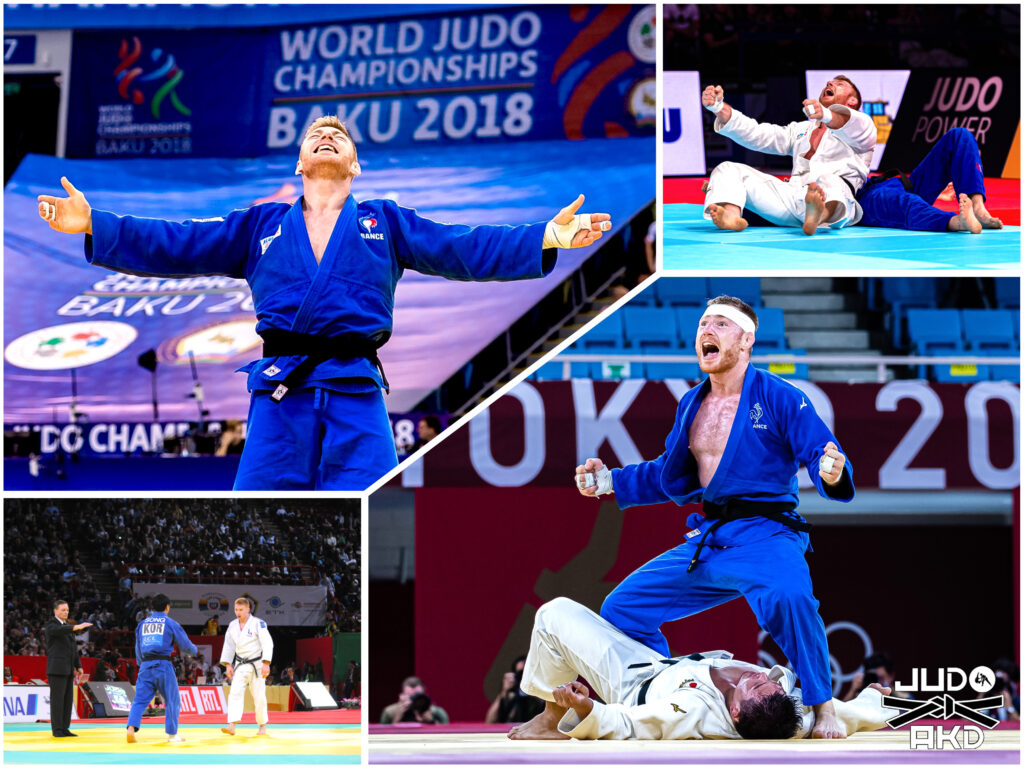
“C’est certain”, the track chosen by Axel to open and close The 174th Fight, has a story of its own. Mickaël Rémilien had himself helped us retrace its genesis for L’Esprit du judo: “On 23 September 2018, on the eve of his first bout at the Baku World Championships, his old pal Axel Clerget, a former prospect now a thirty-something father, received a 6’51” track signed by his eternal Santo Domingo partner. The title is ‘C’est certain’. It sums up fifteen years of top-level sport, of doubts, of thwarted hopes and of champing at the bit, but above all the touching trust of a friend of a kind one rarely meets in a lifetime. Axel pressed ‘Play’, then ‘Repeat’. The next day, the protégé of Stéphane Auduc and Christophe Massina won, at thirty-one, his first senior world medal, twelve years after his junior bronze in the Caribbean. ‘And in front of my screen I cried,’ confides his junior by six days. ‘I cried both out of joy and because I hadn’t gone all the way with it myself. I cried because it was him, because I know his parents, his sister and his brother, and because it was powerful. Tomorrow will be just one fight fewer, I told him in the track… So many others have been waiting for us since, and that, we all measure sooner or later.'”
Rémilien’s mention of the Clerget clan echoes an observation regularly made by another clan he crossed paths with a great deal in the U81kg days and then in his first seasons in the U90kg category: the Pietris, father and son. Regional roots around Saint-Dizier are indeed the exception that proves the twofold rule recalled by Marcel Pietri during his recent examination, in mid-November 2026, for the grade of eighth dan: that the French team is shrinking ever more around the Paris basin alone (“of the fourteen French starters at the Paris Games, only Shirine Boukli, trained in the Gard, and Luka Mkheidze, who arrived from Georgia but still came through JC Bolivar before continuing in Le Havre, did not come from the Paris region”). The other observation? “Another factor of success is to come from a family of judokas yourself,” as confirmed by the recent junior world title of Manon Agati-Alouache, daughter of Habib Alouache, himself a former pupil of… Marcel Pietri.
Family, then. The one you come from and the one you take as armour, the two complementing or cancelling each other depending on the case. At the end of a sequence in the dojo of his childhood, where his son scrambles about as Lukas Krpalek‘s once did in Prague, Axel shows in passing the (very) fine remains of his father Francis’s judo, then wonders aloud: “After that, what matters most is: is he proud of the man I’ve become? That’s another question. And it’s the most important, I think,” he smiles as he walks away.
His second family, he built at INSEP. First through chance encounters, then, from 2014, in a more structured way, on the model of professional tennis players. “I built this environment because I took some hits,” he asserts without saying more. His criteria are humanity, the ability to see the glass as half full even when it is almost empty, consistency and reliability. Small wonder, then, that he drew closer to Stéphane Auduc, one of those coaches who shouts less than he murmurs in his athletes’ ears. “My strength was to understand his singularity, to work with it and to try to sublimate it,” the latter confirms.
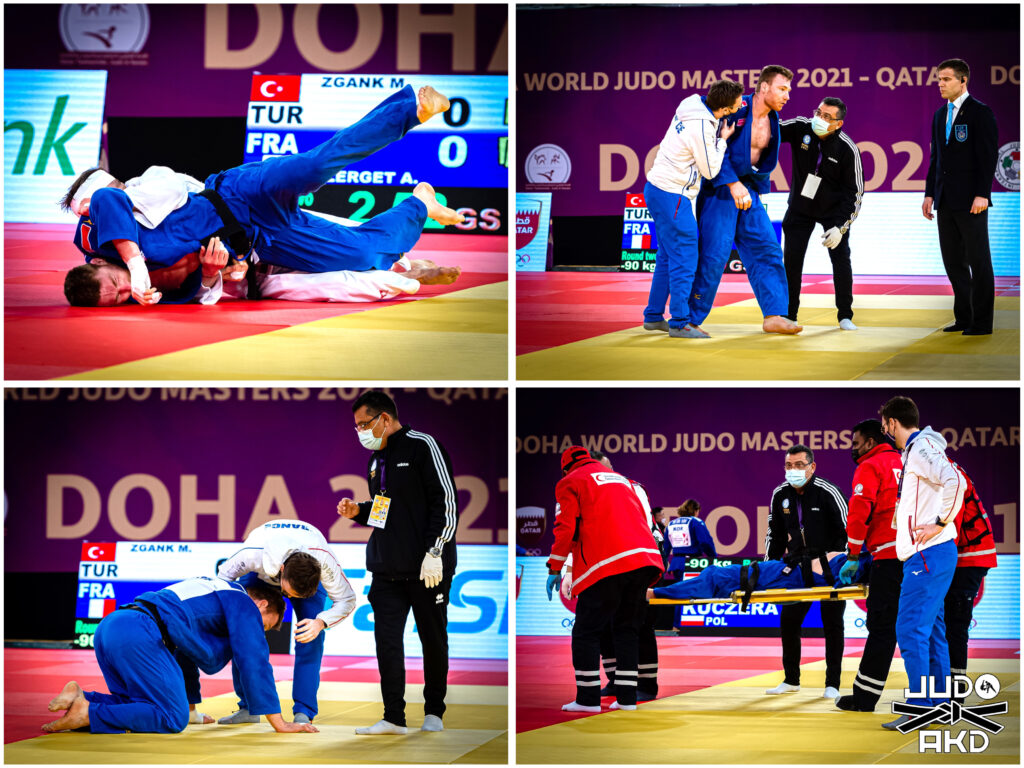
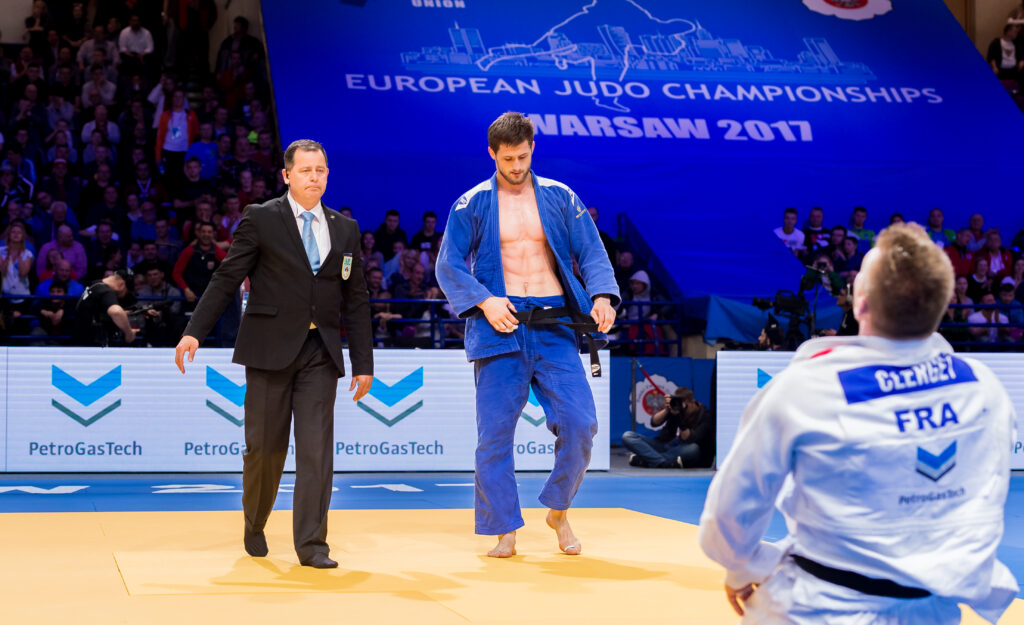
Methodically, rationally, the pieces of the puzzle gradually fall into place, with his Marnaval and Sucy Judo mates as with the national team. It is in his thirties that this specialist of standing-to-ground transitions would know his best years. European vice-champion in 2017, individual world medallist in 2018 and 2019, Olympic mixed team champion in 2021, he achieved that last feat barely six months after a concussion suffered in January at the Doha Masters. In golden score against Turkey’s Mihael Zgank, his head struck the mat violently, as it must have done dozens of times in his career. But this time everything started spinning, he could not regain his balance, to the point of being carried out on a stretcher. The sequence worried the entire Qatari hall, still sparsely filled in that very particular era of gradual emergence from the pandemic… A physiotherapist by trade, Axel would treat and then intellectualise the incident with all the seriousness it deserved, to the point of becoming, like Britain’s Nekoda Smythe-Davis, a respected voice in the West on the subject of concussion.
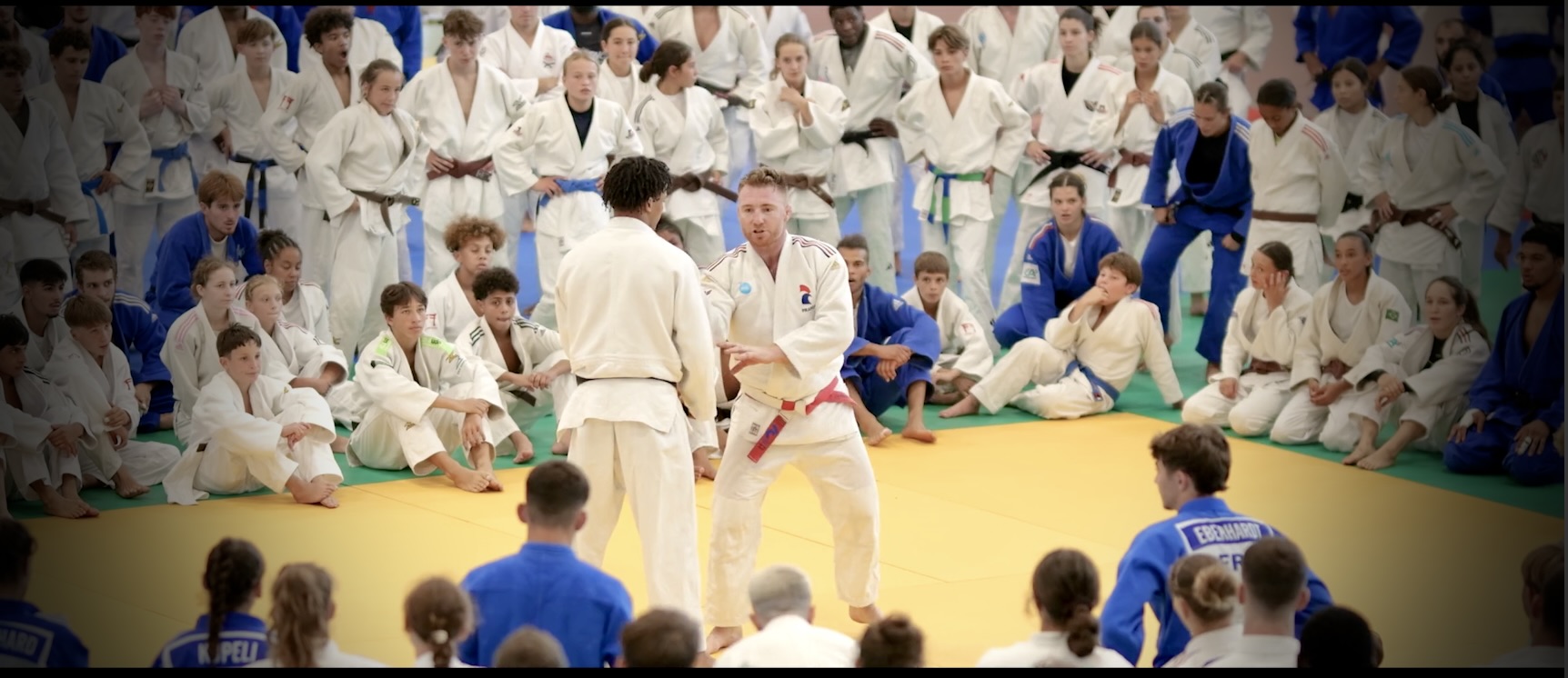
Without spoiling too much of the heart of the documentary, which recalls, as meritorious judoka such as Switzerland’s Dominique Hischier or the then-Moldovan Victor Scvortov experienced in their careers, the cruelty of missing an Olympic qualification by a breath, it shows in its final minutes a page being turned. It shows the passing from one moustachioed man (Jigoro Kano) to another (Pierre de Coubertin), and a touching lucidity that leads him to say, because of the dull worry that the sword of Damocles of a possible new concussion cast over the end of his career, a line steeped in a thoroughly Nietzschean amor fati: “Maybe my competitors will give me the most beautiful gift for my future life by retiring me earlier.” An unexpected and at last peaceful reading of the ideal of mutual aid and prosperity. – Anthony Diao, autumn 2026. Opening picture: screenshot from the documentary The 174th Fight ©Axel Clerget and Lucas Hauchard/JudoAKD.
A French version of this article is available here.
More articles in English:
-
- JudoAKD#001 – Loïc Pietri – Pardon His French
- JudoAKD#002 – Emmanuelle Payet – This Island Within Herself
- JudoAKD#003 – Laure-Cathy Valente – Lyon, Third Generation
- JudoAKD#004 – Back to Celje
- JudoAKD#005 – Kevin Cao – Where Silences Have the Floor
- JudoAKD#006 – Frédéric Lecanu – Voice on Way
- JudoAKD#009 – Abderahmane Diao – Infinity of Destinies
- JudoAKD#008 – Annett Böhm – Life is Lives
- JudoAKD#010 – Paco Lozano – Eye of the Fighters
- JudoAKD#011 – Hans Van Essen – Mister JudoInside
- JudoAKD#021 – Benjamin Axus – Still Standing
- JudoAKD#022 – Romain Valadier-Picard – The Fire Next Time
- JudoAKD#023 – Andreea Chitu – She Remembers
- JudoAKD#024 – Malin Wilson – Come. See. Conquer.
- JudoAKD#025 – Antoine Valois-Fortier – The Constant Gardener
- JudoAKD#026 – Amandine Buchard – Status and Liberty
- JudoAKD#027 – Norbert Littkopf (1944-2024), by Annett Boehm
- JudoAKD#028 – Raffaele Toniolo – Bardonecchia, with Family
- JudoAKD#029 – Riner, Krpalek, Tasoev – More than Three Men
- JudoAKD#030 – Christa Deguchi and Kyle Reyes – A Thin Red and White Line
- JudoAKD#031 – Jimmy Pedro – United State of Mind
- JudoAKD#032 – Christophe Massina – Twenty Years Later
- JudoAKD#033 – Teddy Riner/Valentin Houinato – Two Dojos, Two Moods
- JudoAKD#034 – Anne-Fatoumata M’Baïro – Of Time and a Lifetime
- JudoAKD#035 – Nigel Donohue – « Your Time is Your Greatest Asset »
- JudoAKD#036 – Ahcène Goudjil – In the Beginning was Teaching
- JudoAKD#037 – Toma Nikiforov – The Kalashnikiforov Years
- JudoAKD#038 – Catherine Beauchemin-Pinard – The Rank of Big Sister
- JudoAKD#039 – Vitalie Gligor – « The Road Takes the One Who Walks »
- JudoAKD#040 – Joan-Benjamin Gaba and Inal Tasoev – Mindset Matters
- JudoAKD#041 – Pierre Neyra – About a Corner of France and Judo as It is Taught There
- JudoAKD#042 – Theódoros Tselídis – Between Greater Caucasus and Aegean Sea
- JudoAKD#043 – Kim Polling – This Girl Was on Fire
- JudoAKD#044 – Kevin Cao (II) – In the Footsteps of Adrien Thevenet
- JudoAKD#045 – Nigel Donohue (II) – About the Hajime-Matte Model
- JudoAKD#046 – A History of Violence(s)
- JudoAKD#047 – Jigoro Kano Couldn’t Have Said It Better
- JudoAKD#048 – Lee Chang-soo/Chang Su Li (1967-2026), by Oon Yeoh
- JudoAKD#050 – Hermann Monne – Burkina, a Land Already Peopled
- JudoAKD#051 – Mariana Esteves – A Chronicle of Life Passing By
- JudoAKD#052 – Tiphaine Gingelwein – Chechnya and the Caucasus, a Feminine Perspective in Nuance and Complexity
- JudoAKD#053 – Victor Scvortov – Born Again Under a Lucky Star
- JudoAKD#054 – Eric Gervasoni – From Moves to Movies
- JudoAKD#055 – Mihael Žgank – Coming Home Is Where the Real Journey Starts
- JudoAKD#056 – Patrick Grosperrin – Laterality, a Little-Known Lever of Performance
- JudoAKD#057 – Rest in Peace, René Nazaret (1936-2026)
- JudoAKD#058 – Alexandre Paysan – We Saw Him in the Vercors, Bungee Jumping…
- JudoAKD#059 – Habib Alouache – Teaching Joy
- JudoAKD#060 – Diyora Keldiyorova – Another Giant Leap for (Wo)Mankind
- JudoAKD#061 – Angelika Szymańska – With the Restraint of Those Still on Their Way
- JudoAKD#062 – Valentin Ménard – The Click (That Moment When Champions Just Know)
- JudoAKD#063 – Loïc Pietri (II) – “Talking Is for Laughs. Doing Shuts People Up.”
- JudoAKD#064 – Two Stories of Judo and Empathy
- JudoAKD#065 – Tiphaine Gingelwein (II) – Baku 2026, In and Out
- JudoAKD#066 – Clémence Émé – Love (É)mé Do
- JudoAKD#067 – A Journey to the Line – Jack Yonezuka
Also in English:
- JudoAKDReplay#001 – Pawel Nastula – The Leftover (2017)
- JudoAKDReplay#002 – Gévrise Emane – Turn Lead into Bronze (2020)
- JudoAKDReplay#003 – Lukas Krpalek – The Best Years of a Life (2019)
- JudoAKDReplay#004 – How Did Ezio Become Gamba? (2015)
- JudoAKDReplay#005 – What’s up… Dimitri Dragin? (2016)
- JudoAKDReplay#006 – Travis Stevens – « People forget about medals, only fighters remain » (2016)
- JudoAKDReplay#007 – Sit and Talk with Tina Trstenjak and Clarisse Agbégnénou (2017)
- JudoAKDReplay#008 – A Summer with Marti Malloy (2014)
- JudoAKDReplay#009 – Hasta Luego María Celia Laborde (2015)
- JudoAKDReplay#010 – What’s Up… Dex Elmont? (2017)
- JudoAKDReplay#011 – Zakopane, or Lives Passing By (2017)
- JudoAKDReplay#012 – Thierry Frémaux (1/2) – About The Legend of the Great Judo(2016)
- JudoAKDReplay#013 – Thierry Frémaux (2/2) – Judo in the Light (2021)
And also :
- JudoAKDRoadToLA2028#01 – Episode 1/13 – Summer 2025
- JudoAKDRoadToLA2028#02 – Episode 2/13 – Autumn 2025
- JudoAKDRoadToLA2028#03 – Episode 3/13 – Winter 2026
- JudoAKDRoadToLA2028#04 – Episode 4/13 – Spring 2026
- JudoAKDRoadToLA2028#05 – Episode 5/13 – Summer 2026
JudoAKD – Facebook – Instagram – X (Twitter).