On 10 May 2026, Tiphaine Gingelwein did us the honour of contributing JudoAKD#052, entitled Chechnya and the Caucasus, a Feminine Perspective in Nuance and Complexity. The title may have seemed rather long to those accustomed to vertical scrolling. In fact, it was almost an understatement, given how much this 24-year-old French doctoral researcher had to say about a region of the world she has been exploring for several years, judogi over her shoulder. Travelling the world? She leaves that ambition to others. Her own field of action is more limited, but she instinctively knows that even an entire lifetime will not be enough to fully explore it.
In 2024, she wrote a 200-page master’s dissertation for INALCO (the French National Institute for Oriental Languages and Civilisations), entitled Contemporary Combat Sports among the Chechens. Having already attended the European Championships in Tbilisi in April, from where she sent us translations and explanations of some of the local spectators’ reactions, she was back at it in early October at the World Championships in Baku. This time, with a promise we had made together some time beforehand: the travel diary presented here, a detailed and candid account of things seen, heard and experienced, both on the ground and several hours away from the capital. An attentive and unexpected journey through Azerbaijan. Our thanks to her for sharing it with us. – JudoAKD#065.
A French version of this diary is availabe here.
Before departure: some background
I am travelling to Azerbaijan for the second time, once again as part of my PhD research at the University of Bordeaux, which focuses on wrestling traditions in the South Caucasus. Both of my stays have been funded by the University’s ECOr department.
My first visit took place this summer, from 26 July to 3 August. I attended the U17 World Wrestling Championships and visited two judo clubs in Baku (JC Atilla and JC 2012), as well as the National Deaflympic Committee. The committee’s vice-president, Fariz Huseynov, is the former president of JC 2012. I had first contacted him almost two years ago, when I was supposed to travel to Azerbaijan for the 2025 Baku Grand Slam. That trip was cancelled after my passport was confiscated and incinerated following an administrative error at the prefecture…
My second visit, and the one described here, takes place from 1 to 15 October. It coincides with the World Judo Championships, held in the Azerbaijani capital from 4 to 11 October. I plan to attend several days of competition to make observations for my thesis, but also to visit a number of sports facilities outside Baku, whose management teams have agreed to receive me.
Stage 1/6 – From Imereti to Gusar (29 September-1 October)
Since August, I have been based in Samtredia, Georgia. I am working on my thesis and training in judo every day. Although Kutaisi Airport is nearby, there are no direct flights to Baku, so I have to travel from Tbilisi. I take the train there on 29 September, hoping to spend a little time in the capital, where I lived for eight months.
I had planned a quiet evening and a long night’s sleep, since the following night would be a sleepless one: my flight was scheduled for 2 a.m. Instead, I get dragged off to a wrestling session, then dinner, then a Harley ride to Jvari Monastery, which is fifteen centuries old and overlooks Mtskheta, the former capital. I end up sleeping for just five hours. The following day, I work in a café until evening, when I climb the hill overlooking the old town, from where the whole of Tbilisi can be seen. A thunderstorm catches me by surprise and sends me rushing towards the airport, where I board my 2 a.m. flight.
I arrive in Baku an hour later. After clearing passport control without any problems, just as during my first visit, I try unsuccessfully to sleep on the airport seats. I decide to make the best of it, fuel myself with coffee and head for the bus station as soon as I consider the time reasonable. After an hour and twenty minutes in a taxi stuck in traffic, a ticket purchase conducted with considerable difficulty in my extremely rudimentary Azerbaijani, and three and a half hours on the road, during which I doze on and off, I reach Gusar, the administrative centre of the district of the same name, near the Dagestani border. The World Championships are just three days away.
Stage 2/6 – Gusar, among the Lezgins (1–3 October)
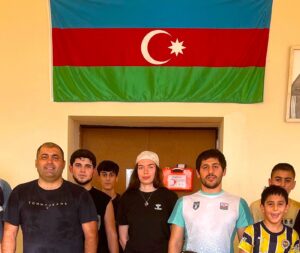
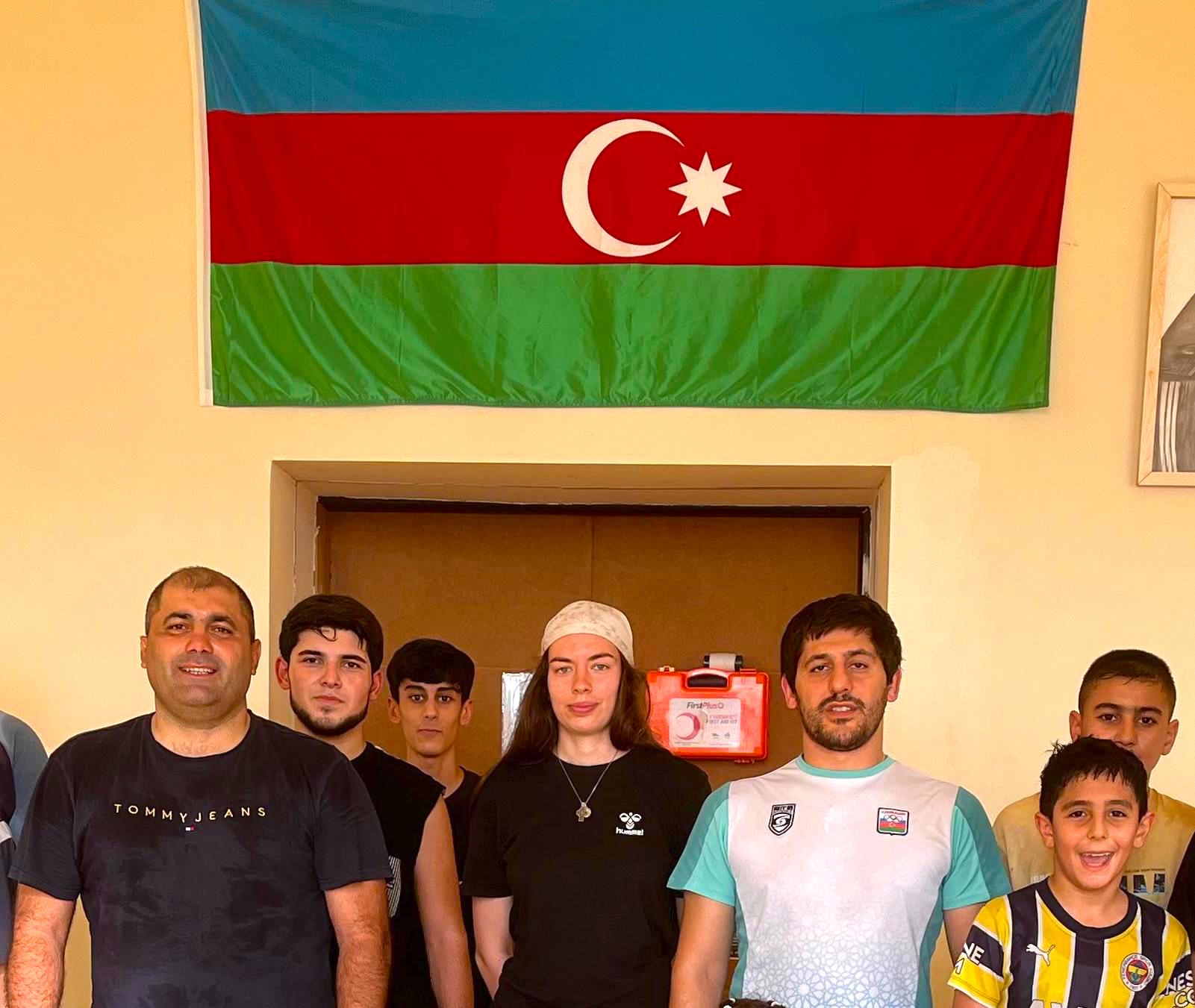
Gusar district is part of the territory inhabited by the Lezgins, a people living on both sides of the border between southern Dagestan and northern Azerbaijan. As I did in Georgia’s Pankisi Valley, I am interested in how ethnic minorities can express their identities through sport. I therefore contacted the judo section of the local public sports school, one of whose coaches kindly agreed to host me.
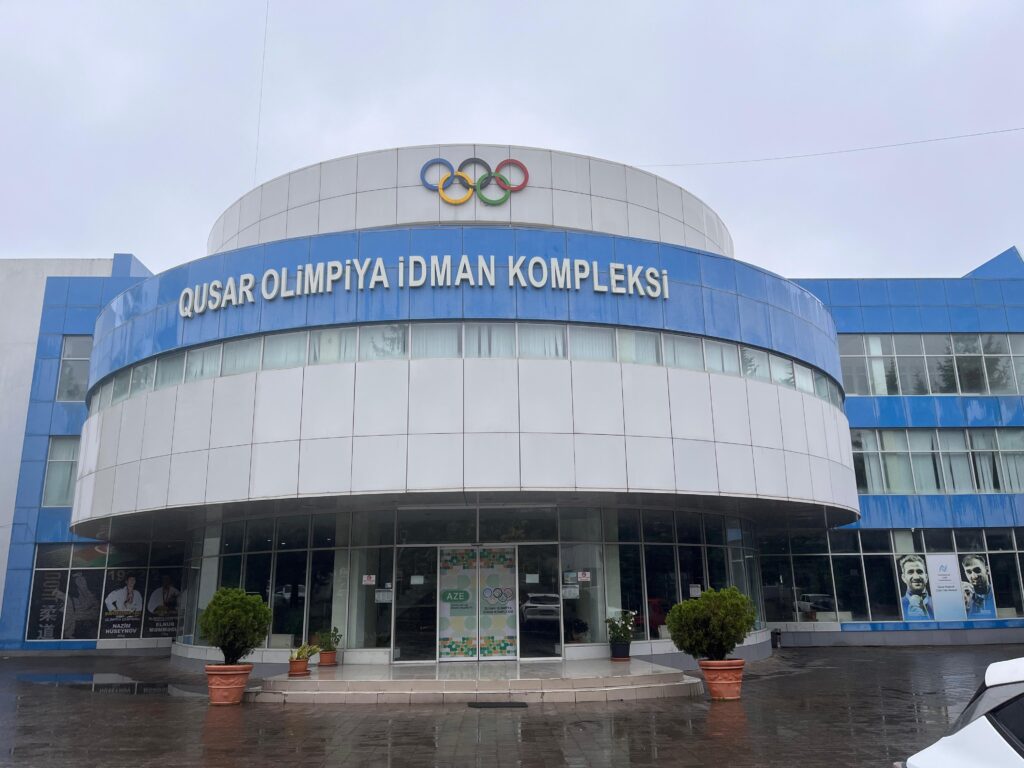
As soon as I arrive, Hajibala Sultanov picks me up and shows me around the town. He takes me on a tour of the local sports facilities. We begin with the public sports school, which is free of charge. The building dates back to before the 1917 Revolution and has undergone considerable changes over the years. Its most recent renovation took place just a few years ago. The school has a two-mat dojo and a small Greco-Roman wrestling room.
As I watch Hajibala’s judo session – he gets onto the mat and warms up alongside his students, something quite unusual in the Caucasus – an elderly man enters the room. He is introduced to me as the school’s first judo coach, and also one of the very first judo coaches in Azerbaijan, back in the 1970s.
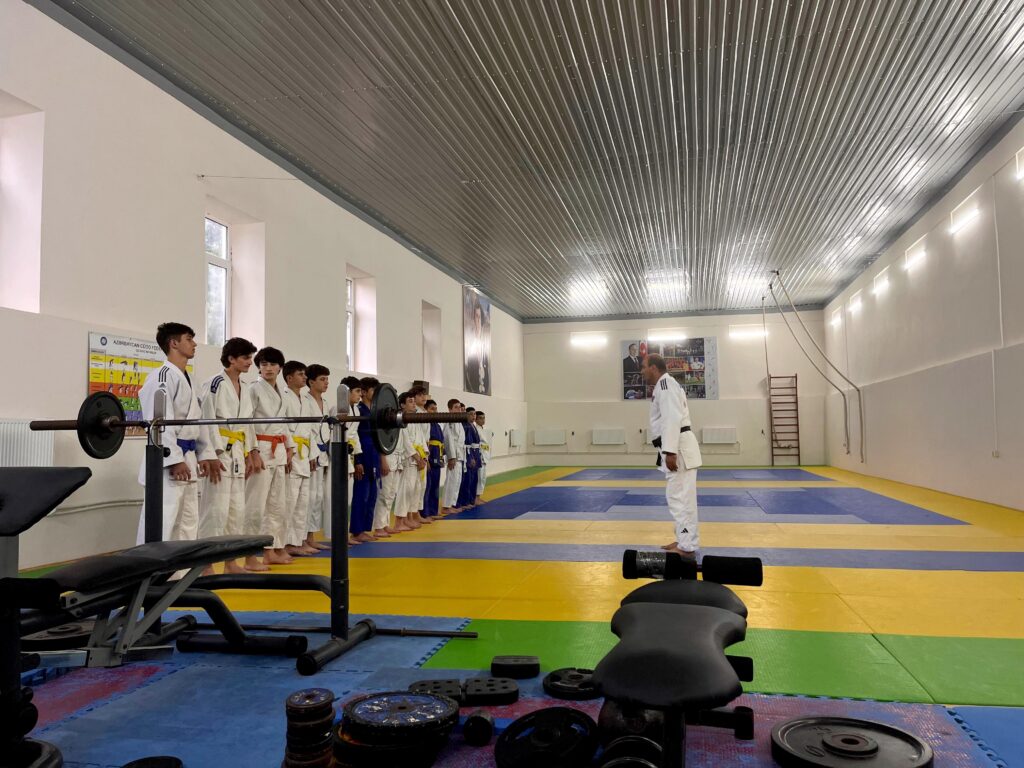
Hajibala also takes me to Gusar Olympic Sports Complex, built in the 1990s. The Azerbaijani Judo Federation has recently had a new dojo built there. Unlike the public sports school, the sections at the complex charge fees. After watching part of the judo session, Hajibala shows me the Greco-Roman wrestling and boxing sections, where training takes place in fairly basic conditions, as well as the swimming pool, whose architecture I find particularly appealing. Motionless, empty and grey, it features large panels depicting diving scenes. The only splashes of colour come from the lane markings and the enormous Azerbaijani flag hanging from the ceiling.
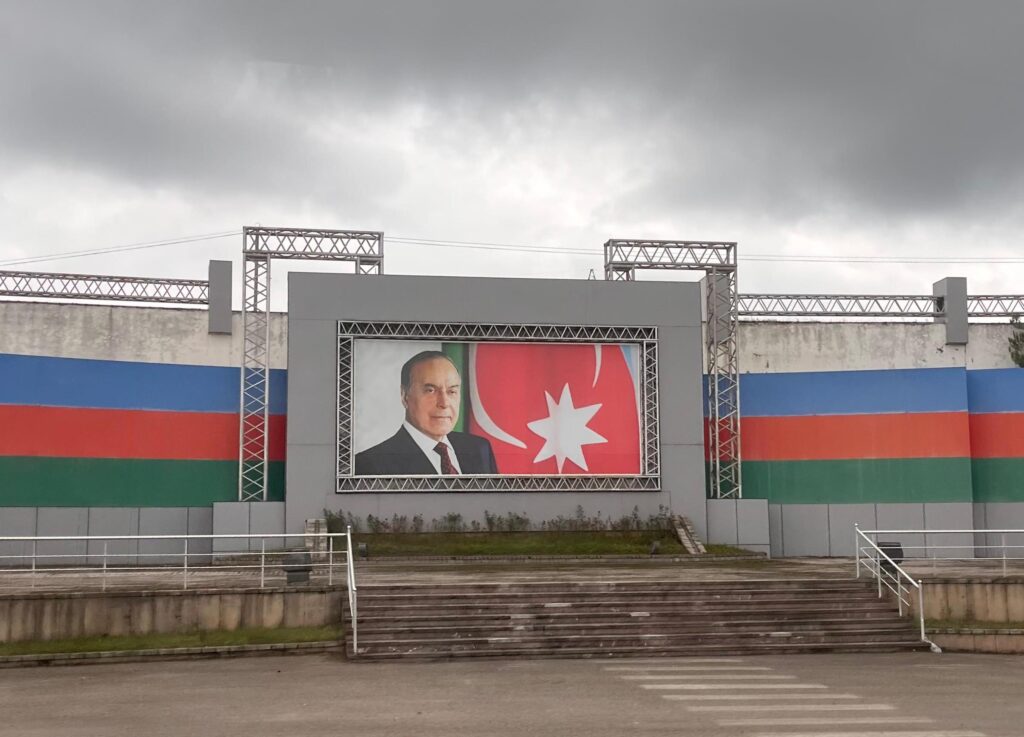
In both facilities – in fact, throughout Azerbaijan’s public spaces – it is impossible to miss the countless portraits of Heydar and Ilham Aliyev. Heydar, Ilham’s father and the country’s current president’s predecessor, headed the KGB from 1967 to 1969, before becoming First Secretary of the Communist Party of the Azerbaijan Soviet Socialist Republic from 1969 to 1976. He was a member of the Soviet Communist Party’s Politburo from 1976 to 1982, then a Deputy Prime Minister of the USSR until 1987, and finally president of post-Soviet Azerbaijan from 1993 to 2003. His son Ilham succeeded him as president two months before his death. Heydar Aliyev is still regarded as the country’s “National Leader” and remains at the centre of numerous commemorations. During my stay, I will see his portrait absolutely everywhere: in sports halls, public buildings, medical practices and alongside deserted roads.
The two days I spend in Gusar end with dinners at restaurants alongside Hajibala and the sports school’s staff. They introduce me to Lezgin culinary specialities – Lezgin is the more conventional French adjective, but I prefer the sound of the Russian version.
Not really understanding Azerbaijani and seriously short on sleep, it takes me several hours to realise that nobody in Gusar actually speaks Azerbaijani: the conversations are taking place in Lezgin. These dinners provide the setting for some interesting discussions about sport, history and religion.
Hajibala complains about the prices charged for the upcoming World Judo Championships. Tickets had been advertised at five manats (€2.50), but in reality prices are much higher. Religion also plays a significant role for some young people and can interfere with judo: a few believe they should bow only before God and refuse to perform the customary bow.
On the second evening, I find myself amused by a conversation. I meet one of the school’s Greco-Roman wrestling coaches and am surprised by his first name: Tigran. We are in Azerbaijan, and that is an… Armenian name.
Hajibala’s professional commitments and the weather prevent him from taking me to a village near the border, where a coach has built a judo hall, or up to Shahdag, the local mountain peak. On the morning of 3 October, I leave rainy Gusar for Baku, only to find that the entrance to my accommodation has been flooded by the rain that has followed me there.
Stage 3/6 – Baku, the first days of the individual competition (3–8 October)
In Baku, I spot advertisements for the judo championships on city buses. Everywhere, there are signs that Baku is the “World Sports Capital” of 2026. Over the past ten years, it has indeed become a genuine sporting city. In 2015, it hosted the inaugural European Games; in 2017, the Islamic Solidarity Games; in 2019, the European Youth Olympic Festival. It has also been a regular stop on the Formula One calendar since 2016.
As far as judo is concerned, the Azerbaijani capital is an annual stop on the World Judo Tour, hosting a Grand Slam since 2013. The city has already staged the World Championships once, in 2018. Anthony was there and tells me that the stands at the National Gymnastics Arena seemed rather sparsely populated at the time. I can confirm that they are now pretty full. Perhaps this is thanks to the extensive advertising campaign across the city and in the local media, but perhaps also because the country has doubled its number of Olympic champions since 2018.
Having bought my tickets rather late, I find that very few seats are left for the first day, and none at all for the second. I only manage to attend the competition thanks to Fariz, who has some spare tickets. On the ticketing app, there is indeed a five-manat option, but it applies to only a small number of seats, all of which have already been snapped up. The remaining tickets range from 20 to 70 manats (€10–35). Once inside, however, nobody seems to pay much attention to their allocated seats.
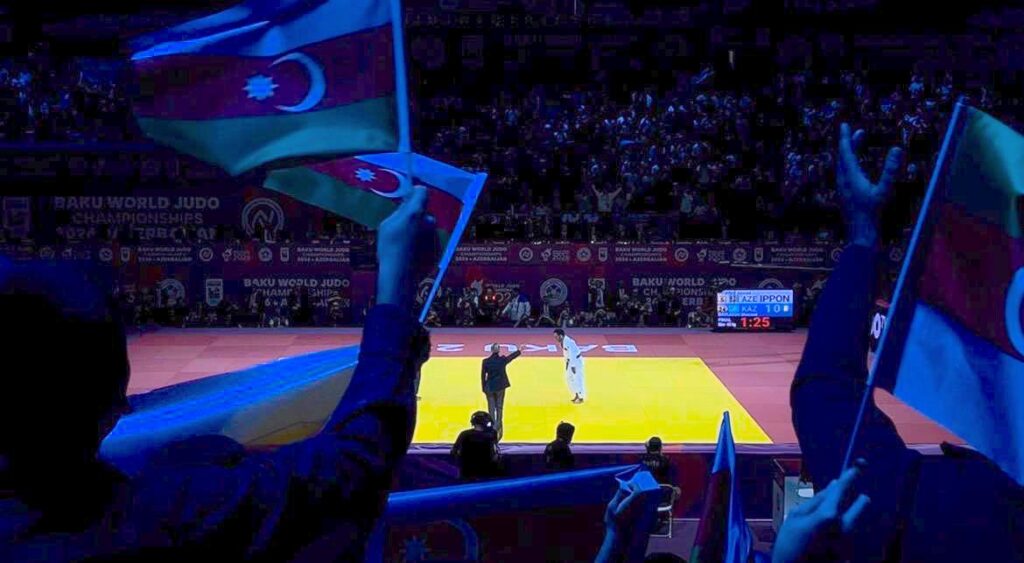
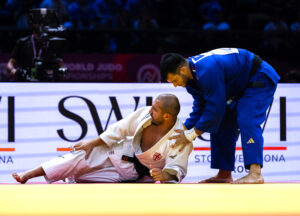
For the first two days, I find myself a rather nice spot with a superb view of Mat 1, where the finals will take place. From here, I watch the opening contests of Balabay Aghayev, the world’s number-one U60 judoka and a representative of the host nation. Unfortunately, he is knocked out in the preliminary rounds by young Jonathan Yang (USA), who scores a fine ippon in golden score.
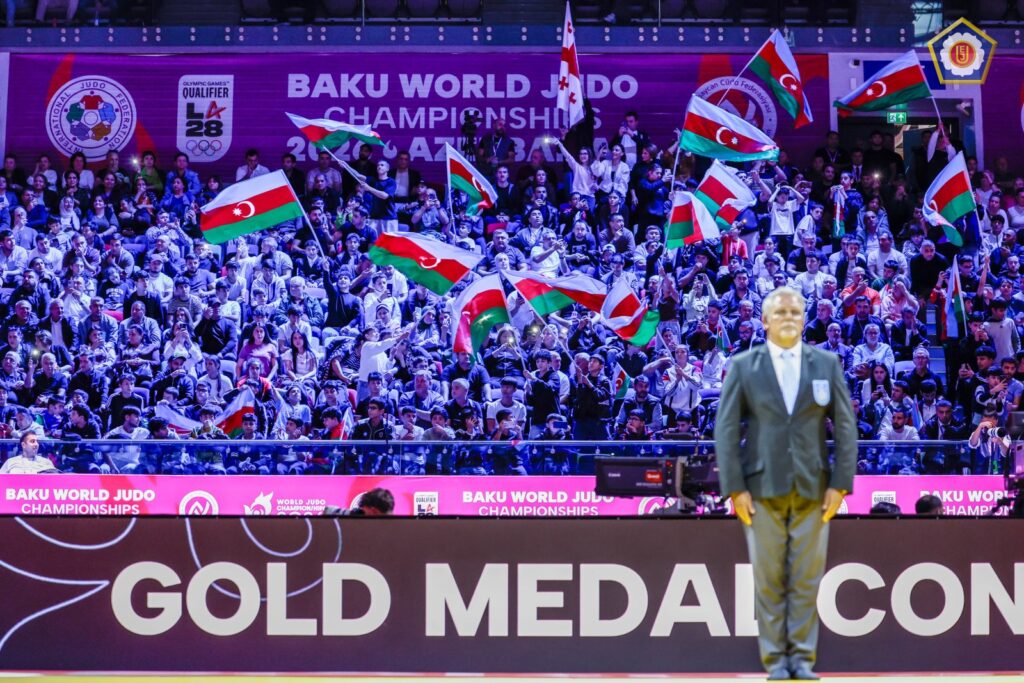
The day nevertheless ends with an Azerbaijani victory: Ahmad Yusifov takes gold against Sherzod Davlatov (KAZ), despite trailing by a waza-ari. When he counters his opponent and then holds Davlatov down, the arena erupts around me. My view of the mat is almost completely blocked by the Azerbaijani flags being waved everywhere. The organisers have indeed handed out large numbers of flags in various sizes. I end up with a little flag of my own (and some Oreos), offered by the children sitting next to me, to whom I had lent my power bank.
Even when there is no world final at stake, the stands are fairly lively. Naturally, whenever an Azerbaijani judoka takes to the mat, local supporters cheer them on, banging drums and blowing air horns. But they sometimes choose to support foreign judoka as well.
Could the encouragement given to Izhak Ashpiz (ISR), facing Giorgi Sardalashvili (GEO), have something to do with the Georgian’s highly controversial victory over Aghayev at the recent European Championships in Tbilisi?
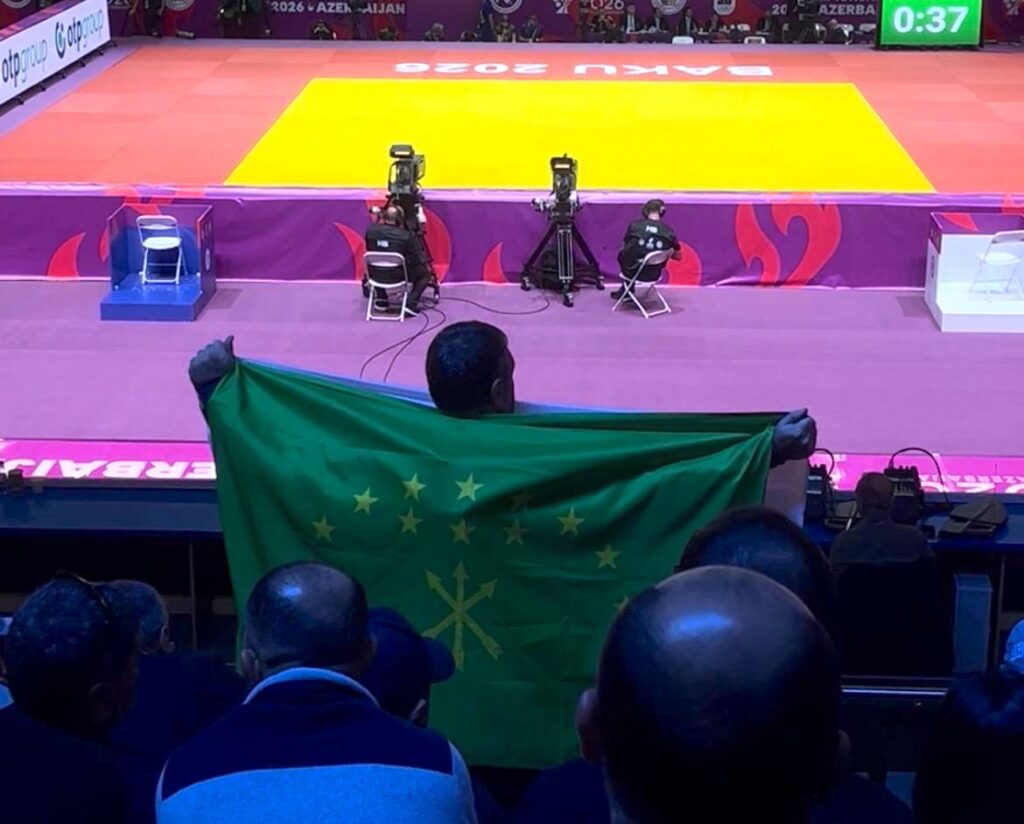
The crowd is, of course, not made up exclusively of local supporters. There are quite a few Georgian flags and, as one might expect in the Caucasus, some flags that an untrained eye would struggle to recognise. Alongside Russian and Azerbaijani flags, a few spectators are also waving Circassian and Ossetian flags.
The Circassian flag, green and decorated with stars and arrows, is carried by a spectator during the contests of Ayub Bliev (RUS, U60), who represents the Kabardian ethnic group, the eastern branch of the peoples known as Circassians in English and French, Cherkess in Russian, and Adyghe by their own name. Bliev eliminates the reigning European champion, France’s Luka Mkheidze, in the opening round.
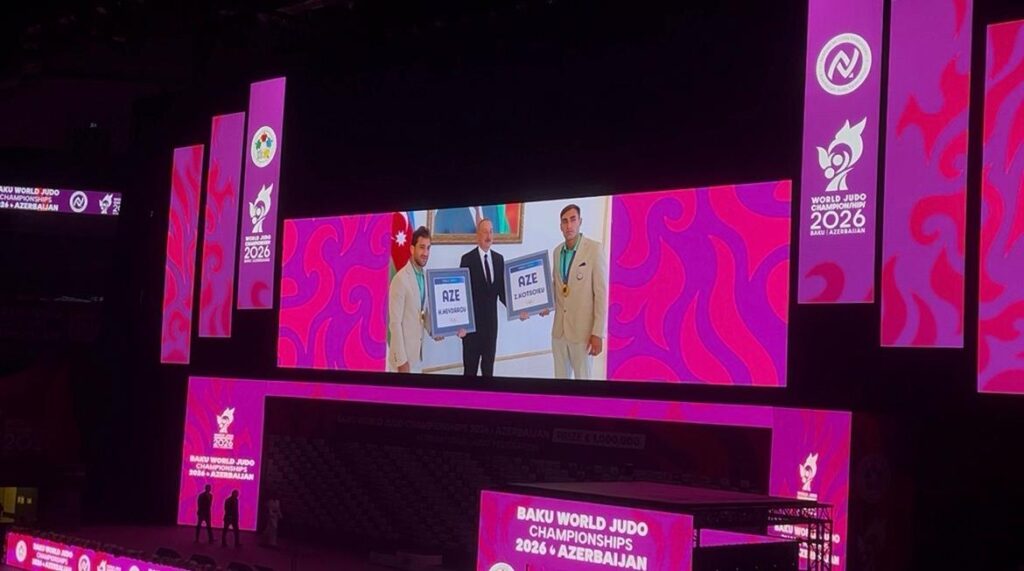
Later in the competition, several Ossetian flags can be spotted. They are there to support six judoka: Zelim Tçkaev (AZE, U81), Zelym Kotsoiev (AZE, U100), Madina Kaisinova (AZE, U70), Theódoros Tselidis (GRE, U90), Madina Taimazova (RUS, U70) and Inal Tsaoev (RUS, O100).
The presence of Ossetians – natives of North Ossetia, and therefore of the Russian Federation – in the Azerbaijani team attracts a number of comments on social media. Some users call them “mercenaries” or “foreign legionnaires” rather than “genuine” representatives of Azerbaijan.
The criticism is not entirely unfounded, and the recruitment of foreign athletes is indeed common in Azerbaijani sport. Besides the Ossetians who previously represented Russia, the judo team also includes Ushangi Kokauri (O100), who formerly competed for Georgia.
The only Olympic medal ever won by Azerbaijani women’s judo is also the achievement of a “foreign legionnaire”: Iryna Kindzerska, who previously represented Ukraine. The same approach can be found in other sports, including wrestling – particularly women’s wrestling. In fact, it is precisely because I know one of the Georgian “foreign legionnaires” on Azerbaijan’s wrestling team that I was persuaded to visit the country.
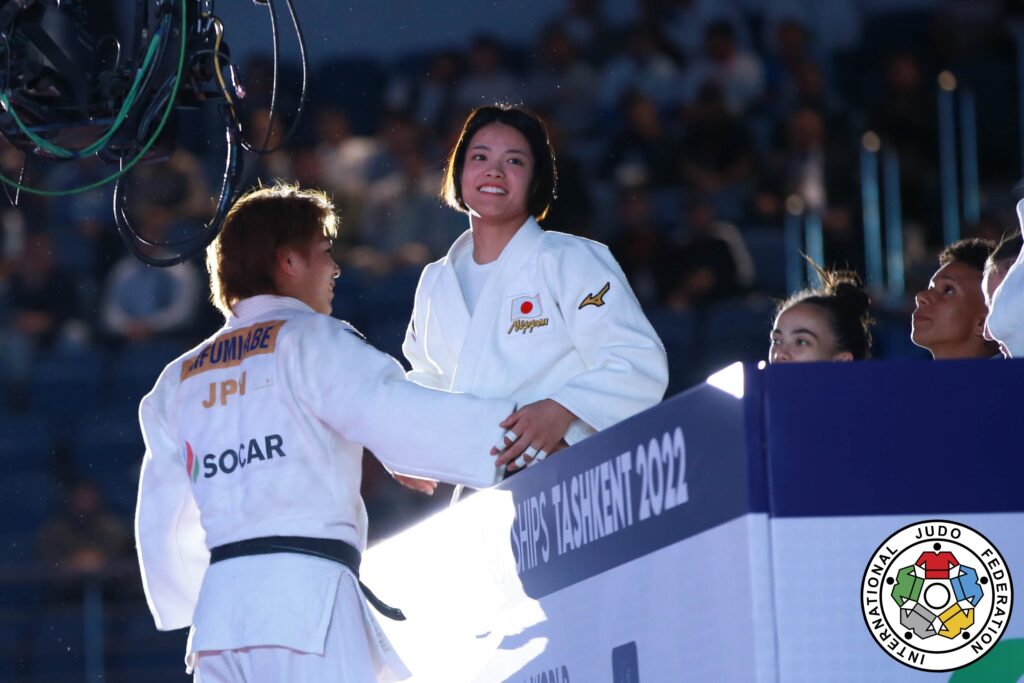
The second day is particularly noisy in the stands because Hifumi and Uta Abe are competing. The entire arena seems to belong to them. Almost the entire arena, anyway. On my left, there is a group of French supporters, including Kelvin Ray, who took Hifumi into golden score in the opening round before receiving a third shido. His entourage seems convinced that if Hifumi looks a little tired on the mat, it is because Kelvin has worn him out.
Perhaps. Hifumi does indeed seem to take a while to get going, winning two contests on penalties and two others without scoring an ippon, before delivering a real beating to David Garcia Torne (ESP) in the final.
And, as it happens, there are Spaniards sitting on my right. Eight years earlier, in this very arena, Spain had claimed its first men’s world title thanks to Nikoloz Sherazadishvili (U90). This year, Garcia Torne misses out, as does Ariane Toro Soler in the women’s final. She faces Uta Abe, who wins on shidos.
In the semi-finals, Uta had already beaten another Spaniard, Ayumi Leiva Sanchez, who also goes on to claim a place on the podium.
In the stands, one of the Spanish supporters manages to persuade two little Azerbaijani boys, armed with air horns, to cheer for “Ari” during her semi-final. She hopes they will continue supporting the Spanish judoka alongside her, but receives an almost outraged look when this means cheering against Uta Abe. And just like that, their brief friendship comes to an end.
The children are simply following the general mood in the arena: the crowd is firmly behind Uta. When, in the quarter-finals, Mascha Ballhaus (GER) throws her and scores a waza-ari with a “Khabareli” (obi tori gaeshi), the stands respond with a fresh burst of anxious encouragement, before calming down when Ballhaus receives her third shido with ten seconds left on the clock.
Uta and Hifumi thus become world champions once again, one after the other on the same day, just as they did for the first time eight years earlier in… Baku.
The second day is also the day of the opening ceremony. It begins with applause for President Ilham Aliyev, who greets us from the VIP stand. We then watch a three-minute film about “the development of sport and judo in Azerbaijan”, made up of archive footage of Azerbaijani sport, particularly the Olympic victories of judoka Nazim Huseynov (1992), Elnur Mammadli (2008), Hidayat Heydarov (2024) and Zelym Kotsoiev (2024). These images are interspersed with footage of Heydar and then Ilham Aliyev inaugurating sports complexes or rewarding athletes.
This is followed by speeches from Rashad Nabiyev, president of the Azerbaijani Judo Federation, and Marius Vizer, president of the IJF. Only then does the ceremony really begin.
It takes the form of a succession of eight performances featuring both traditional and more modern dances. For each performance, a woman wearing an elaborately designed dress stands on a podium. These dresses, created for the ceremony by designer Laman Suleymanova, establish a connection with the National Carpet Museum, dedicated to the art of weaving, which is recognised by UNESCO as part of Azerbaijan’s intangible cultural heritage.
This is also true of one of the dances, which I recognise as kotchari, having seen it many times in Armenia. In Azerbaijan, it is called köçəri. Armenia and Azerbaijan have each had this collective dance inscribed separately, in an attempt to claim exclusive ownership of a cultural heritage that is, in reality, shared by the inhabitants of both countries.
This heritage dispute extends to other things, particularly food. Lavash (flatbread) and dolmas (stuffed vine leaves) are both inscribed on UNESCO’s lists for the two countries, thus extending into the realm of cultural heritage a conflict that has existed between Armenia and Azerbaijan since 1988. Although a peace agreement was signed in 2025, tensions remain.
The absence of Armenian judoka is also worth noting, even if their world rankings offered little hope of qualification. This is all the more striking in a context where Armenian athletes, or athletes of Armenian descent, have often chosen not to compete in Azerbaijan.
In July, however, I had attended the U17 World Wrestling Championships, where the Armenian team was present and young Janes Nazaryan even won gold, with the Armenian national anthem ringing out in Azerbaijan. This was certainly a historic moment.
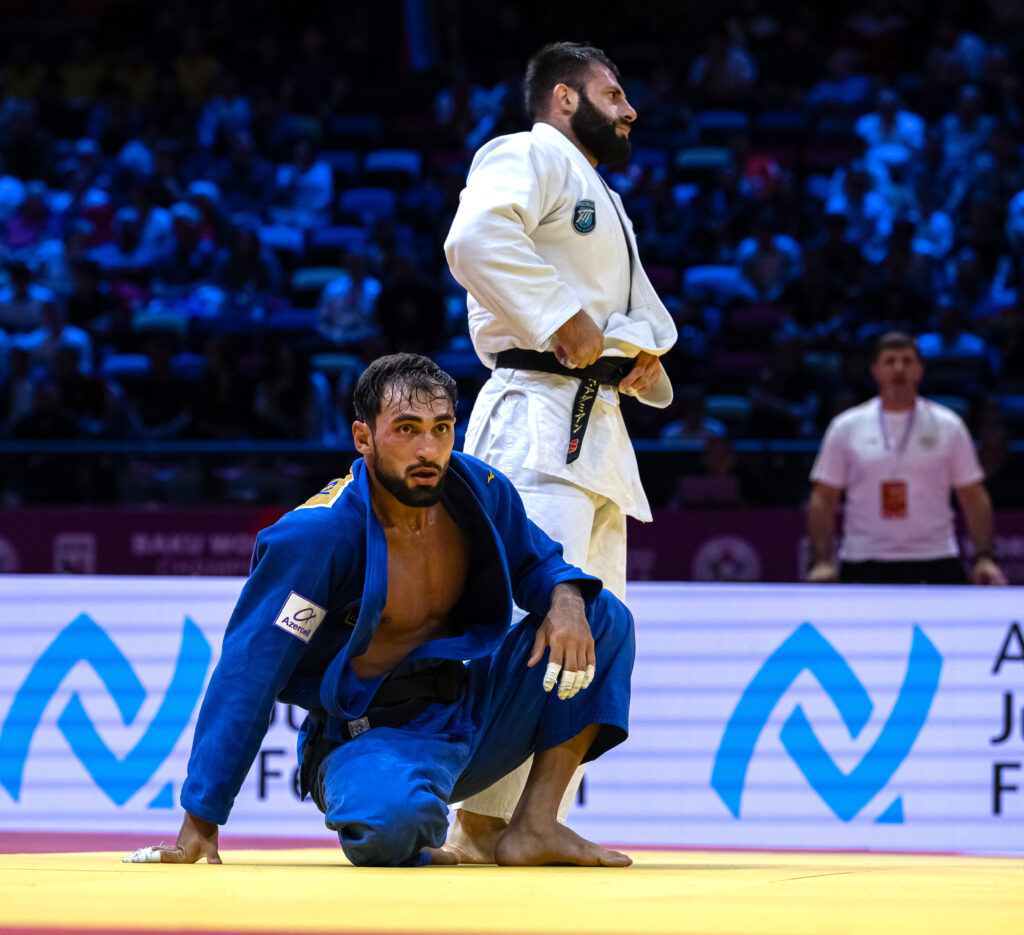
At the judo championships, some competitors are of Armenian descent: Narek Vardanyan (SWE, U73), but above all Arman Adamian (RUS, U100), who eliminates Olympic champion Zelym Kotsoiev (AZE) in the preliminary rounds.
Is the little display of macho posturing that follows linked to the highly questionable yuko awarded to Adamian, to the fact that he has beaten the local favourite, or to the fact that a Russian judoka of Armenian descent has defeated an opponent in Azerbaijan who, although Ossetian, is competing under the Azerbaijani flag?
It is a scene that perfectly illustrates the region’s ethnocultural complexity and the tensions it can sometimes generate.
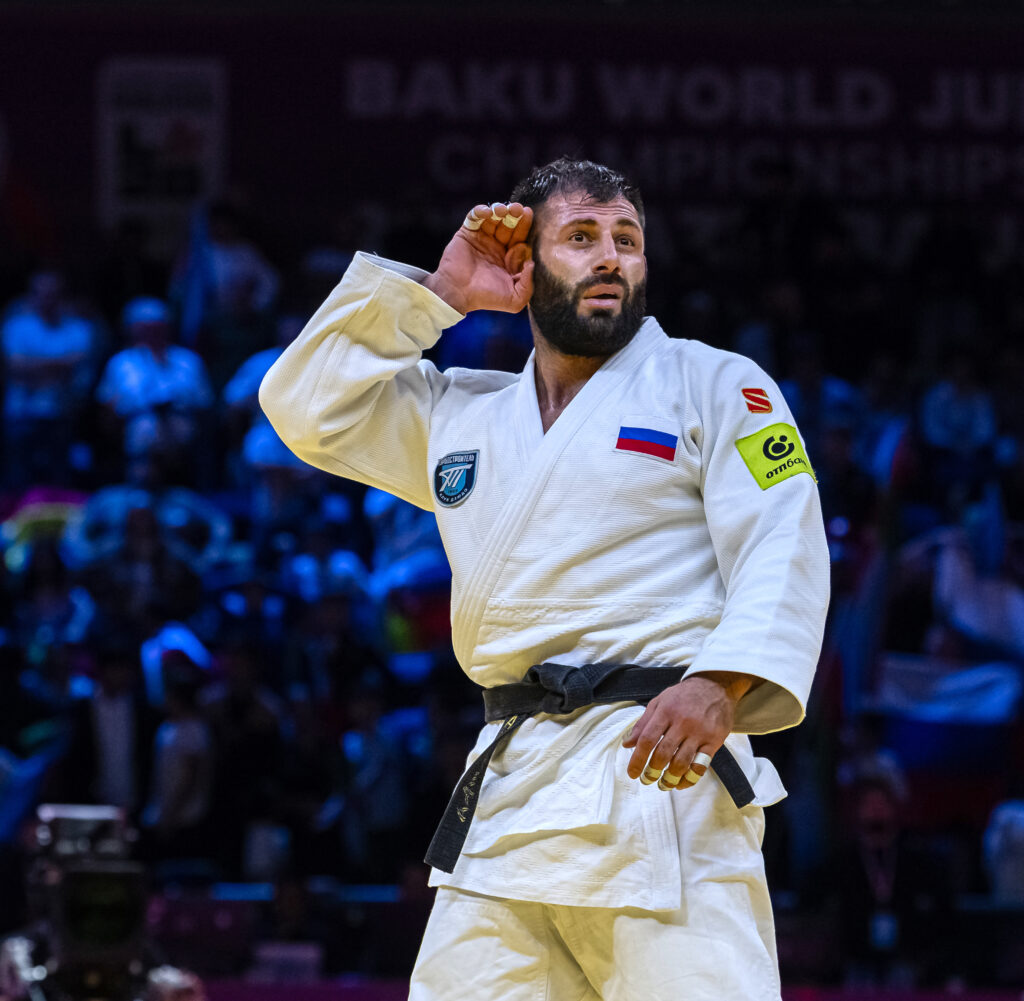
The opening ceremony continues with a beautiful rendition of the Azerbaijani national anthem by a children’s choir, before concluding with a concert by Italian singer Al Bano. Every day, the break in the competition features performances by local artists.
On one of the days I am away, the programme includes a presentation of the Azerbaijani Judo Federation’s work on adapted judo, particularly through a programme launched in 2024. This is part of a broader series of inclusive projects led by the national federation. Another example is the promotion of judo among young girls, in partnership with telecommunications operator Azercell, through a campaign called “White Looks Good on Girls”.
The campaign was intended to persuade parents to swap wedding dresses for judogi – in a country where child marriage remains a problem…
On the third and fourth days, I find another seat in the stands, from where I can see the full length of the arena. I witness the defeat of Azerbaijani – and ethnic Azerbaijani – Olympic champion Hidayat Heydarov (U73), much to the crowd’s dismay.
He nevertheless finds some consolation at the end of the day when another local judoka, Rashid Mammadaliyev, wins bronze. As he leaves the podium after collecting his third-place medal, he spends a little time with the children who have rushed down the stands in the hope of catching his attention. He finds himself at the centre of a sea of young supporters, a sight that makes me smile and causes me to miss our compatriot Dayyan Boulemtafès (FRA) scoring an ippon in his bronze-medal contest.
From this corner of the arena, I also witness the unfortunate moment when Sarah-Léonie Cysique (U57) is carried out on a stretcher, as well as the impressive throws by Eter Liparteliani (GEO), who loses her red back patch in the final against Akari Omori (JPN).
The Georgian supporters get their revenge the following day through Tato Grigalashvili (U81), who wins back the red patch after surrendering it last year to Timur Arbuzov (RUS), who is absent from this championship. While rumours circulate about a possible doping-related exclusion, Arbuzov announces that he has actually decided to move up to U90. Grigalashvili comments that he will go after him there, even though he already occasionally competes in that category with considerable success.
Still from my little corner of the arena, I watch Clarisse Agbegnenou (FRA) make her comeback. Unfortunately, she fails to reach the podium. We are still left wondering whether she, having won everything there is to win, might have been the one capable of ending the remarkable run of Haruka Kaju (JPN), who claims gold for the second time and has remained unbeaten on the international circuit since making her debut at the 2024 Tokyo Grand Slam.
When I am not attending the championships, I take the opportunity to explore Baku again.
Unless you know that Azerbaijan is a former Soviet republic, you would have difficulty guessing it. Unlike Yerevan and Tbilisi, the capitals of its neighbouring countries, Baku has retained relatively few traces of Soviet architecture. The city is now recognised above all for its modern buildings, and people have described it to me as a Caucasian version of “Dubai”.
Indeed, ultra-modern skyscrapers rise along the boulevard, the seafront promenade. They are home primarily to shopping centres, some of which are certainly impressive – the star- or flower-shaped Deniz Mall and the crescent-shaped Crescent Mall – but visiting them holds little appeal for me.
The Martyrs’ Lane attracts me more. It offers a striking contrast between panoramic views of the city and the seafront, the graves of the victims of Black January (the deadly Soviet crackdown in Baku on 20 January 1990), an Ottoman-style mosque from which a particularly beautiful adhan (call to prayer) can be heard, and the Flame Towers, three buildings that light up at night.
The Old City is perhaps the most interesting district, with its narrow streets and old palaces. But it is a small jewel set within an ultra-modern city that, to my taste, lacks a little greenery.
During my walks, I repeatedly come across advertising billboards displaying Ahmad Yusifov’s portrait, already the day after his victory.
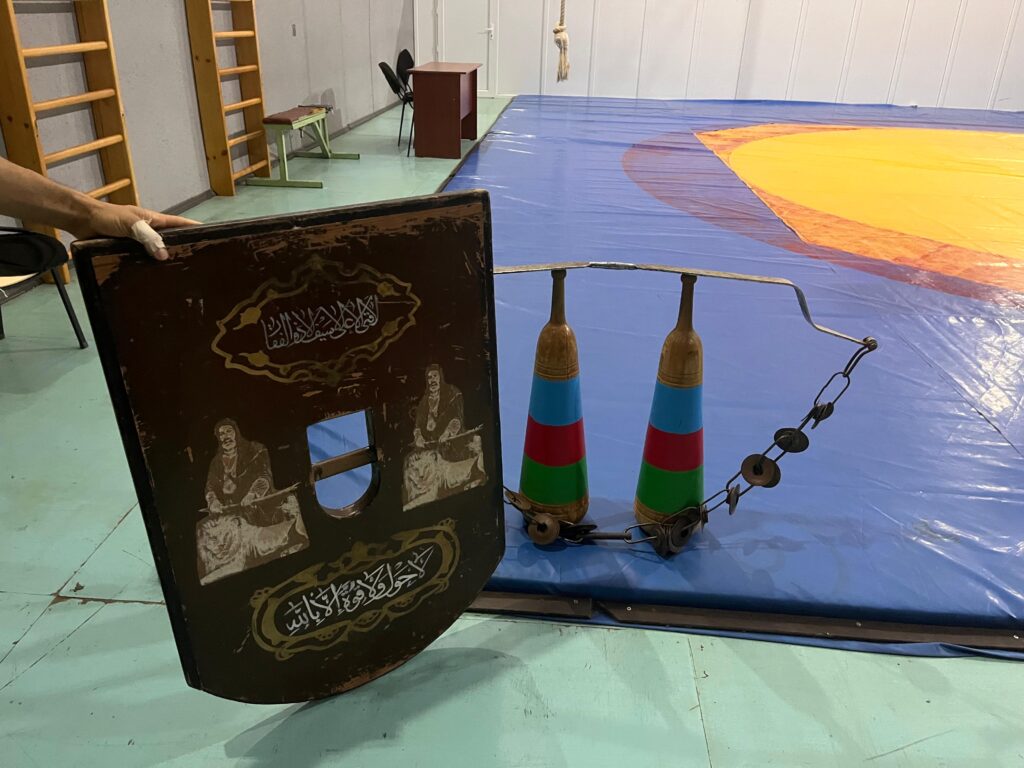
One evening, I am invited by Khayyam Orujov, coach of the national zorkhana team, to discover the instruments used in this discipline at the National Academy of Sport.
Zorkhana is a series of traditional exercises developed when Azerbaijan was part of the Safavid Persian Empire. In Persian, zurkhaneh means “house of strength” and refers to establishments where wrestlers used to train.
The exercises in zorkhana involve various instruments, mastery of which has become an art form in its own right and an independent sporting practice in Iran, separate from wrestling.
Having disappeared from Soviet Azerbaijan, zorkhana is now being developed and revived by Khayyam. Thanks to his efforts, both the discipline and milli güləş, the wrestling style traditionally associated with it, featured at the 2017 Islamic Solidarity Games in Baku and at the World Nomad Games in 2016 and 2026.
On my very first day in Baku, back in July, I had stumbled upon a demonstration of traditional games in the Old City. There, I recognised the miller, the heavy wooden clubs used in zorkhana, and met one of Khayyam’s students.
Stage 4/6 – Ganja (8–10 October)
After five days in Baku, I set off for the country’s second-largest city, Ganja. The bus journey takes around five hours and crosses some rather barren regions. The landscape gradually becomes greener as we approach Ganja. The city announces its presence first through enormous walls on either side of the motorway, followed by a succession of murals depicting works by Nizami Ganjavi, the medieval Persian poet who was born there.
My fellow passenger shares her biscuits with me during the journey, as regularly happens on buses and minibuses in the Caucasus. She gives me advice about what to visit in Ganja, then warns me that taxi drivers at the bus station will try to rip me off because I am a foreigner.
She gets off the bus with me to fend off the drivers who swarm around us as we step outside. Once she has made sure she understands where I need to go, she calls back one of the very drivers she has just argued with and entrusts me to him.
He turns out to be very kind. He apologises for having rushed at us, but explains that this is common practice here because people are poor and need customers.
By the time I have settled in, it is already dark, but I head out to explore the city centre. On the main square, Heydar Aliyev Square, I stumble upon a volleyball festival accompanied by a techno DJ set – quite an unexpected combination.
I continue exploring the following day and get to see the architectural mix of old mosques, a Baroque philharmonic hall and, further from the city centre, the recently built sports complexes.
Along the way, I wander through small streets filled with smoke at lunchtime. Residents have brought out their mangals (Caucasian barbecues) and are grilling kebabs right there in the street.
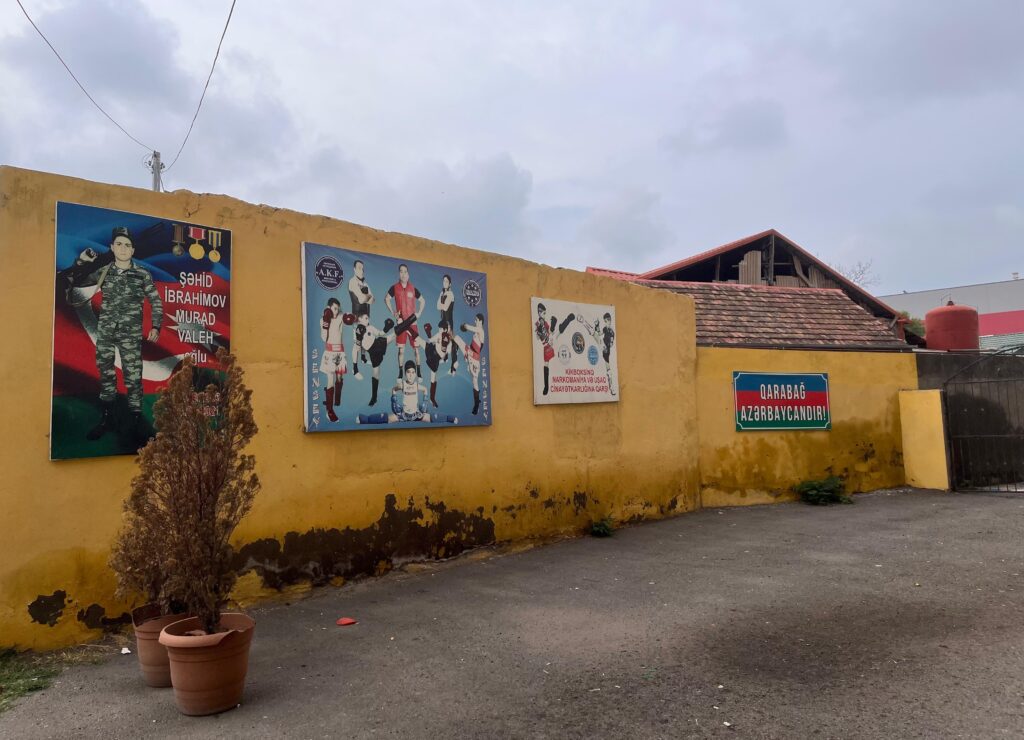
I also come across the entrance to a kickboxing club, where several signs catch my attention. The first reads Qarabağ Azərbaycandır (“Karabakh is Azerbaijan”). Another displays a portrait of a young şahid (a martyr killed in the war, originally from the city and presumably a former member of the club). The last promotes kickboxing as a way of combating drug addiction and juvenile delinquency, a slogan that seems almost lifted straight from the Soviet era.
Although I have received no reply from the Ganja Olympic Complex, I still go and have a look, as well as visiting the brand-new Sports Palace, which opened in 2024.
Once I have photographed the buildings, I decide to explore Heydar Aliyev Park, whose entrance lies between the two sports complexes. The park is enormous and opens onto a vast arch dedicated to the former president, almost as tall as the Arc de Triomphe.
The park gives an impression of immense emptiness: there are more security guards and maintenance workers than people out for a walk, and all the greenery seems to have been trimmed with scissors.
At the far end stands the Heydar Aliyev Cultural Centre, complete with its statue of the former president. A building and statue that can be found in every Azerbaijani city.
Stage 5/6 – Baku, the mixed team event (10–12 October)
After this brief visit to Ganja, I return to Baku to attend the final day of competition, the mixed team event.
I witness France’s premature elimination, after the team had become accustomed, until just two years ago, to reaching the final against Japan almost as a matter of course.
Here, the French lose to Russia, then to Georgia.
The repechage match is surprising to watch from the stands. France are leading Georgia 3–1, despite two Georgian athletes being visibly injured, when Eter Liparteliani levels the score with an extremely quick victory over Martha Fawaz.
I film the contest in a wide shot, which allows me to capture not only the action but also Sopho Somkhishvili, who appears to have injured her hip and is receiving treatment on the floor, and Lasha Bekauri, limping on his injured knee.
Unfortunately for him, it is his U90 category that is drawn to decide the tie. He defeats Aleksa Mitrovic, whose medical history – seven operations on his cruciate ligaments – very probably explains his reluctance to press Bekauri too hard, despite having thrown him rather beautifully at the beginning of their first encounter just a few minutes earlier.
As Mitrovic tentatively attempts something resembling a kata guruma, Bekauri counters him, gets back to his feet and returns to his place hopping on one leg. The scene is almost surreal.
He then leaves the arena carried by his teammates, to applause from the crowd.
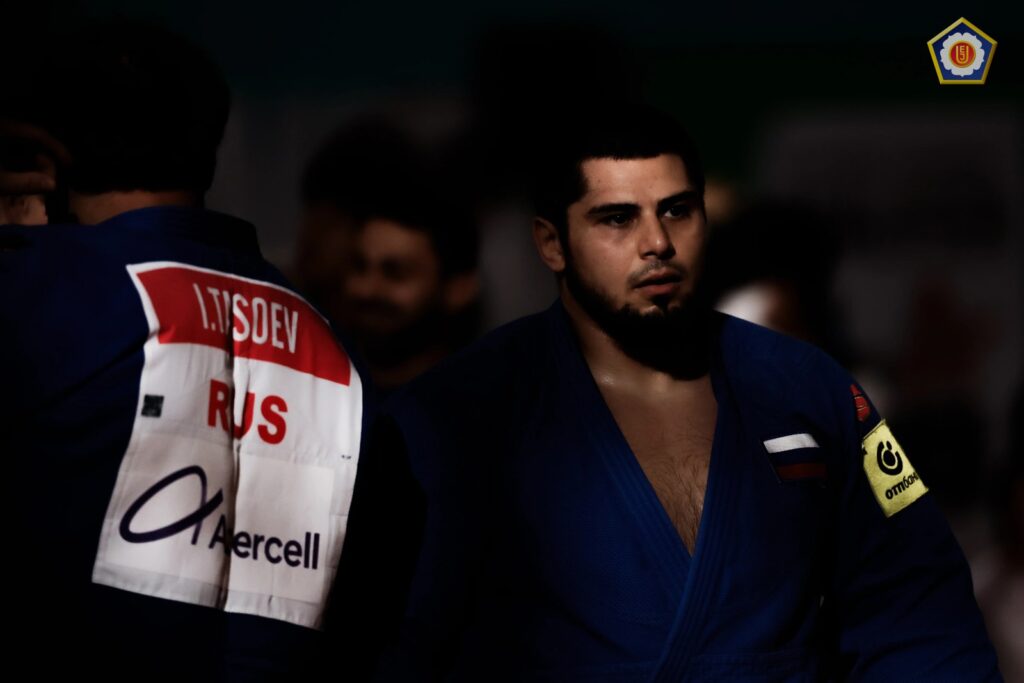
As expected, Japan eventually wins the event, defeating Russia. The Russians’ only victory comes from Tamerlan Bashaev, whom I finally get to see compete in person.
His cousin, whom I know well, tells me I should go and see him, as she has mentioned me to him. But even if I had access to the athletes, I do not stay for the final. I have been invited to a restaurant by friends and need to get back to prepare for my departure to Astara the following day.
Stage 6/6 – Astara, on the Iranian border (12–15 October)
As I am about to leave for Astara, I notice that I am having trouble accessing my social media messages. I have time to investigate during the bus journey: a few days earlier, the Azerbaijani government had adopted a ban on wearing the hijab in schools, with pupils and teachers wearing it being denied access to educational establishments.
Several demonstrations have taken place, people have been detained, and access to social media is now restricted.
Fortunately, I have a VPN, and I am leaving Baku behind.
The landscape around the capital is extremely barren, broken up only by a few enormous industrial complexes, cement works and oil and gas refineries. It becomes progressively greener as we head south, towards Lankaran, where the landscape turns subtropical and mandarins, kiwis and pomegranates grow.
Astara lies about thirty kilometres south of Lankaran, on the Caspian Sea. The town is divided in two by the border: one part is in Azerbaijan, the other in Iran.
I have the whole of my first day in Astara free, so I decide to see what the border looks like. To get there, I walk four kilometres from my hotel through the town.
The outskirts are somewhat run-down, as is the town beach. Eventually, I reach the boulevard, the landscaped seafront, which ends close to the border at a wall.
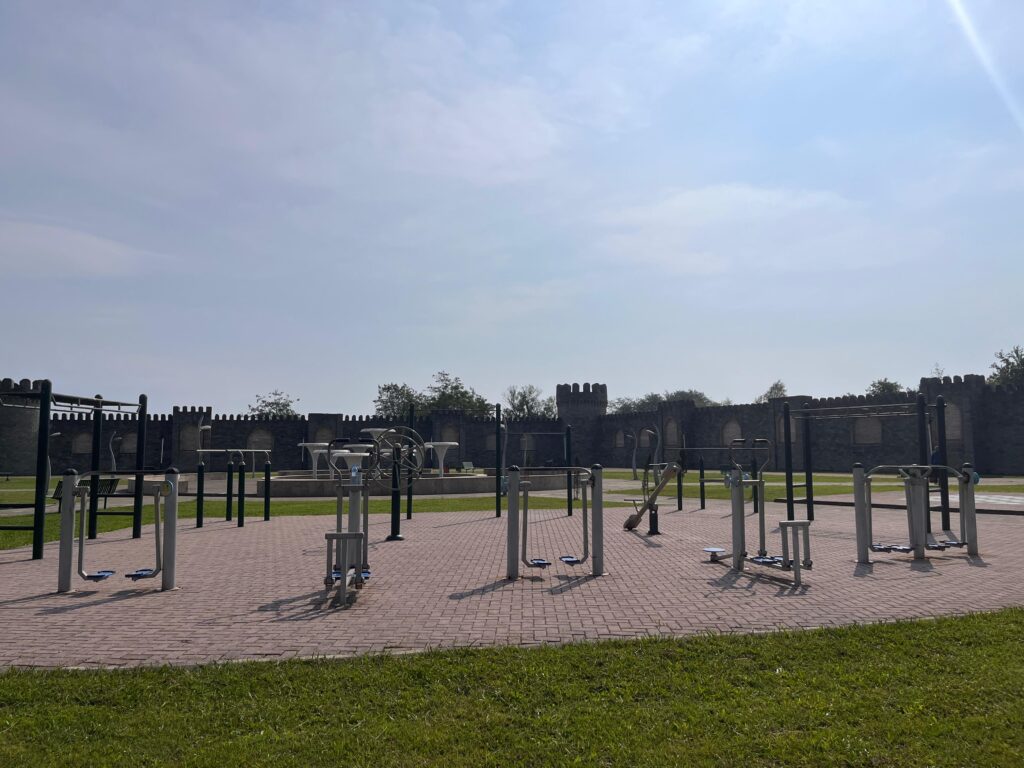
I follow it until I find myself in a small park, between the border-crossing car park, where I can see trucks waiting, and the wall, behind which a watchtower is visible.
In this austere and slightly threatening environment, the park nevertheless has street workout equipment and a children’s playground.
The rest of the town is much like other provincial Azerbaijani towns: a street bazaar, a square with its statue and Heydar Aliyev Cultural Centre, old Ladas and an Olympic sports complex.
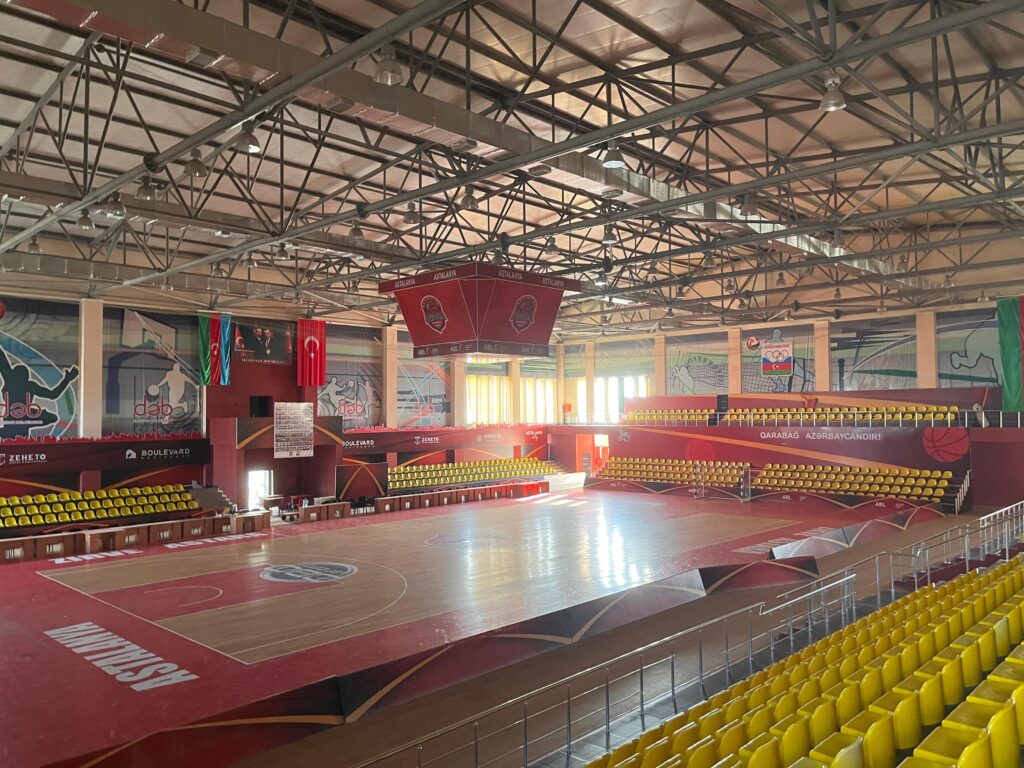
The Olympic complex is on the outskirts of town. To get there, I have to walk along dirt roads, weaving between livestock and free-roaming geese.
I am welcomed at the complex by Loghman Aghayev, a freestyle wrestling coach. He is extremely friendly and shows me around the complex, including its wrestling and judo sections.
As in other Olympic complexes, the national Judo Federation has established a section here as part of its efforts to popularise judo in the provinces following the 2024 Olympic Games.
These sections are financially independent of the complexes themselves and simply rent space there. The coaches are paid by the Federation, not by the complex. Unlike the judo section, the wrestling sections are free of charge.
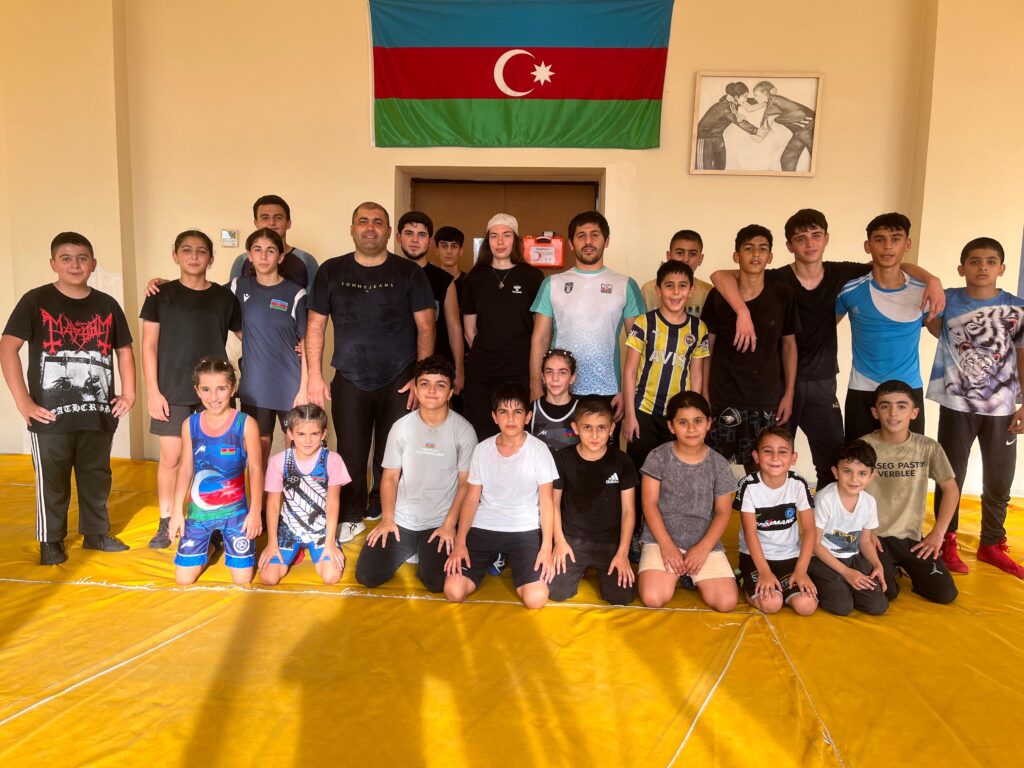
After the tour, I am invited to watch a wrestling session led by Loghman and his colleague Samir.
For the first time on my expeditions through Caucasian wrestling halls, I find myself looking at a fully-fledged women’s wrestling section: of the roughly twenty students, almost a third are girls.
Loghman explains in considerable detail the particular challenges of his work with women’s wrestling in the Caucasus, in a Muslim-majority country and just a few hundred metres from the Iranian border.
He introduces me to a young girl whom he tells me used to wear the hijab. She first became interested in wrestling after accompanying her younger sister to training, and decided to take it up herself, initially wearing the hijab and later without it.
This year, she is the Azerbaijani national runner-up in her age group.
With a section that only opened in 2021, Loghman has already managed to send several female wrestlers to the U15 and U17 European and World Championships.
After this visit to Astara, my stay in Azerbaijan comes to an end. The local wrestling section is the last one I visit as part of my doctoral fieldwork. The end of this research trip is somewhat eventful. Getting back to Baku and then to Samtredia proves rather complicated: there are no buses from Astara, I have to negotiate in Azerbaijani with a taxi driver to get to Lankaran, then take a minibus to Baku.
At the Azerbaijani border, an officer questions me about my lack of administrative registration, which is required for stays of more than fifteen days. I have stayed exactly fifteen days. Then comes a flight to Tbilisi, followed by an arrest by Georgian customs officers, who find it extremely suspicious that I should say I live in Samtredia and have… dates in my bag. Finally, I negotiate with a minibus driver travelling to Batumi to drop me off along the way in Samtredia. Once back home, I can finally get on with writing my thesis. My observations in Azerbaijan will help complete the third part of my research into the South Caucasus. – Tiphaine Gingelwein, autumn 2026, for JudoAKD.
A French version of this diary is available here.
More articles in English:
-
- JudoAKD#001 – Loïc Pietri – Pardon His French
- JudoAKD#002 – Emmanuelle Payet – This Island Within Herself
- JudoAKD#003 – Laure-Cathy Valente – Lyon, Third Generation
- JudoAKD#004 – Back to Celje
- JudoAKD#005 – Kevin Cao – Where Silences Have the Floor
- JudoAKD#006 – Frédéric Lecanu – Voice on Way
- JudoAKD#009 – Abderahmane Diao – Infinity of Destinies
- JudoAKD#008 – Annett Böhm – Life is Lives
- JudoAKD#010 – Paco Lozano – Eye of the Fighters
- JudoAKD#011 – Hans Van Essen – Mister JudoInside
- JudoAKD#021 – Benjamin Axus – Still Standing
- JudoAKD#022 – Romain Valadier-Picard – The Fire Next Time
- JudoAKD#023 – Andreea Chitu – She Remembers
- JudoAKD#024 – Malin Wilson – Come. See. Conquer.
- JudoAKD#025 – Antoine Valois-Fortier – The Constant Gardener
- JudoAKD#026 – Amandine Buchard – Status and Liberty
- JudoAKD#027 – Norbert Littkopf (1944-2024), by Annett Boehm
- JudoAKD#028 – Raffaele Toniolo – Bardonecchia, with Family
- JudoAKD#029 – Riner, Krpalek, Tasoev – More than Three Men
- JudoAKD#030 – Christa Deguchi and Kyle Reyes – A Thin Red and White Line
- JudoAKD#031 – Jimmy Pedro – United State of Mind
- JudoAKD#032 – Christophe Massina – Twenty Years Later
- JudoAKD#033 – Teddy Riner/Valentin Houinato – Two Dojos, Two Moods
- JudoAKD#034 – Anne-Fatoumata M’Baïro – Of Time and a Lifetime
- JudoAKD#035 – Nigel Donohue – « Your Time is Your Greatest Asset »
- JudoAKD#036 – Ahcène Goudjil – In the Beginning was Teaching
- JudoAKD#037 – Toma Nikiforov – The Kalashnikiforov Years
- JudoAKD#038 – Catherine Beauchemin-Pinard – The Rank of Big Sister
- JudoAKD#039 – Vitalie Gligor – « The Road Takes the One Who Walks »
- JudoAKD#040 – Joan-Benjamin Gaba and Inal Tasoev – Mindset Matters
- JudoAKD#041 – Pierre Neyra – About a Corner of France and Judo as It is Taught There
- JudoAKD#042 – Theódoros Tselídis – Between Greater Caucasus and Aegean Sea
- JudoAKD#043 – Kim Polling – This Girl Was on Fire
- JudoAKD#044 – Kevin Cao (II) – In the Footsteps of Adrien Thevenet
- JudoAKD#045 – Nigel Donohue (II) – About the Hajime-Matte Model
- JudoAKD#046 – A History of Violence(s)
- JudoAKD#047 – Jigoro Kano Couldn’t Have Said It Better
- JudoAKD#048 – Lee Chang-soo/Chang Su Li (1967-2026), by Oon Yeoh
- JudoAKD#050 – Hermann Monne – Burkina, a Land Already Peopled
- JudoAKD#051 – Mariana Esteves – A Chronicle of Life Passing By
- JudoAKD#052 – Tiphaine Gingelwein – Chechnya and the Caucasus, a Feminine Perspective in Nuance and Complexity
- JudoAKD#053 – Victor Scvortov – Born Again Under a Lucky Star
- JudoAKD#054 – Eric Gervasoni – From Moves to Movies
- JudoAKD#055 – Mihael Žgank – Coming Home Is Where the Real Journey Starts
- JudoAKD#056 – Patrick Grosperrin – Laterality, a Little-Known Lever of Performance
- JudoAKD#057 – Rest in Peace, René Nazaret (1936-2026)
- JudoAKD#058 – Alexandre Paysan – We Saw Him in the Vercors, Bungee Jumping…
- JudoAKD#059 – Habib Alouache – Teaching Joy
- JudoAKD#060 – Diyora Keldiyorova – Another Giant Leap for (Wo)Mankind
- JudoAKD#061 – Angelika Szymańska – With the Restraint of Those Still on Their Way
- JudoAKD#062 – Valentin Ménard – The Click (That Moment When Champions Just Know)
- JudoAKD#063 – Loïc Pietri (II) – “Talking Is for Laughs. Doing Shuts People Up.”
- JudoAKD#064 – Two Stories of Judo and Empathy
Also in English:
- JudoAKDReplay#001 – Pawel Nastula – The Leftover (2017)
- JudoAKDReplay#002 – Gévrise Emane – Turn Lead into Bronze (2020)
- JudoAKDReplay#003 – Lukas Krpalek – The Best Years of a Life (2019)
- JudoAKDReplay#004 – How Did Ezio Become Gamba? (2015)
- JudoAKDReplay#005 – What’s up… Dimitri Dragin? (2016)
- JudoAKDReplay#006 – Travis Stevens – « People forget about medals, only fighters remain » (2016)
- JudoAKDReplay#007 – Sit and Talk with Tina Trstenjak and Clarisse Agbégnénou (2017)
- JudoAKDReplay#008 – A Summer with Marti Malloy (2014)
- JudoAKDReplay#009 – Hasta Luego María Celia Laborde (2015)
- JudoAKDReplay#010 – What’s Up… Dex Elmont? (2017)
- JudoAKDReplay#011 – Zakopane, or Lives Passing By (2017)
- JudoAKDReplay#012 – Thierry Frémaux (1/2) – About The Legend of the Great Judo(2016)
- JudoAKDReplay#013 – Thierry Frémaux (2/2) – Judo in the Light (2021)
And also :
- JudoAKDRoadToLA2028#01 – Episode 1/13 – Summer 2025
- JudoAKDRoadToLA2028#02 – Episode 2/13 – Autumn 2025
- JudoAKDRoadToLA2028#03 – Episode 3/13 – Winter 2026
- JudoAKDRoadToLA2028#04 – Episode 4/13 – Spring 2026
- JudoAKDRoadToLA2028#05 – Episode 5/13 – Summer 2026
JudoAKD – Facebook – Instagram – X (Twitter).