Born respectively on 6 January 2022 in Nice and 11 August 1987 in Dijon, the Frenchmen Aleksa Mitrovic and Cyrille Maret found themselves, in spite of themselves, the foils in two moments as heroic as they were cruel, depending on one’s perspective: on 11 October 2026 in Baku (Azerbaijan) in the U90 kg category, and on 29 August 2015 in Astana (Kazakhstan) in the U100 kg category. Their opponents on the day, the Georgian Lasha Bekauri and the Belgian Toma Nikiforov, were unanimously celebrated on the spot for their courage and resilience, embodying better than anyone the famous hashtag #NoPainNoGain, which is to the twenty-first century what the raw egg swallowed before a dawn jog was to Rocky Balboa’s seventies.
In the detail of how the fights unfolded, though, the mental mechanics at work are more complex than they appear. Reflecting on the Astana 2015 trauma, Thierry Dibert, one of Cyrille Maret’s club coaches at the time, once gave us this key to understanding it: “Astana offended him, because he’s a good guy and, to win that medal, he would have had to betray in his attitude certain principles that structure not only the judoka but above all the man he is. […] He’s a nice guy who learned to force his nature to go after the record he deserves.” A look back at two “shipwrecks” which, between the lines, also remind us that some inner compasses go beyond the stakes of victory and defeat, ennobling the latter, even if those concerned will only truly grasp it long after their careers. – JudoAKD#064.
A French version of this article is available here.
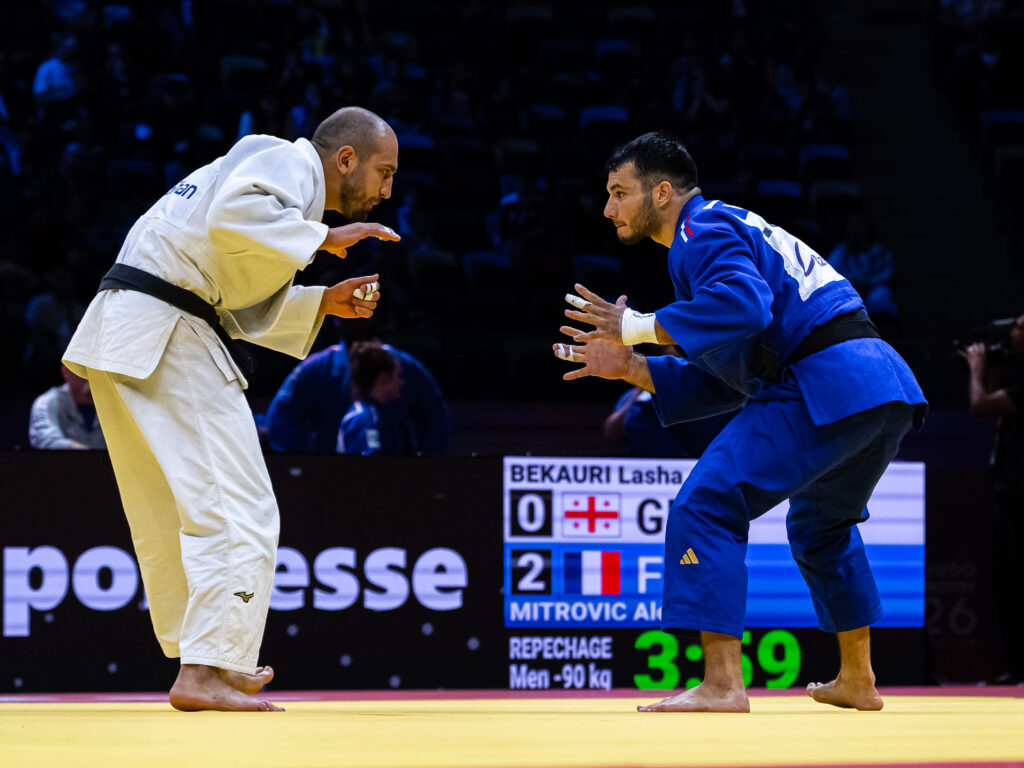
Baku, Azerbaijan, 11 October 2026. As he steps onto the mat this Sunday in the repechage of the mixed team event against the reigning double Olympic champion Lasha Bekauri, the Frenchman Aleksa Mitrovic is starting his ninth fight of the week, and his thirty-ninth (!) since April.
Seventh on Thursday in the U90kg category, the world number 65 had successively eliminated world numbers 13, 6 and 10 before losing in the quarter-finals to world number 3, then in the final seconds of a repechage fight that seemed in his hands, against world number 11. A bittersweet epic which, at twenty-four, had the air of a rebirth for a fighter who has already undergone seven cruciate ligament operations.
As he steps up this Sunday against Lasha Bekauri, then, France leads Georgia 2-0. But it is already the fourth fight of the day for the Stakhanovite Frenchman, a swift winner in the morning against Kazakhstan, then beaten twice in the quarter-finals by his Russian counterpart: the first time by tapping out to a hold-down, the second to a flick of a technique in the deciding fight that settled their U90 kg category and separated the two teams, then tied at three wins apiece.
Lasha Bekauri, for his part, is infinitely fresher. Absent from the circuit since April and his fifth place at “his” European Championships in Tbilisi against Maxime-Gaël Ngayap Hambou, he took the time to treat a wrecked shoulder and fought “only” three individual bouts in Baku, surprised by the mastery of the defending champion and eventual winner, the Japanese Sanshiro Murao.
On his very first grip on the sleeve, the Georgian sidesteps a ura-nage attempt by the Frenchman and drops him onto his side with o-soto-gari. The waza-ari is beyond dispute. The problem: as he gets back up, Bekauri grimaces. He lifts his trouser leg and grabs his right knee. Something has just given way there. The man is known to be tough against pain, and everyone understands he is not faking.
Bekauri carries on regardless. On the next sequence, Mitrovic’s left arm makes him collapse. The Georgian clutches his knee again. His gaze is elsewhere, worried. He carries on anyway, limping. He clings to the ends of the sleeves and keeps his hips as far away as possible so as not to expose himself to the hip movements the Frenchman favours. He collapses again, flat on his stomach. Receives a legitimate shido.
The next sequences bring the two fighters closer and closer to those clinches where each knows he can be decisive. The third is almost the right one for the Frenchman, who hooks and flips his rival. Waza-ari for the referee, even though Eteri Liparteliani, pacing at the edge of the mat, briefly holds her head in her hands, believing the action was worth ippon against her teammate.
Back against the wall, Bekauri then returns to his scales. A left hand to grab Mitrovic’s (too) loose right arm. And a right hand that gnaws handful by handful into the Frenchman’s back until it seizes his belt and sets off one of those trademark o-goshi maki-komi, ample and invincible, fit to be displayed on billboards in the streets of Tbilisi or on the flyers for his next seminars. Ippon.
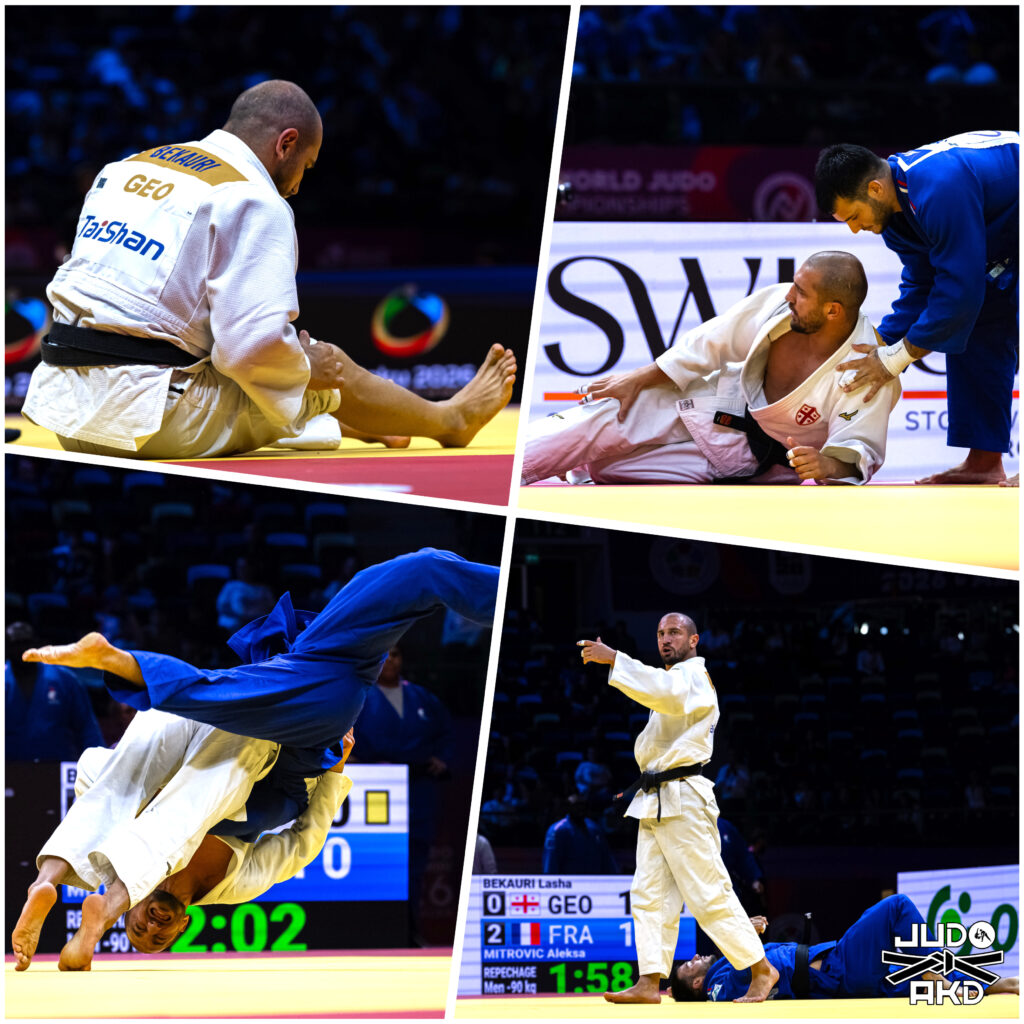
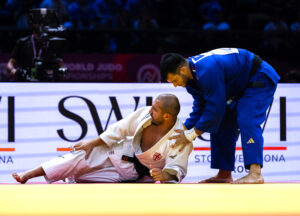
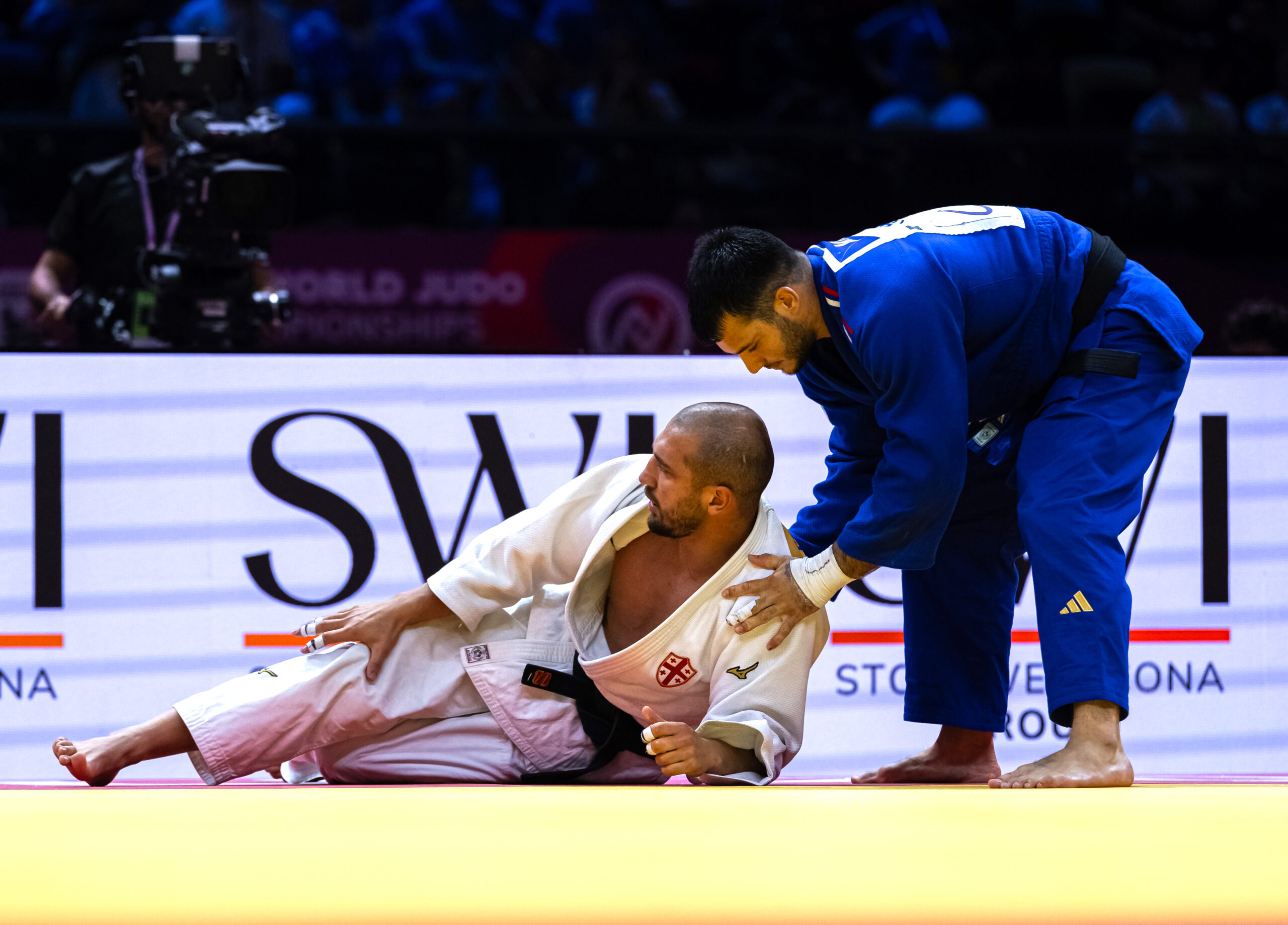
The Frenchman is dazed. The Georgian, meanwhile, harangues his teammates, upright as a rooster, one finger on the flag embroidered over his heart. He limps back into place, shakes his beaten opponent’s hand and passes the baton to his teammate, the O78 kg Sophio Somkhishvili… who, she too, will leave her fight against the Frenchwoman Léa Fontaine clutching her leg.
End of Act One.
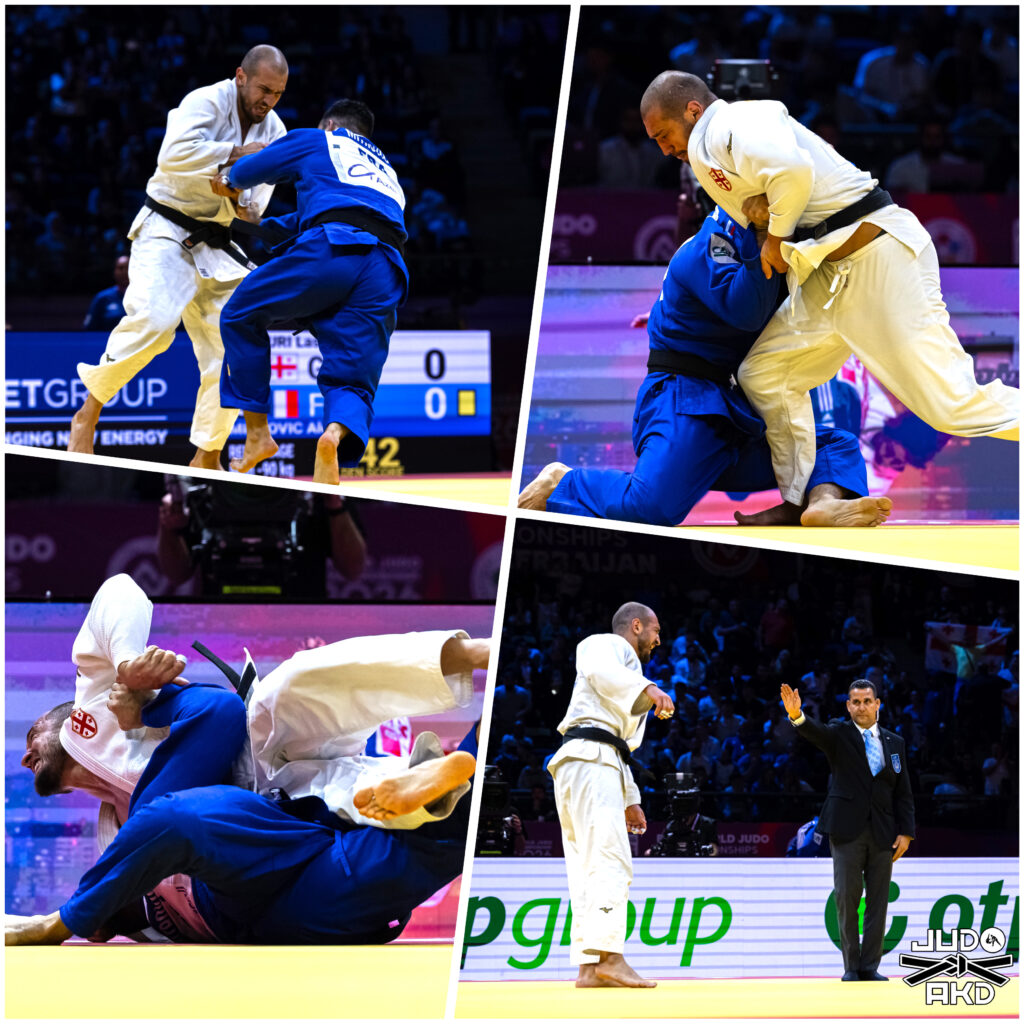
A few minutes later, the two teams are at 3-3. As against Russia in the previous round, they must go through the electronic roulette to separate them. And as against Russia, where he had been called back – and beaten a second time – against his U90 kg counterpart Mansur Larsanov, Aleksa Mitrovic is designated once again. And once again it is Lasha Bekauri who stands before him.
The double Olympic champion could have withdrawn and spared his knee for the rest of his season, even his career. That is to misunderstand the pain-embracing relationship to performance of the twenty-six-year-old gladiator. More Rambo than Rimbaud, he crosses himself and steps forward. Opposite him, the Frenchman is pale. His moral dilemma is written on his face. Must he play to win at full force, even if it means worsening his rival’s injury? Or must he hold back, winning fairly, or at least without leaning on his opponent’s weaknesses?
This tension is as old as the world. At the 1989 French Open, world number 1 Ivan Lendl has a thousand chances to “kill” his young rival Michael Chang, riddled with cramps at the start of the fifth set of their round of sixteen. Yet something inside him stops him from doing it. He holds back his shots like a vegetarian bullfighter, letting his opponent, twelve years his junior, switch his brain into survival mode. And against all odds, after 4 hours 27 minutes of battle, it is the seventeen-year-old American who comes out on top – even going on to lift the trophy six days later.
The same at the 1996 US Open. Seized by vomiting during the deciding tie-break of the fifth set of his quarter-final against the Spaniard Alex Corretja, the American Pete Sampras manages to save a match point and then win while barely standing, also taking the tournament a few days later – against… Michael Chang.
If the press of the day made a meal of those feats, very few took an interest in the inner brakes that led the two losers to hold back their shots. Those moral prohibitions – “Don’t hit a man who is down”, that kind of safeguard – which durably structure a person and hold them back on the big day, as was probably the case both times.
In judo, the most famous precedent remains that of 11 August 1984, when at the Los Angeles Olympics the Japanese Yasuhiro Yamashita won the title on one leg, helped both by his unique aura and by the categorical refusal of his Egyptian opponent Mohamed Ali Rashwan, sometimes linked to religious convictions, to lean on the injured leg to build a victory that would have prevented him, for life, from sleeping soundly.
Closer to us, on 2 August 2012, the U100 kg final at the London Olympics remains one of the rare cases of an athlete, here the Russian Tagir Khaibulaev, managing to disregard the serious knee injury of his rival, the Mongolian defending champion Tuvshinbayar Naidan – who would hide it as best he could on the mat, though everyone in the warm-up room remembers his inability to put one foot in front of the other after his semi-final – not only to avoid aggravating it but above all to land his speciality on him, a textbook sode-guruma.
Baku 2026, then. First to score wins, whatever the value of the score. Better a sudden death than a death suffered. Bekauri concentrates on the hands, Mitrovic on the movement. The sequences follow one another. Every matte he forces is already a victory for the Georgian, and it increases his French rival’s doubt accordingly. Once – just once – Bekauri manages to establish his invasive grip. Mitrovic, cornered, tries to go underneath and hook him while pivoting, as he had done for his waza-ari in their previous encounter. But this time Bekauri stays planted on his axis. He pushes backwards. Mitrovic gives way. “Oh my goodness!” exclaims Théa Cowen live on Ippon TV. “It’s over!” echoes her partner Dennis Van Der Geest.
The hero hops away on one leg. Mitrovic, for his part, stays prostrate, both hands on his knees. That evening, at the ceremony held at the French Embassy, he sadly takes the microphone to apologize: “It’s a bit because of me that we lost […] but know that next time it won’t end the same way.”
For every French judoka, the episode takes us back eleven years to that famous, unmissable world medal which Cyrille Maret nonetheless left to his Belgian rival Toma Nikiforov. Here is what we wrote about it at the time in the columns of the French bimonthly L’Esprit du judo. Title of the article? “The Hand of God”.
Something mystical happened in the bronze-medal match of the U100 kg, on Saturday 29 August 2015 at around 6 p.m., on mat no. 2 of the Alau Ice Palace in Astana. On one side, the Frenchman Cyrille Maret, 28, 2006 junior world champion, winner of the 2014 Paris Grand Slam and three-time European medallist, still in search of a first podium at this level. On the other, “Monsieur Kalashnikiforov”, 22, who has been piling up bronzes since the good weather arrived – third at the Masters, the European Games and the Tyumen Grand Slam – who came very close to a decisive pin in the quarter-finals against defending champion Krpalek, and who has beaten, among others, the Russian Bisultanov and the 2008 Olympic champion, the Mongolian Naidan.
From the very first matte, the Belgian seems bothered by cramps in his left hand. “Actually, it started in the previous round and it affected the bone of his middle finger, which was starting to move,” his coach Damiano Martinuzzi would explain afterwards. “He’ll have tests soon but it resembles compartment syndrome.” Not a man prone to whining – did he not compete at the 2010 Youth Olympics with a wrecked shoulder and knee, or at the 2011 junior Worlds with a broken rib? – and despite the Hungarian referee Anamaria Fridrich’s pressing questions about his ability to continue, the Belgian will stay standing, stretching his fingers whenever possible and striving to push back the inevitable with one hand.
Opposite him, Cyrille Maret runs into an unexpected, invisible and intimate barrier: his deepest Self refuses to finish off the injured rival. He starts but does not finish. Wants to but cannot. Down 3 shidos to 1, Toma faces two paths in life and one certainty: “It hurts more to leave without a medal than to be in physical pain.” With 34 seconds left, a poorly secured attack from the Frenchman is countered by the dying man: waza-ari! Stupor in the hall. Will he hold on? “Go get him!” shouts Philippe Taurines from the chair. Cyrille complies and… Toma catches him on the fly with soto-maki-komi.Ippon with five seconds to go!
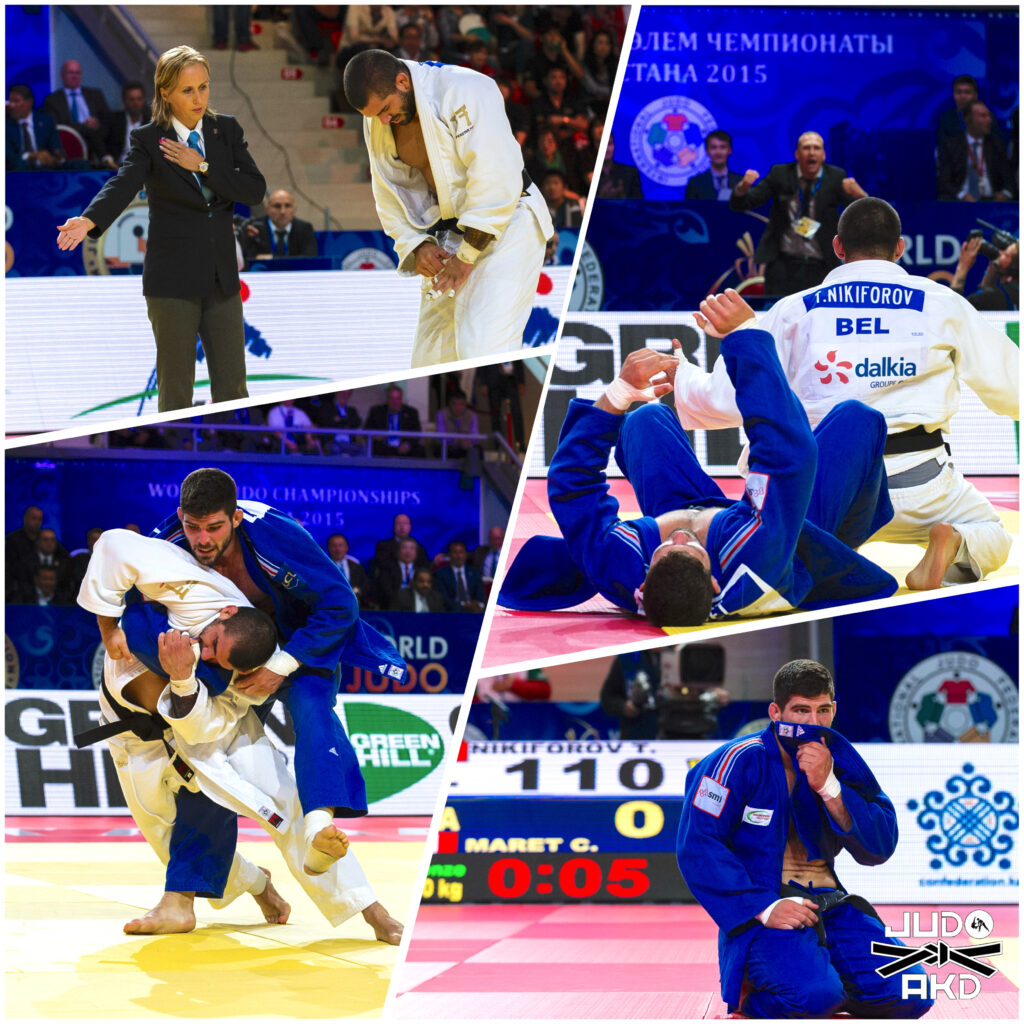
The Belgian falls to his knees. So does Cyrille, naked before his demons like Ivan Lendl facing Michael Chang at Roland-Garros 1989. “You’re a beast,” applauds Damiano, while at that very moment in a packed flat in Belgium, his old accomplice the U73 Sami Chouchi, back the day before, throws his iPad in the air and “screams like a man possessed”. On site, the Frenchman and his coach stand up, silent, already introspective. The hall, moved by the two men, applauds for a long time. “A star is born,” declared the Ippon TV commentator live when the Belgian won the Cuba Grand Prix in June 2014. Who knows whether Astana 2015 will not have marked his passage into Year Two. – Anthony Diao, summer 2015-autumn 2026. Opening picture: Paco Lozano/JudoAKD.
A French version of this article is available here.
More articles in English:
-
- JudoAKD#001 – Loïc Pietri – Pardon His French
- JudoAKD#002 – Emmanuelle Payet – This Island Within Herself
- JudoAKD#003 – Laure-Cathy Valente – Lyon, Third Generation
- JudoAKD#004 – Back to Celje
- JudoAKD#005 – Kevin Cao – Where Silences Have the Floor
- JudoAKD#006 – Frédéric Lecanu – Voice on Way
- JudoAKD#009 – Abderahmane Diao – Infinity of Destinies
- JudoAKD#008 – Annett Böhm – Life is Lives
- JudoAKD#010 – Paco Lozano – Eye of the Fighters
- JudoAKD#011 – Hans Van Essen – Mister JudoInside
- JudoAKD#021 – Benjamin Axus – Still Standing
- JudoAKD#022 – Romain Valadier-Picard – The Fire Next Time
- JudoAKD#023 – Andreea Chitu – She Remembers
- JudoAKD#024 – Malin Wilson – Come. See. Conquer.
- JudoAKD#025 – Antoine Valois-Fortier – The Constant Gardener
- JudoAKD#026 – Amandine Buchard – Status and Liberty
- JudoAKD#027 – Norbert Littkopf (1944-2024), by Annett Boehm
- JudoAKD#028 – Raffaele Toniolo – Bardonecchia, with Family
- JudoAKD#029 – Riner, Krpalek, Tasoev – More than Three Men
- JudoAKD#030 – Christa Deguchi and Kyle Reyes – A Thin Red and White Line
- JudoAKD#031 – Jimmy Pedro – United State of Mind
- JudoAKD#032 – Christophe Massina – Twenty Years Later
- JudoAKD#033 – Teddy Riner/Valentin Houinato – Two Dojos, Two Moods
- JudoAKD#034 – Anne-Fatoumata M’Baïro – Of Time and a Lifetime
- JudoAKD#035 – Nigel Donohue – « Your Time is Your Greatest Asset »
- JudoAKD#036 – Ahcène Goudjil – In the Beginning was Teaching
- JudoAKD#037 – Toma Nikiforov – The Kalashnikiforov Years
- JudoAKD#038 – Catherine Beauchemin-Pinard – The Rank of Big Sister
- JudoAKD#039 – Vitalie Gligor – « The Road Takes the One Who Walks »
- JudoAKD#040 – Joan-Benjamin Gaba and Inal Tasoev – Mindset Matters
- JudoAKD#041 – Pierre Neyra – About a Corner of France and Judo as It is Taught There
- JudoAKD#042 – Theódoros Tselídis – Between Greater Caucasus and Aegean Sea
- JudoAKD#043 – Kim Polling – This Girl Was on Fire
- JudoAKD#044 – Kevin Cao (II) – In the Footsteps of Adrien Thevenet
- JudoAKD#045 – Nigel Donohue (II) – About the Hajime-Matte Model
- JudoAKD#046 – A History of Violence(s)
- JudoAKD#047 – Jigoro Kano Couldn’t Have Said It Better
- JudoAKD#048 – Lee Chang-soo/Chang Su Li (1967-2026), by Oon Yeoh
- JudoAKD#050 – Hermann Monne – Burkina, a Land Already Peopled
- JudoAKD#051 – Mariana Esteves – A Chronicle of Life Passing By
- JudoAKD#052 – Tiphaine Gingelwein – Chechnya and the Caucasus, a Feminine Perspective in Nuance and Complexity
- JudoAKD#053 – Victor Scvortov – Born Again Under a Lucky Star
- JudoAKD#054 – Eric Gervasoni – From Moves to Movies
- JudoAKD#055 – Mihael Žgank – Coming Home Is Where the Real Journey Starts
- JudoAKD#056 – Patrick Grosperrin – Laterality, a Little-Known Lever of Performance
- JudoAKD#057 – Rest in Peace, René Nazaret (1936-2026)
- JudoAKD#058 – Alexandre Paysan – We Saw Him in the Vercors, Bungee Jumping…
- JudoAKD#059 – Habib Alouache – Teaching Joy
- JudoAKD#060 – Diyora Keldiyorova – Another Giant Leap for (Wo)Mankind
- JudoAKD#061 – Angelika Szymańska – With the Restraint of Those Still on Their Way
- JudoAKD#062 – Valentin Ménard – The Click (That Moment When Champions Just Know)
- JudoAKD#063 – Loïc Pietri (II) – “Talking Is for Laughs. Doing Shuts People Up.”
Also in English:
- JudoAKDReplay#001 – Pawel Nastula – The Leftover (2017)
- JudoAKDReplay#002 – Gévrise Emane – Turn Lead into Bronze (2020)
- JudoAKDReplay#003 – Lukas Krpalek – The Best Years of a Life (2019)
- JudoAKDReplay#004 – How Did Ezio Become Gamba? (2015)
- JudoAKDReplay#005 – What’s up… Dimitri Dragin? (2016)
- JudoAKDReplay#006 – Travis Stevens – « People forget about medals, only fighters remain » (2016)
- JudoAKDReplay#007 – Sit and Talk with Tina Trstenjak and Clarisse Agbégnénou (2017)
- JudoAKDReplay#008 – A Summer with Marti Malloy (2014)
- JudoAKDReplay#009 – Hasta Luego María Celia Laborde (2015)
- JudoAKDReplay#010 – What’s Up… Dex Elmont? (2017)
- JudoAKDReplay#011 – Zakopane, or Lives Passing By (2017)
- JudoAKDReplay#012 – Thierry Frémaux (1/2) – About The Legend of the Great Judo(2016)
- JudoAKDReplay#013 – Thierry Frémaux (2/2) – Judo in the Light (2021)
And also :
- JudoAKDRoadToLA2028#01 – Episode 1/13 – Summer 2025
- JudoAKDRoadToLA2028#02 – Episode 2/13 – Autumn 2025
- JudoAKDRoadToLA2028#03 – Episode 3/13 – Winter 2026
- JudoAKDRoadToLA2028#04 – Episode 4/13 – Spring 2026
- JudoAKDRoadToLA2028#05 – Episode 5/13 – Summer 2026
JudoAKD – Facebook – Instagram – X (Twitter).