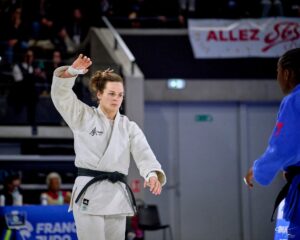
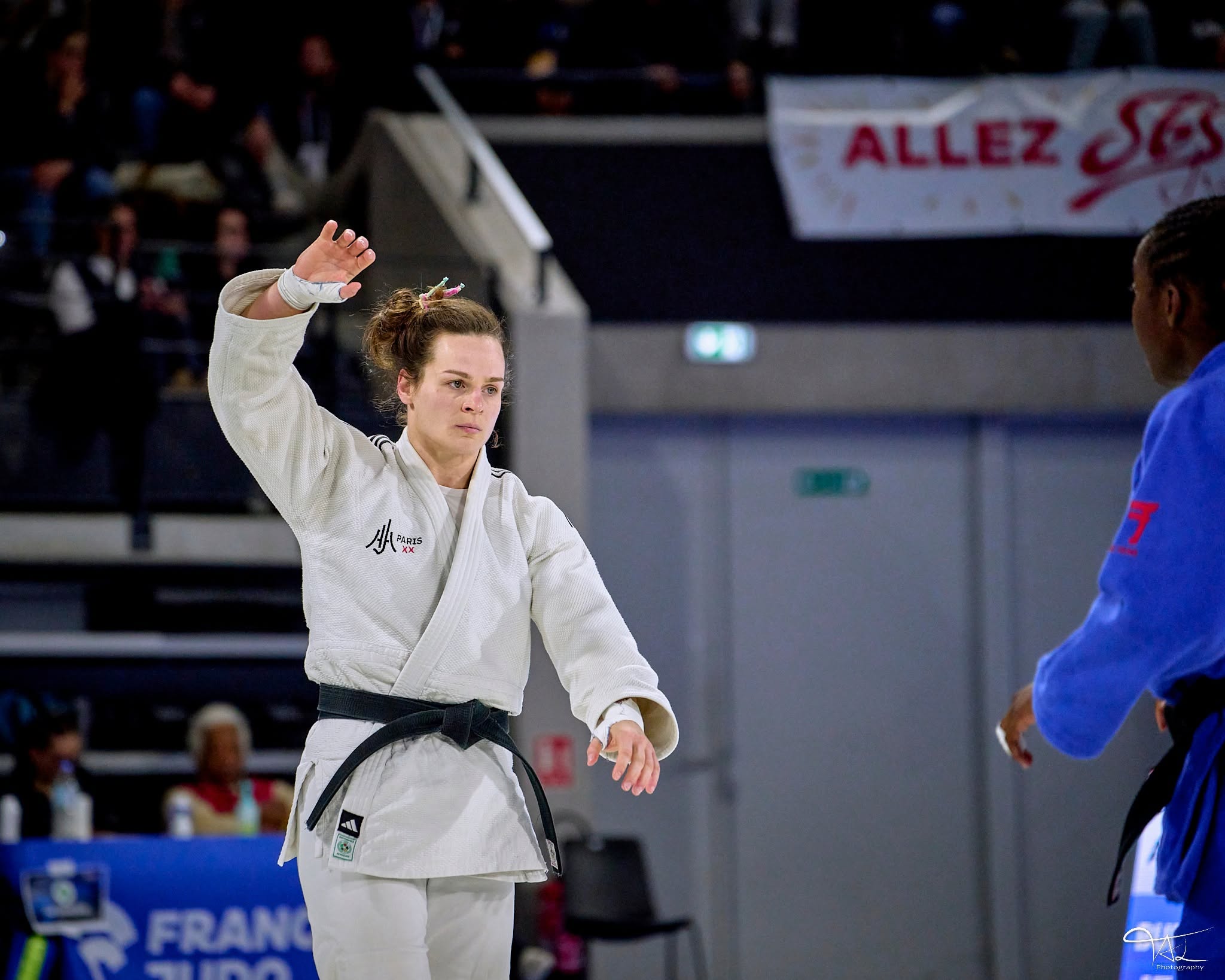
Born on April 24, 1997 in Saint-Laurent-du-Var (France), Clémence Émé stepped up a level in 2026 with three notable Grand Slam podiums, including the title in Kazakhstan in the spring. Those three warning shots were followed, as a matter of course, by a first individual selection at twenty-nine for the World Championships in Baku in early October. It was a bold choice within a squad reputed to be tailor-made, going as far as leaving out a safe bet like Amandine “double project” Buchard.
Why such a late blossoming for a woman who was nevertheless a junior world medallist in the U63 kg category in… 2017? What did she figure out along the way? The U70 kg athlete agreed to answer these questions, and many others, in two sittings: a few weeks before the Baku Worlds, then on her return. It’s a chance to hear the aspirations, contingencies and lessons that make up the charm of a career in a judogi. – JudoAKD#066.
A French version of this interview is available here.
Why is your personal puzzle only coming together now, at twenty-nine?
It’s true that as a youth I was very strong, since I won the French junior championships while I was still a cadet. Internationally, it took me longer to build up. I think it was first of all a matter of self-confidence.
Really?
I’ve always had impostor syndrome, from the start of my junior years through my senior years, especially at international events. I needed to learn to know myself, to know what I was capable of… There’s also something else: for years, I fought to make my father proud. My father teaches judo. But at one point, he made me understand that whether I did judo or not, he would always be proud of me and love me as his daughter. That was at the beginning of my senior years.
Normally that feels good to hear, doesn’t it?
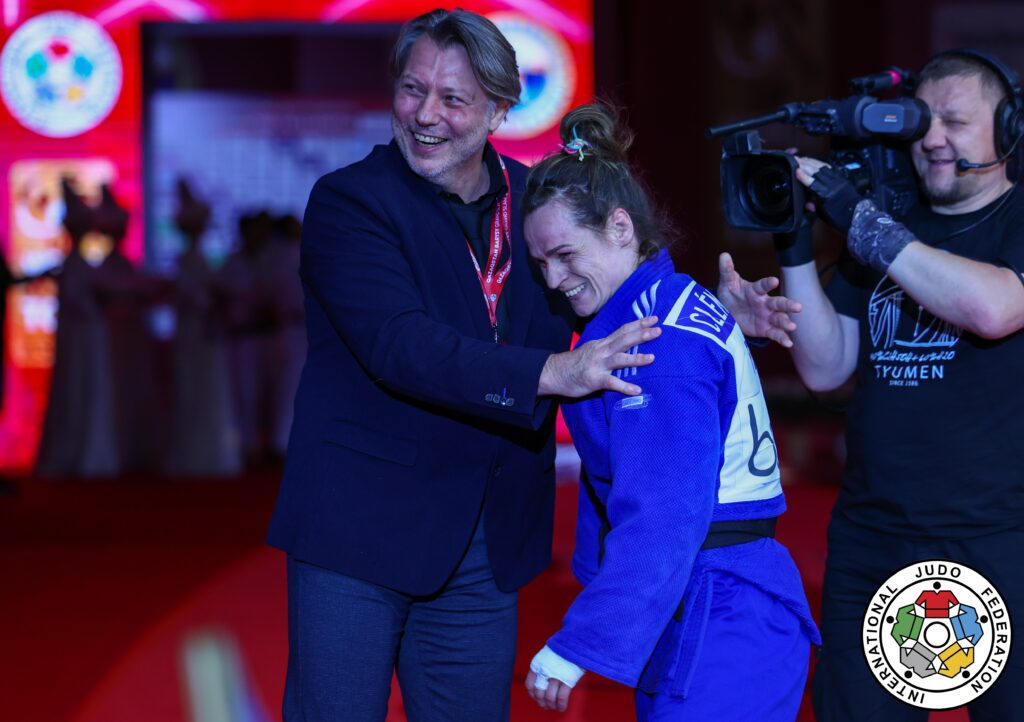
Well, for me it had the opposite effect. By symbolically “killing” the father, I had lost a source of motivation… It’s a bit odd to say, but only very recently, when I started working with Alexandre Borderieux, the coach at AJA Paris XX, did I feel I’d found a father to make proud again. It became a new motivational lever. With confidence, the coaching, the change of training and of group, I joined a new family: people to make proud, a club to make shine. I think that’s largely what got me up a level.
Yet you came from RSC Champigny, a club known for its family image…
But the big difference is that Champigny was very female-oriented.
True, at AJA you’re in the middle of a male group…
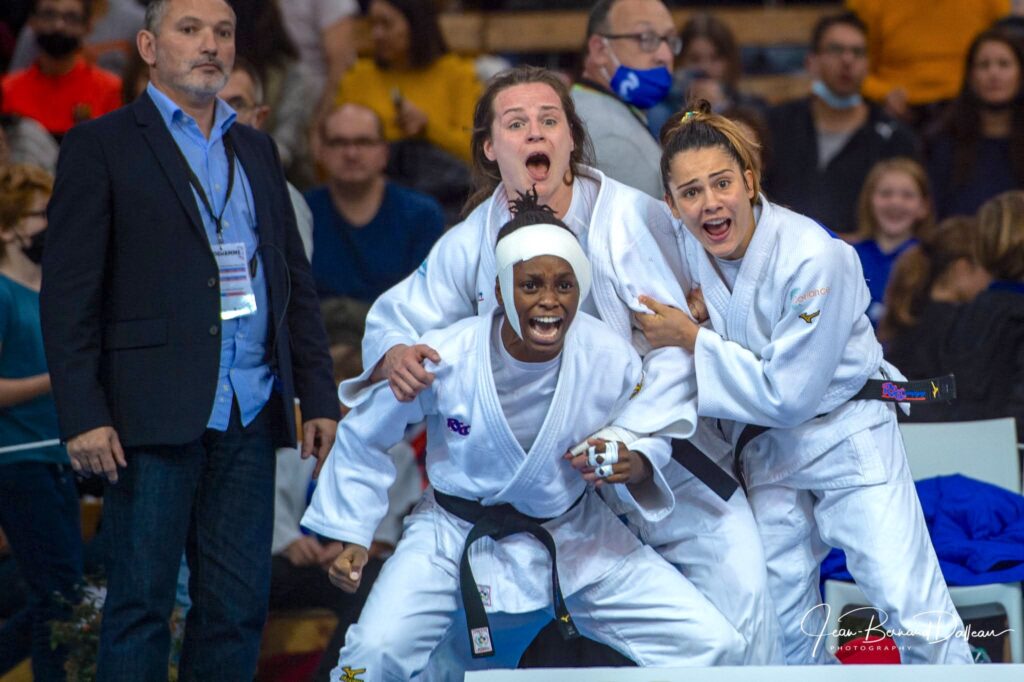
I’m the only woman in the high-performance group, yes, but I’m integrated as a judo teacher. I also have students, children from age three up to adults. When I make my group proud, it’s for my club too. At Champigny, there was this split: elite on one side, recreational on the other. I was trained at Saint-Laurent-du-Var, where everything was mixed together while still being very family-like. When I arrived at AJA, I found that dynamic again. It let me find my real place: not only as an athlete but also as a mentor, teacher, coach, in a group I train with all the time. And training only with guys makes me improve. All of this formed a good alchemy, and I managed to “pop up” this year.
Why hadn’t you understood that earlier?
At Champigny, I loved Barbara Harel and Samy Zran, my coaches. But little by little a routine set in and I think I started hitting a ceiling. Because I got along with everyone, and had been in that club for ten years, I didn’t dare leave, otherwise I felt I’d be betraying them. I had a lot of trouble detaching myself to avoid hurting people. And then there were the injuries: each time, I went back into rehab, and I couldn’t allow myself to leave when they had supported me through difficult periods. All that took time to click.
You compete in a U70kg category that, on the French side, has produced one great after another for three decades: Séverine Vandenhende, world and Olympic champion; Gévrise Émane, three-time world champion and Olympic medallist; Lucie Décosse, three-time world champion and Olympic champion; Marie-Ève Gahié and Margaux Pinot, world and European champions… Faced with such a legacy, did you tell yourself “I’ll be happy just to get a selection from time to time,” or “I’m going to go after them one by one”?
It’s true that when I moved up to U70kg for good in 2018, the rivalry between Margaux and Marie-Ève was in full swing. I wasn’t even thinking about the competition itself. I first had to prove to myself that I belonged. Again, I always had a confidence problem: on the tatami, in training, I was throwing everybody, and people would say to me, “But why can’t you do it?” At the national level, I was always there. But internationally, I told myself I wasn’t made for it. And with the injuries, every time it took a whole process to regain confidence… My mental coach likes to say I had a headwind for a long time and that it became a vicious circle with the lack of confidence, the crowd in my category, the injuries, and even the fact that I wasn’t progressing in my club, locked in my routine… I was sailing in troubled waters and it was very hard to get out.
What made you cut the cord with Champigny and take the leap to AJA?
Several things. I was already starting to tell myself: either I stop, or I try something else. In eleven seasons, I’d never tried anything new, so maybe it was time to change clubs. And then, financially, Champigny had to trim its payroll and part ways with some athletes, and I was one of them.
I went to see several clubs. I had a very attractive profile for teams, because in team events I didn’t have impostor syndrome: I put in big performances, especially with the Pro League system. But every time, they talked to me about the team project, never the individual project. Alexandre told me right away: “We’ll do you first, and if you want to do the teams, we’ll do the teams.” I told myself: he believes in me, so I’ll give myself the means to make it.
After the Paris Games, Joan-Benjamin Gaba and Maxime-Gaël Ngayap Hambou told me they felt it as a slight, and therefore as a source of motivation, that they’d been selected primarily for their contribution to the team event, with expectations for them individually almost secondary. How do you experience that?
It doesn’t bother me. I see it as a real strength to be labeled the girl who’s strong in teams, and I like the idea of the collective. However, when I’m offered an individual project while others don’t believe in it, I go toward the person who believes in me as a human being, not as a piece of a team.
What has fundamentally changed in your training since you arrived at AJA?
I train much harder, with much more rigor, and it’s much more polarized. I actually train fewer sessions, but they’re denser. That leaves me time to rest, recharge and work, because yes, I work on the side. This adjusted schedule helped me a lot this year and, I hope, will help me in the years to come. Physically and technically, we emphasize repetitions. It’s a blend of several training systems that work super well on me, but also on the AJA athletes: Daïki Bouba, Benjamin Axus for years, and Tieman Diaby, who is coming back. Alexandre has a truly relevant training system for performance.
Who follows you at the moment at the national team level?
Kilian Le Blouch follows me as national coach, but he has a lot of athletes, so he can’t focus on me specifically. Fortunately, I have a collective: at each session, one of the guys on the team is with me. Tuesday it was Benjamin; this afternoon, Daïki; next week, Maxime Merlin. Alex gives the instructions, and they aren’t there as coaches but as emotional support, because I’m the only girl in the club’s group. They repeat the theme of the session to me, again and again. It gives me a reference point and, if needed, support.
You said you did judo a bit for your father. Are both your parents in judo?
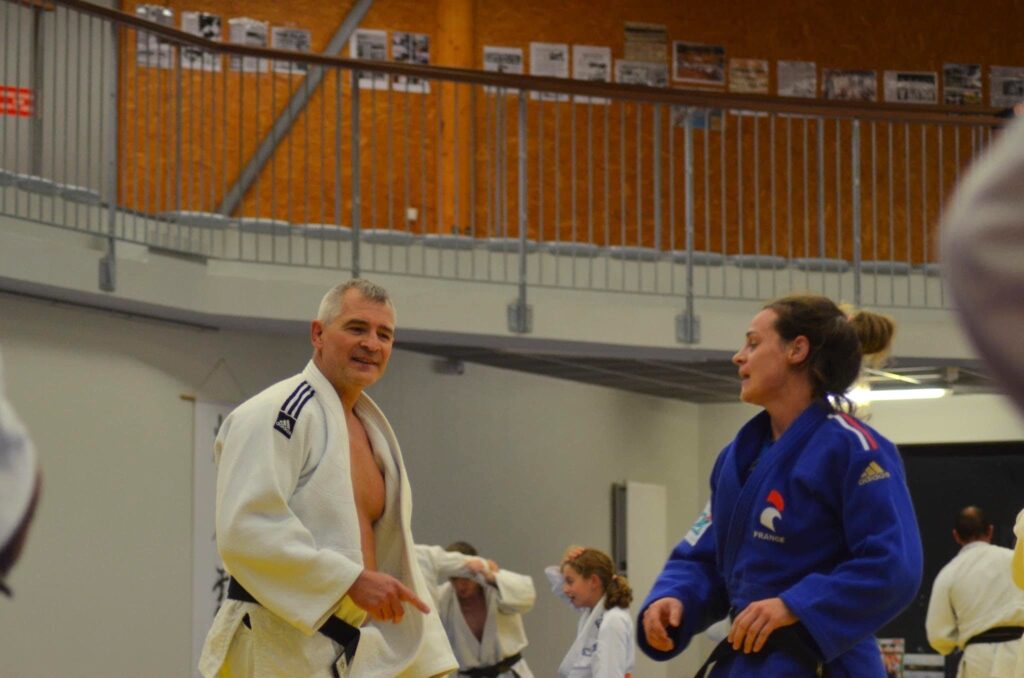
Yes, both. I want to point out that even though I’m “only” a third dan, I now outrank my father, and that’s very stylish [laughs]. My mother has always been proud of me and has always shown it. My parents are divorced, so I was mostly raised by my mother. What connected me to my father was judo, the only interest we had in common. My earliest memories are of him picking me up from school to take me to judo: I’d do my class, then wait for my father’s class in the evening, and I watched judo from when I was very little. I have two younger sisters who were raised by my father. For me, I had to find something to attach myself to him. And that was judo.
Loïc Pietri, another famous southerner, often points to the “Jacobinism” of French judo: many talents from the South disappear fairly quickly once they’ve “moved up” to Paris, because of early uprooting. How did you experience your arrival in Paris at seventeen?
It’s a real issue. First, to redo the chronology: I was registered in Saint-Laurent-du-Var until cadet 3, or rather junior 1, I can’t tell you the exact age. As a cadet 3, I won the French junior championships. I was at the Marseille pôle France at the time, and I won the French juniors in U63 kg. They then offered me to move up to Paris. At first, I wanted to stay in Marseille because I was a baby, but Marc Alexandre, my pôle coach, encouraged me to go: “We make you this offer once, we won’t make it again.” That was more or less his speech. I told him, “Listen, yeah, I’m going to Paris.”
But my coach, Manuel Armitano, couldn’t move to Paris, he has his life in the South. So we did a year of transition with Champigny, because I had done the European Cadet Championships, and because I was a cadet, first and foremost. Gilles Bonhomme was national coach for the boys. He’s from Saint-Laurent, from the same club as me, and he went to see Manu, who had come to watch me at the Europeans. Manu told me: “I spoke with Audrey La Rizza, who is Gilles’s wife and was a coach at Champigny at the time. She’d like Champigny to take care of Clémence for a year, then make the transition to the club later.” Basically, to build the bridge. That’s how it happened: I went from Saint-Laurent to Champigny in September 2015. And I stayed there ten years.
Now, regarding the South… You see it with Aleksa Mitrovic, who moved back down last year and just finished seventh at the World Championships. Despite all his cruciate ligament surgeries, he’s much more fulfilled in his practice because he has reconnected with his roots.
What’s the hardest part when you have to develop far from where you grew up?
The hardest thing, actually, is telling yourself that you’re missing family moments. I’m afraid of the day I lose my grandmother, because I won’t be there. Obviously, I’d rush down, but I probably couldn’t be there if she had to go into hospital, for example.
My younger sister had cancer, diagnosed in 2020, the weekend I became senior French champion. My father knew but didn’t tell me, because I had my competition. I could feel something was off. I won my title, everyone was very happy, a bit too much even, and it was afterwards that he told me: “Juliette has cancer.” She was sixteen, seventeen. I broke down and left in a rush, but I wasn’t there the day she found out, not there to talk to her. When you’re from the South, you know you take that risk: distance.
Did your parents encourage you to spread your wings?
I’ve known that from a very young age, because they detached from me quickly, but not in a pejorative way, eh. Letting me leave for Paris at seventeen proves they were happy to see their daughter flourish in her passion, at the highest level.
Marcel Pietri, Loïc’s father, believes that those who succeed in French judo today come either from the Paris region or from the sérail, meaning families who know judo, its crossroads and its pitfalls. That’s a bit your case, then…
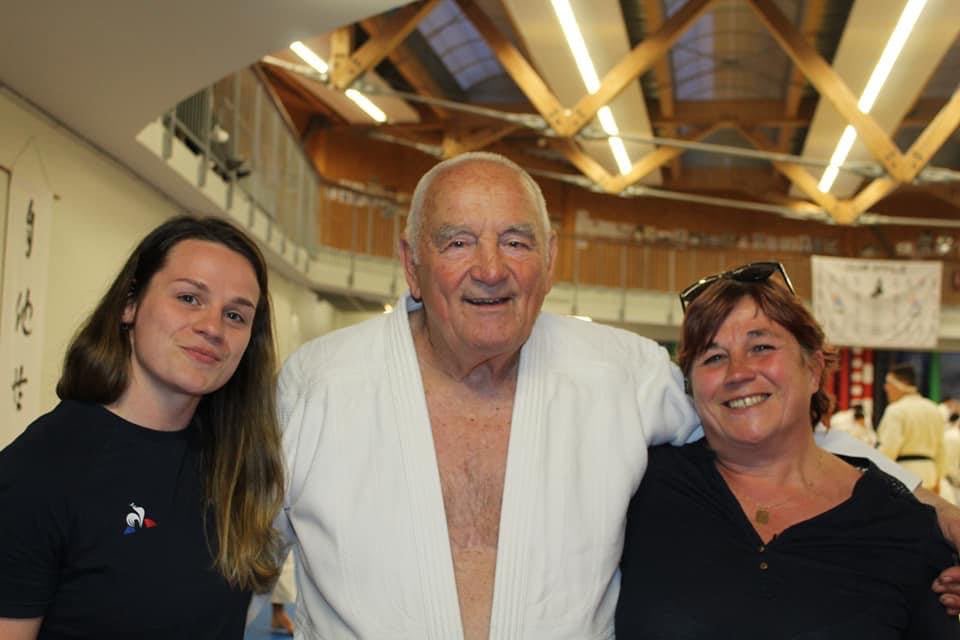
I was lucky to have parents who do judo but who hadn’t known the high level. In Saint-Laurent-du-Var, José Allari was a bit like my second father: I slept at his place during training camps. So I had the same relationship with his son Manu, who had been on the national team. When Manu took over the coaching from José, he drilled me on all the weak points, on what you must stay vigilant about to avoid injury. He wasn’t my father, but he had touched the high level and he knew how to do prevention. It helped me enormously.
Serious injuries, precisely, you know what they are. Did you doubt, to the point of thinking “what’s the use of persisting”?
Yes. Sometimes on impulse: you miss a competition, you say “that’s it, I quit,” but you know it will pass. There was one moment when I had truly decided: when they told me about the rupture of my second cruciate ligament, in 2023. I called my godfather, a judoka who came through the Nice pôle. I told him I couldn’t go on, that it was too hard. I also told my club, my president, my coach: I’ll do the teams, but individual, I’m stopping. What I love is the team events. I talked to Christophe Massina, at the internationals: I’m quitting, I can’t take it anymore. I’d already had surgery on both shoulders and every time I came back, I got injured again or couldn’t perform at the level I should be at.
How did they react?
They were ultra-understanding. It allowed me to do my rehab with a much freer mind, a bit disconnected.
And yet you came back…
Actually, very quickly, finding myself in a life without high-level sport, I told myself: I’m not in my place, I’m not ready. I was already working, giving classes in Saint-Denis and I was an educator for the city of Champigny, under an agreement, but it wasn’t what I wanted yet. I went to see Ludovic Delacotte, who coached Clarisse Agbégnénou, and told him: “I’ve changed my mind, I want to come back.” And that’s where the Federation has always been very cool with me: every time I got injured, they let me come back. They put me back on the lists, no problem. That trust helped me a lot over the years.
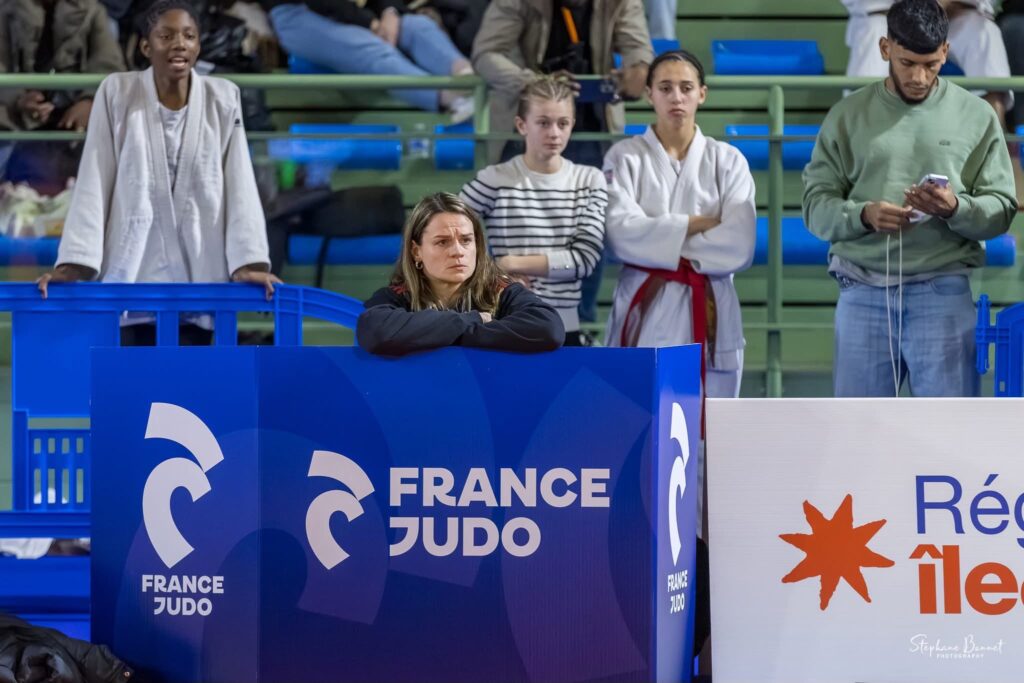
Alongside your career, you teach judo and you’re a trainer. Did you feel this knack for passing things on very early?
Yes. Very young, when I was asked what I wanted to do, I answered judo teacher. There’s the discipline, the beauty of the movement, all the values it instills: it’s a real philosophy of life, which seemed obvious to pass on… I started teaching in 2020-2021, in Saint-Denis, at Franc-Moisin. The technical director, Fabien Farge, is also the club’s creator and a friend of my mother’s. It wasn’t the easiest audience from the start, since it’s a QPV (Quartier prioritaire de la politique de la ville, priority neighborhood, ed.), but it did me good. I wanted to be useful: giving classes to rich kids doesn’t interest me at all. I wanted a real social purpose, and I wasn’t doing it for the money: concretely, with my agreement, it was a bonus, and experience… I loved it and I stayed five years. I still have students I brought to AJA this year: little ones I had as mini-cadets who are now juniors.
Knowing that kids are watching you also gives meaning to what you do on the mat. Did teaching and training others play a role in your success in recent months?
Yes. What allowed me to succeed this year is my change of club, obviously, but also having worked as a trainer and judo teacher. It allowed me not to put all my eggs in the same basket with performance, to clear my head, to intellectualize my discipline differently.
You work at the Dojo Academy. What exactly does that involve?
Basically, I’m a trainer for future judo teachers, from the BPJEPS to the DESJEPS level [professional certificate and higher state diploma in youth, popular education and sport, ed.]. I handle the project development part. For the BPJEPS, these are activity-leading projects, whether in judo or fitness activities. For the DESJEPS, it’s structure development: setting up, for example, a new judo class, a new activity, taiso for instance. They have to develop a project based on creating not a structure but a new offering.
How long have you been doing that?
I sat on juries for several years before: first BP judo, then DE, and now DES too, where I’m only on the jury. By doing juries, you understand the methodology, how it works. And last year, they brought me into the training. So it’s been a year.
Judo with children was something I mastered. Starting as a trainer helped me fight the famous impostor syndrome I mentioned earlier. Learning to speak to a class, argue on a subject I master, pass on knowledge that goes beyond pedagogy and theory… My trainees followed my competitions. I’d arrive at the training right after coming back from a competition, with my medal, and they were happy for me. I gained credibility, even though it had nothing to do with what I taught them: developing activity or structure projects, the management side, etc. I gave my all on correcting their files, thinking that if they saw my investment, they’d give their all in return. It’s win-win.
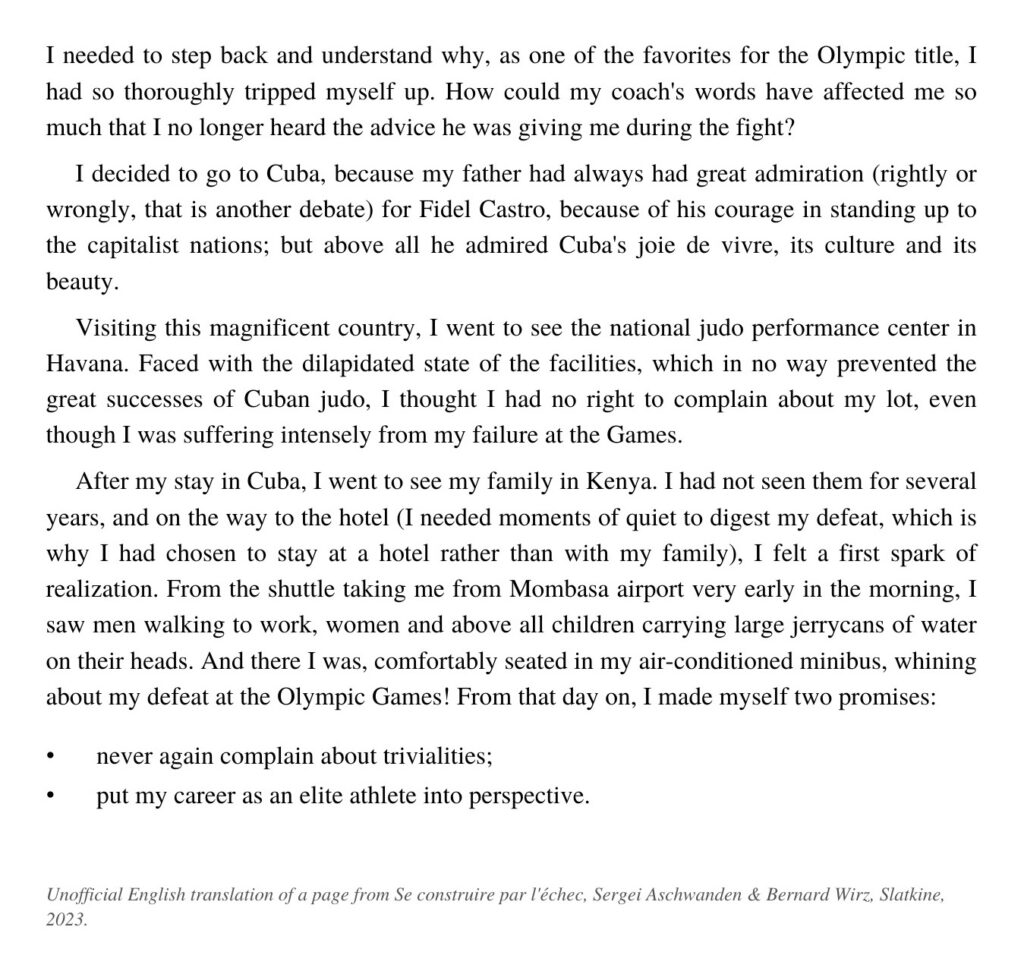
In his biography, the Swiss Sergei Aschwanden recounts that after a first-round loss at the Athens Olympics, he flew to Cuba and then Kenya, where he has family ties. Through the hard scenes of daily life he observed there, he became aware of how lucky he was and came back “almost on a mission.” So much so that four years later in Beijing, he finally won an Olympic medal at thirty-three. How do maturity and perspective change one’s relationship to performance?
What’s good when you’re a bit older is that performance isn’t your only goal. You have other objectives: social, family (Clarisse Agbégnénou or Madeleine Malonga had babies), professional… I won’t lie: my performances put lines on my CV, and that will help me with my career transition. And when you hear “she’s performing, but she’s a bit old,” honestly, you don’t care about age. There are Olympic champions who are well past thirty. As long as you have the desire, the flame, and you do the work, that deserves respect.
The former British sprinter Linford Christie often explained that he had a late click, at twenty-six. Hence his Olympic and world titles at thirty-two and thirty-three, at the height of his “monk-soldier” years. Is that also what drives you: going to the end of your potential so as to have no regrets?
It’s funny, it’s a bit the same thing. When you’re young, you go out, you feel like recovery is infinite: big night, coming home from the club at six in the morning, being at training camp at ten the next day, no problem. Having much more rigor in my lifestyle changed everything. That’s why I’m much more performant at twenty-nine than at twenty-five. There’s the training rigor I mentioned, but also that of everyday life. It lets you work, train, perform. It’s a considerable key, and it’s one you can choose to master.
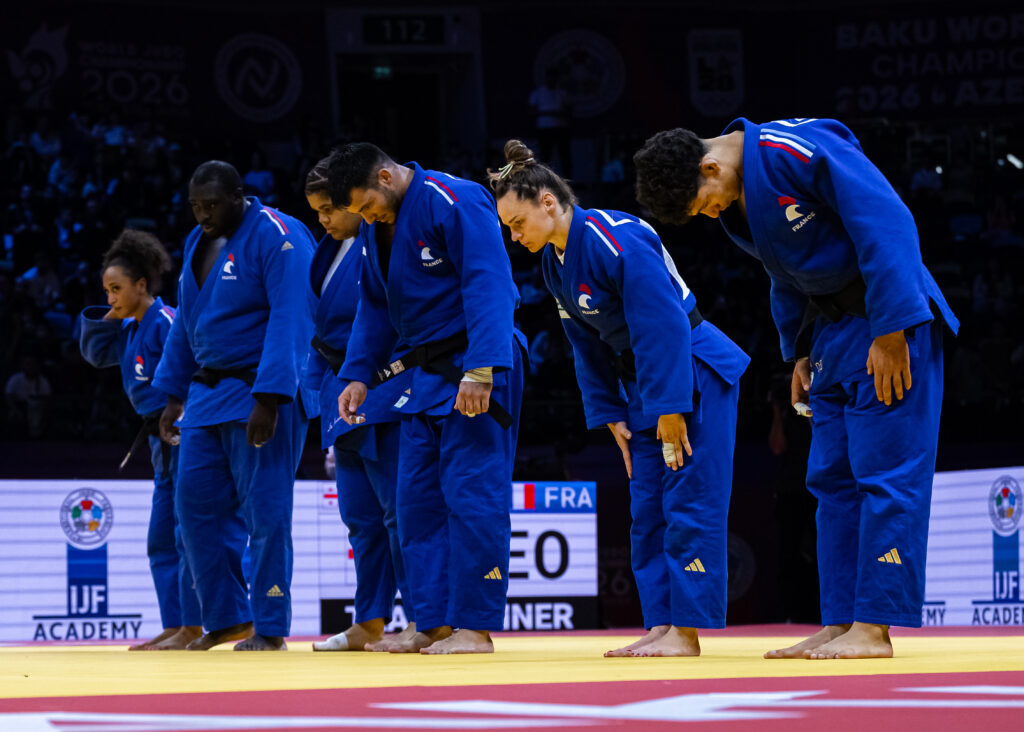
Do you feel like a big sister on the mat?
A little, yes. When I arrived at INSEP, older athletes played that role for me. Now it’s a bit me. But the French team has performed so much with Clarisse, Madeleine, that whole generation that’s still around, that I’m not yet the “mama-mama.” On the other hand, I have younger ones, especially those from Champigny that I was always with, like Julie Falgon or Maylis Rozan. The other day, I ran into them, they were so happy about my journey, because they knew me at Champigny when I was struggling. Julie told me: “You’re my favorite judoka.” I feel the gaze of the younger ones, and each time I try to advise and guide them. It’s not always easy: at that age, you want to party, go out for drinks. I’m mostly with those who want it and need it.
The former O78kg Eva Bisseni once told me that French judo lacks a status for athletes at the end of their careers, who would come and give younger ones a hard time in a few randori without necessarily being coaches. What do you think?
With the new INSEP system, we train much more than before at the Institut du judo, which allows more variety in partners: more experienced partners, but also slightly weaker ones, which lets you attack more and set up new grip strategies. But it’s true that when I arrived at INSEP in 2015, there were more training partners, national groups or people coming for camps. Now the collective is reduced because access has become so expensive that people no longer come. It’s a problem, because it’s a real need.
I’ve known open international camps, in Sochi for example, where new, “juicy” young local judokas arrived every two or three days and kept the overall level very high… Is French judo too closed?
International collectives are much more open than the INSEP mat, but it’s super expensive. Since INSEP has been privatized in several sectors (boarding, medical, access, the paid card), it poses a real problem. I was a delegate of the national collective last year, and still am, even though I feel a bit less legitimate since I moved into the Elite group. I always try to defend our rights, because they are human rights.
A paid collective, where you pay a little over two hundred euros for your card, is huge when you know that many athletes struggle to make ends meet. Clubs have no money left, agreements and CIPs are reserved for high-level athletes or good negotiators, and sponsorship is really not simple. And we’re talking about a population that is often very young, for whom this already considerable financial effort adds to paying rent, food and all the extras. Clearly, if you’re not lucky enough to have a club that invests in you, that’s a lot of fronts to manage at once on top of work or studies, and so yes, at the end of the chain, it can only have an impact on performance… That said, the director of INSEP is a former judoka, he knows the situation. And we’re the biggest pôle and so a bit the piggy bank of INSEP, to simplify. I know it’s complicated financially everywhere, but those of us who live it from the inside also have a duty to alert people to these realities.
Is your own situation representative?
At this moment, it’s quite crazy: I’m the French number one in my category, world number seven, selected for the Worlds, and unemployed. I have to stack jobs to survive, because I’m not in a big club with a lot of money. I left for AJA because they bet on me. Alexandre told me straight: “We don’t have money to pay you, but we’re going to bet on you and give you classes to teach.” The club pays me a little as a judo teacher, not as an athlete, but it has invested in me by paying for competitions and training camps. On the side, Grand Slam prize money is derisory compared to the investment, but it puts a bit of butter on the spinach. I also worked in training and drew unemployment benefits. All this is energy-draining. That’s why I decided, with Anne-Fatoumata M’Baïro, to be a delegate of the Collective: if we can improve our situation, and also that of others in the same boat, we do it. I have infinite gratitude for all those people in the shadows who work hard to try to find us agreements so we can be in better conditions even for just one season.
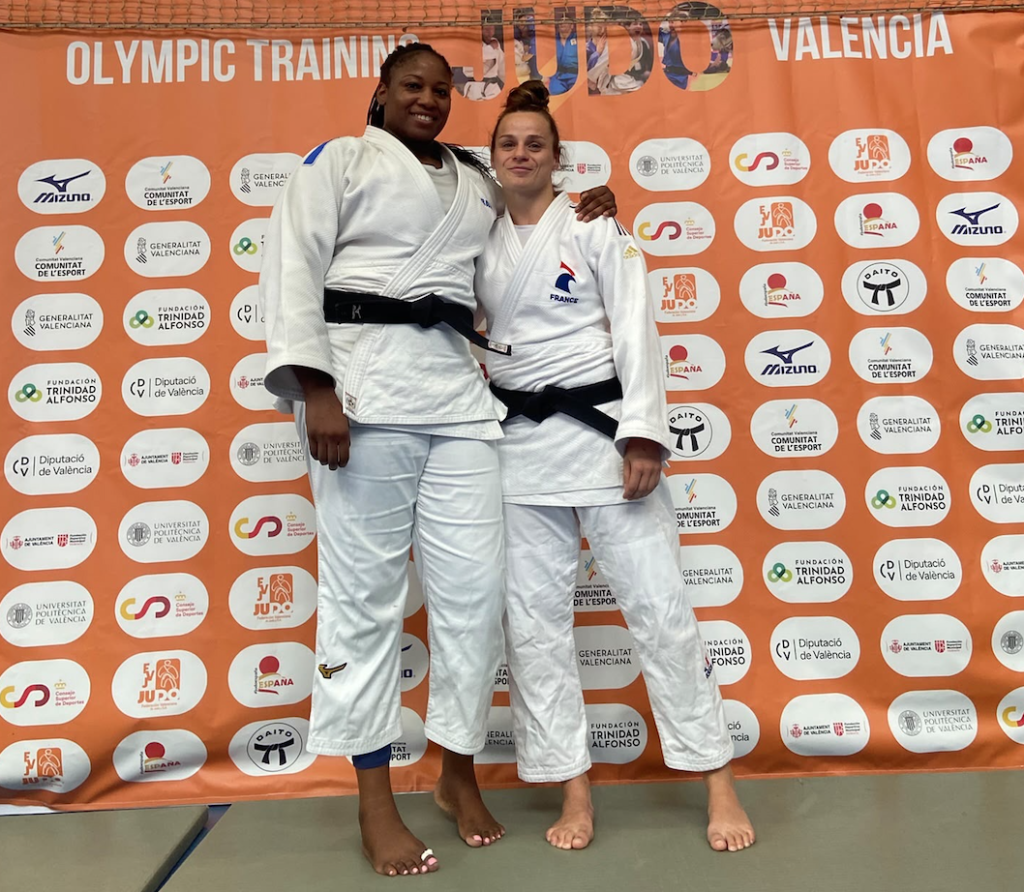
Why is this an important subject for you?
Because I’m in touch with real life. I’m not only in the high-level bubble. I work, I see families and the difficulties they can face. I know what a membership fee represents for my students’ parents. I know budgets are tight everywhere. But we need to ask how we want to develop tomorrow’s athletes and preserve equal opportunities.
You do distinguish between trips funded by the Federation and those funded by the club.
When we leave with the Federation, I don’t feel any particular financial constraint: it manages the costs. It’s public money devoted to national selections, and I don’t feel indebted for being selected to take part in a funded event… With the club, it’s different. I know where the money funding a competition comes from: it’s also the families’ membership fees, including those of parents who make an effort to pay for their children’s activities. On those trips, I feel more responsible and I don’t have the right to make a mistake.
You also see directly the social role a club can play.
Yes. I have kids who, fortunately, have judo. They go to competitions on weekends, train every evening with us, and we support them. I know some could drop out if they didn’t have this activity and the adults around them… Judo remains a real educational lever. We have a fine calling card with the Moral Code, and the practice itself teaches us to fight while respecting rules, to control our gestures and master ourselves. On paper, when you face someone, you have to give everything, but you also learn to respect that person. I truly believe judo can help children evolve in the right direction, with values and a baggage of social and human intelligence. That doesn’t mean our sport is the only one that can do this: education through sport is important. But I find it sad that some parents can’t afford a sports activity for their children.
INSEP is closed in summer and you go off to camps all over the place. Is that a drawback?
It’s good to relocate a bit too. It lets us move around France and make the high level shine in the regions. People say “Paris, Paris,” but it’s good to be represented elsewhere and to reconnect with the training clubs in the provinces. Even though this summer in Vichy we didn’t hold an open-house day, which is a shame. When I was little and saw the champions, it made me dream. That’s also what Maxime Merlin wanted to do with the Judo Camp Excellence, in the Indre: make the high level accessible to everyone, and bring together children from different regions and champions.
Camp memories are also what a career is made of, no? Ugo Legrand told me he remembered his trips with friends in Mongolia or on a South American tour almost more than his medals.
Very true… What’s good with AJA is that we’re really a band of friends. If we want to go to a camp, we go among ourselves, and there’s always someone motivated. This summer, some of the guys went to Georgia. It reminds me of Orelsan’s song ‘La quête’: what counts isn’t the result at the end but the quest. The whole process of getting where you are. In the end, either you’re champion and that’s great, or you aren’t, but you remember everything that happened and you’re satisfied with it. As long as you give everything, you can’t have regrets.
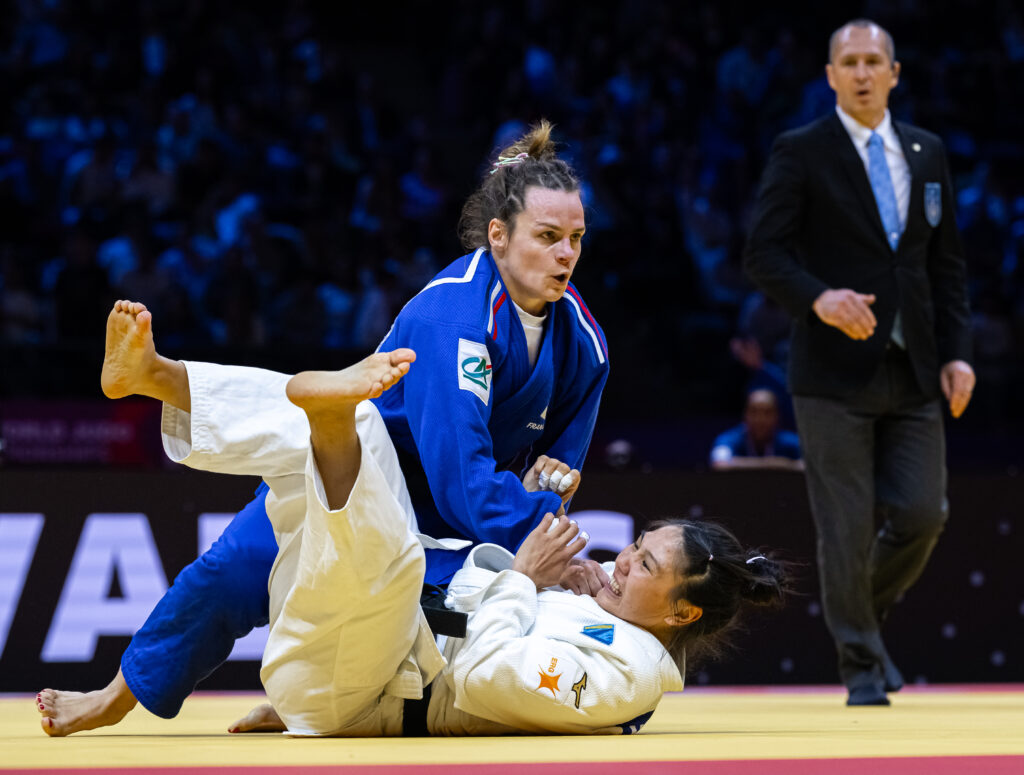
How did foreign athletes see you coming in recent months? Do you feel more expected now?
Actually, everybody knew me. The girls in my category are about my age, give or take a few years: we’ve known each other since the cadet and junior years. They always saw me as a strong girl, because we’d fight each other in training camps. But since it didn’t work in competition, it was more “she’s the tricky one, but it should be fine.” Now that they’ve had me in their hands and seen the results, of course I’m more studied and more expected. That’s normal. The most important thing is to prepare for it and study profiles well so as not to be surprised when the moment comes.
What do you still lack to reach the next level?
Ne-waza. And even the hands: I’ve only been working on kumi-kata for a year. I learned judo by learning to throw first, and only then to place my hands, which isn’t logical at all. But at Saint-Laurent, it was: the best defense is attack. No matter how you have your grips, you have to throw. I learned to throw any which way. Since arriving at AJA, I’m discovering this first part that I was missing internationally and that is super important for the very high level. We worked for months on a single grip combination, and now that I’ve understood, we’re moving on to other things: you can do judo differently than with a classic sleeve-lapel grip, you can go high with the hands.
And on the ne-waza side, on transitions, I’m a marble. On defense, it’s fine, but I’m not punchy enough. I tend to hesitate: I’ve been shown a lot of things over the years, I start on one thing, then finally on another. There’s no guiding line. That’s mostly what’s missing.
Would you be ready to do sessions of only ne-waza for a while?
Yes. At AJA, we already do a lot of pure ne-waza, twenty to thirty minutes straight, and it’s no problem for me: I like it. But this would be very specific work on transitions. It will be one of the themes of the coming months.
What does rivalry bring you?
Rivalry is a driver. Those who think having none is comfortable are fooling themselves. This year, I thank Melkia Auchecorne: we have a very healthy rivalry, which isn’t always the case and can be a source of tension and unspoken things. But here, she makes me improve. We were competing all year, pushing each other, going for the best performances because we knew there was one in the rear-view mirror, and half the time, it was the other. We pushed each other upward. If you remove competition, you impoverish a category.
Melkia is a real warrior. She doesn’t have extravagant judo qualities, but she never lets go. We’re opposites, but we have the same level, with totally different profiles. And she has real human convictions, she isn’t focused only on her own project. When I learned about her injury, obviously I felt relief on a personal level, because it made my selection for the Worlds easier. But I felt sorry for the person and the athlete: nobody deserves that.
The Olympiad is long and Melkia will surely come back. How are you experiencing the race to the Games?
I’m preparing, because obviously I’d love to do these Olympic Games. But I don’t want to sacralize this race, and I said that recently to Anouk Corge of L’Équipe. Too many close friends have been mentally broken by it. I don’t want to endanger my mental health for something that makes me dream, yes, but not at any price. The goal is to take it competition by competition. If I’m to do the Games, it means I’ll have done everything to get there, but I don’t want to put pressure on myself by saying “I have to perform now to earn points.” Mentally, it’s too dangerous.
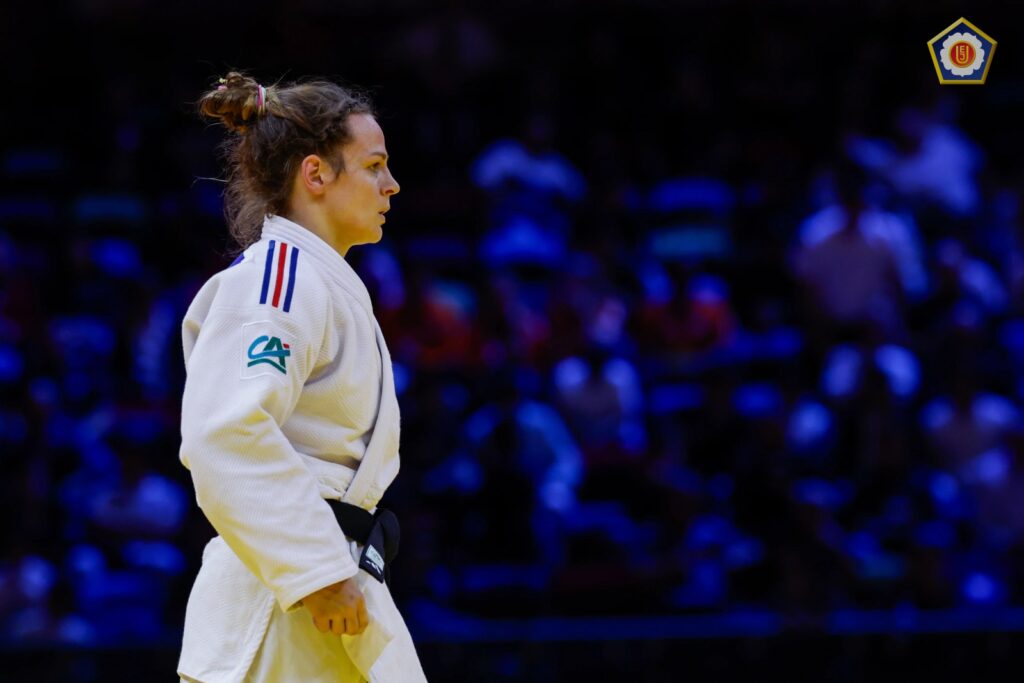
You’re now back from Baku as we resume this interview. What do you take away from these first individual World Championships?
It wasn’t necessarily the best experience of my life, I won’t lie, but I’m glad I went through it. I didn’t expect that. I’d gotten used to the Grand Slams, where you have the national coaches and the team, but not everybody around you. At the Worlds, there are also the physios, the dietitians, the doctors, the president. Everyone is watching you, and I handled that badly.
How so?
The atmosphere disturbed me. From the first day, there were lots of expectations around the group. You could feel the coaches were stressed. There was a need for performance, even if nobody came to tell us directly: “You have to perform.” I felt it, and I didn’t expect it, at least not to that extent… After that, I wasn’t good, and that’s also my fault.
In your post-championship statements, you repeatedly spoke of self-sabotage. Did you feel you’d fought alone against yourself?
Clearly, yes. I was ready physically and technically. Maybe I thought I was ready mentally, but no. I let myself be eaten up by the event, when it’s a competition like any other, even if there are more people around and a more pronounced expectation of results.
I had a draw that wasn’t necessarily very favorable in the first round. I was prepared for a big fight: I told myself it would be long and physical. But once on the mat, I realized it wasn’t that “hard.” The shidos piled up quickly and, coming off, I was rather relieved. For a week, I’d been ruminating on this fight, on the grip patterns and on the fact that it would be complicated. Afterwards, I couldn’t move on.
Meaning?
I fell asleep on my own and did whatever. I didn’t do the work needed to stay in my competition after the first round. I should have refocused on a new profile and told myself it was another fight, another war, and that I had to go back in. That’s what we call professional errors, and it wasn’t the time to make them.
You nonetheless found your form again in the team event.
Team events are a competition I love. No matter whether I had a good or bad individual competition: in teams, I feel untouchable. Individually, I can do anything, like in Baku. But in teams, I know I have capabilities and I manage to elevate myself for others. It didn’t even surprise me that I had a good competition: I knew I was going to.
Coming out of the individuals, I also needed to redeem my image. I’m lucky to be in a category where I could do that in the team event. There, I managed to save the furniture.
What explains this difference between the individual and the collective?
The strength of the collective allows for great performances, even when you’re not the favorite. But I think we could better prepare mixed team cohesion. Ahead of the championships, the men’s group does cohesion activities, the women’s group too, each on its own. But we don’t do any all together, even though in the team competition, we fight alongside the guys. So we should create more ties between girls and boys.
I’m not saying we all have to be friends, but at least do an activity together, get to know each other. When you fight in a team, you fight for the team. Even if judo remains an individual sport and everyone has to bring back their point, knowing the people you fight with can become a real motivational lever.
Do these first World Championships nonetheless leave you wanting more?
Yes. I want to avoid putting pressure on myself like I did in the individual, and above all to be myself. In the teams, the coaches, men and women, kept telling me: “Clémence, don’t put pressure on yourself, otherwise you won’t be yourself, you’ll have regrets and you won’t be strong. Be yourself.” You have to throw, have fun, not tremble on the mat because you don’t feel legitimate being there. I want to go home without regrets, or with fewer regrets than if I’d put too much pressure on myself.
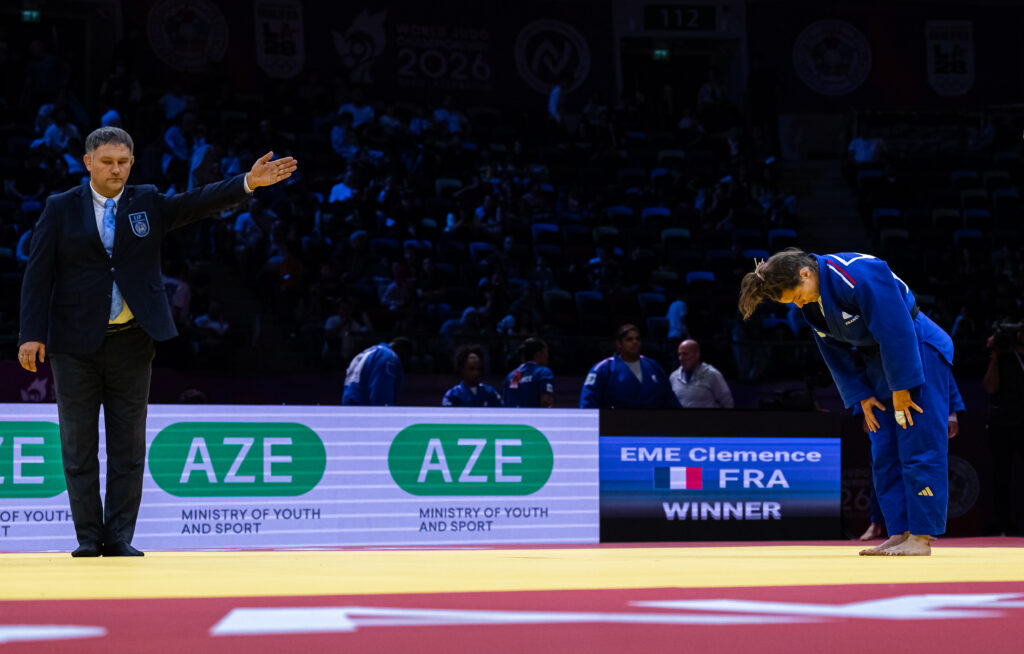
In one of the short video clips released by France Judo during the Baku Worlds, you talk about your love of reading in general and books in particular. You’re one of a kind!
I read a lot, notably to maintain my spelling. I’m dyslexic and school was an ordeal. For a long time, I didn’t like reading, because I kept the memory of French classes where you’re asked to read aloud. Later, when I moved up to INSEP, a friend recommended sagas to me. I tried and loved it.
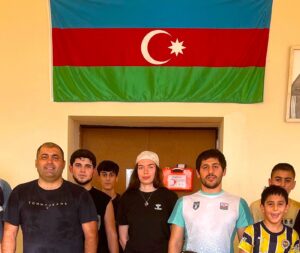
I read comics, graphic novels, crime novels, a bit of everything. I like that reading stimulates creativity. In Baku, I also took the time to discover the city: my mother was there, and since Manon Deketer and I were a bit low mentally, I suggested she come for a walk with us. We visited the old town, climbed to the top of the Maiden Tower and enjoyed the 360-degree view. It was really beautiful, and there were lots of cats, which I love. These moments are also part of a trip, beyond the competition.
Do you have regrets, about these Worlds or on a larger scale?
[She thinks] If I look at things in the long term, I’d say that when you’re an international athlete, not being comfortable in English is sometimes frustrating. I get along with girls from other countries, but the language barrier limits exchanges. I’d like to be able to develop more connections around the world of judo.
If today’s Clémence could, at twenty-nine, slip some advice to the Clémence who started judo at age three, to save her time, what would she say?
To keep confidence in herself. At three, she’ll still be a bit small to wonder about notions of impostor syndrome or legitimacy, but that questioning will inevitably come at some point. So always keep confidence, stay herself, and above all not lose her true nature. You can be a good person and a great champion. One doesn’t prevent the other. – Interview by Anthony Diao, summer-autumn 2026. Opening picture: on the road to a fourth national podium at the 2025 French Championships, ©Thierry Albisetti/JudoAKD.
A French version of this interview is available here.
More articles in English:
-
- JudoAKD#001 – Loïc Pietri – Pardon His French
- JudoAKD#002 – Emmanuelle Payet – This Island Within Herself
- JudoAKD#003 – Laure-Cathy Valente – Lyon, Third Generation
- JudoAKD#004 – Back to Celje
- JudoAKD#005 – Kevin Cao – Where Silences Have the Floor
- JudoAKD#006 – Frédéric Lecanu – Voice on Way
- JudoAKD#009 – Abderahmane Diao – Infinity of Destinies
- JudoAKD#008 – Annett Böhm – Life is Lives
- JudoAKD#010 – Paco Lozano – Eye of the Fighters
- JudoAKD#011 – Hans Van Essen – Mister JudoInside
- JudoAKD#021 – Benjamin Axus – Still Standing
- JudoAKD#022 – Romain Valadier-Picard – The Fire Next Time
- JudoAKD#023 – Andreea Chitu – She Remembers
- JudoAKD#024 – Malin Wilson – Come. See. Conquer.
- JudoAKD#025 – Antoine Valois-Fortier – The Constant Gardener
- JudoAKD#026 – Amandine Buchard – Status and Liberty
- JudoAKD#027 – Norbert Littkopf (1944-2024), by Annett Boehm
- JudoAKD#028 – Raffaele Toniolo – Bardonecchia, with Family
- JudoAKD#029 – Riner, Krpalek, Tasoev – More than Three Men
- JudoAKD#030 – Christa Deguchi and Kyle Reyes – A Thin Red and White Line
- JudoAKD#031 – Jimmy Pedro – United State of Mind
- JudoAKD#032 – Christophe Massina – Twenty Years Later
- JudoAKD#033 – Teddy Riner/Valentin Houinato – Two Dojos, Two Moods
- JudoAKD#034 – Anne-Fatoumata M’Baïro – Of Time and a Lifetime
- JudoAKD#035 – Nigel Donohue – « Your Time is Your Greatest Asset »
- JudoAKD#036 – Ahcène Goudjil – In the Beginning was Teaching
- JudoAKD#037 – Toma Nikiforov – The Kalashnikiforov Years
- JudoAKD#038 – Catherine Beauchemin-Pinard – The Rank of Big Sister
- JudoAKD#039 – Vitalie Gligor – « The Road Takes the One Who Walks »
- JudoAKD#040 – Joan-Benjamin Gaba and Inal Tasoev – Mindset Matters
- JudoAKD#041 – Pierre Neyra – About a Corner of France and Judo as It is Taught There
- JudoAKD#042 – Theódoros Tselídis – Between Greater Caucasus and Aegean Sea
- JudoAKD#043 – Kim Polling – This Girl Was on Fire
- JudoAKD#044 – Kevin Cao (II) – In the Footsteps of Adrien Thevenet
- JudoAKD#045 – Nigel Donohue (II) – About the Hajime-Matte Model
- JudoAKD#046 – A History of Violence(s)
- JudoAKD#047 – Jigoro Kano Couldn’t Have Said It Better
- JudoAKD#048 – Lee Chang-soo/Chang Su Li (1967-2026), by Oon Yeoh
- JudoAKD#050 – Hermann Monne – Burkina, a Land Already Peopled
- JudoAKD#051 – Mariana Esteves – A Chronicle of Life Passing By
- JudoAKD#052 – Tiphaine Gingelwein – Chechnya and the Caucasus, a Feminine Perspective in Nuance and Complexity
- JudoAKD#053 – Victor Scvortov – Born Again Under a Lucky Star
- JudoAKD#054 – Eric Gervasoni – From Moves to Movies
- JudoAKD#055 – Mihael Žgank – Coming Home Is Where the Real Journey Starts
- JudoAKD#056 – Patrick Grosperrin – Laterality, a Little-Known Lever of Performance
- JudoAKD#057 – Rest in Peace, René Nazaret (1936-2026)
- JudoAKD#058 – Alexandre Paysan – We Saw Him in the Vercors, Bungee Jumping…
- JudoAKD#059 – Habib Alouache – Teaching Joy
- JudoAKD#060 – Diyora Keldiyorova – Another Giant Leap for (Wo)Mankind
- JudoAKD#061 – Angelika Szymańska – With the Restraint of Those Still on Their Way
- JudoAKD#062 – Valentin Ménard – The Click (That Moment When Champions Just Know)
- JudoAKD#063 – Loïc Pietri (II) – “Talking Is for Laughs. Doing Shuts People Up.”
- JudoAKD#064 – Two Stories of Judo and Empathy
- JudoAKD#065 – Tiphaine Gingelwein (II) – Baku 2026, In and Out
Also in English:
- JudoAKDReplay#001 – Pawel Nastula – The Leftover (2017)
- JudoAKDReplay#002 – Gévrise Emane – Turn Lead into Bronze (2020)
- JudoAKDReplay#003 – Lukas Krpalek – The Best Years of a Life (2019)
- JudoAKDReplay#004 – How Did Ezio Become Gamba? (2015)
- JudoAKDReplay#005 – What’s up… Dimitri Dragin? (2016)
- JudoAKDReplay#006 – Travis Stevens – « People forget about medals, only fighters remain » (2016)
- JudoAKDReplay#007 – Sit and Talk with Tina Trstenjak and Clarisse Agbégnénou (2017)
- JudoAKDReplay#008 – A Summer with Marti Malloy (2014)
- JudoAKDReplay#009 – Hasta Luego María Celia Laborde (2015)
- JudoAKDReplay#010 – What’s Up… Dex Elmont? (2017)
- JudoAKDReplay#011 – Zakopane, or Lives Passing By (2017)
- JudoAKDReplay#012 – Thierry Frémaux (1/2) – About The Legend of the Great Judo(2016)
- JudoAKDReplay#013 – Thierry Frémaux (2/2) – Judo in the Light (2021)
And also :
- JudoAKDRoadToLA2028#01 – Episode 1/13 – Summer 2025
- JudoAKDRoadToLA2028#02 – Episode 2/13 – Autumn 2025
- JudoAKDRoadToLA2028#03 – Episode 3/13 – Winter 2026
- JudoAKDRoadToLA2028#04 – Episode 4/13 – Spring 2026
- JudoAKDRoadToLA2028#05 – Episode 5/13 – Summer 2026
JudoAKD – Facebook – Instagram – X (Twitter).