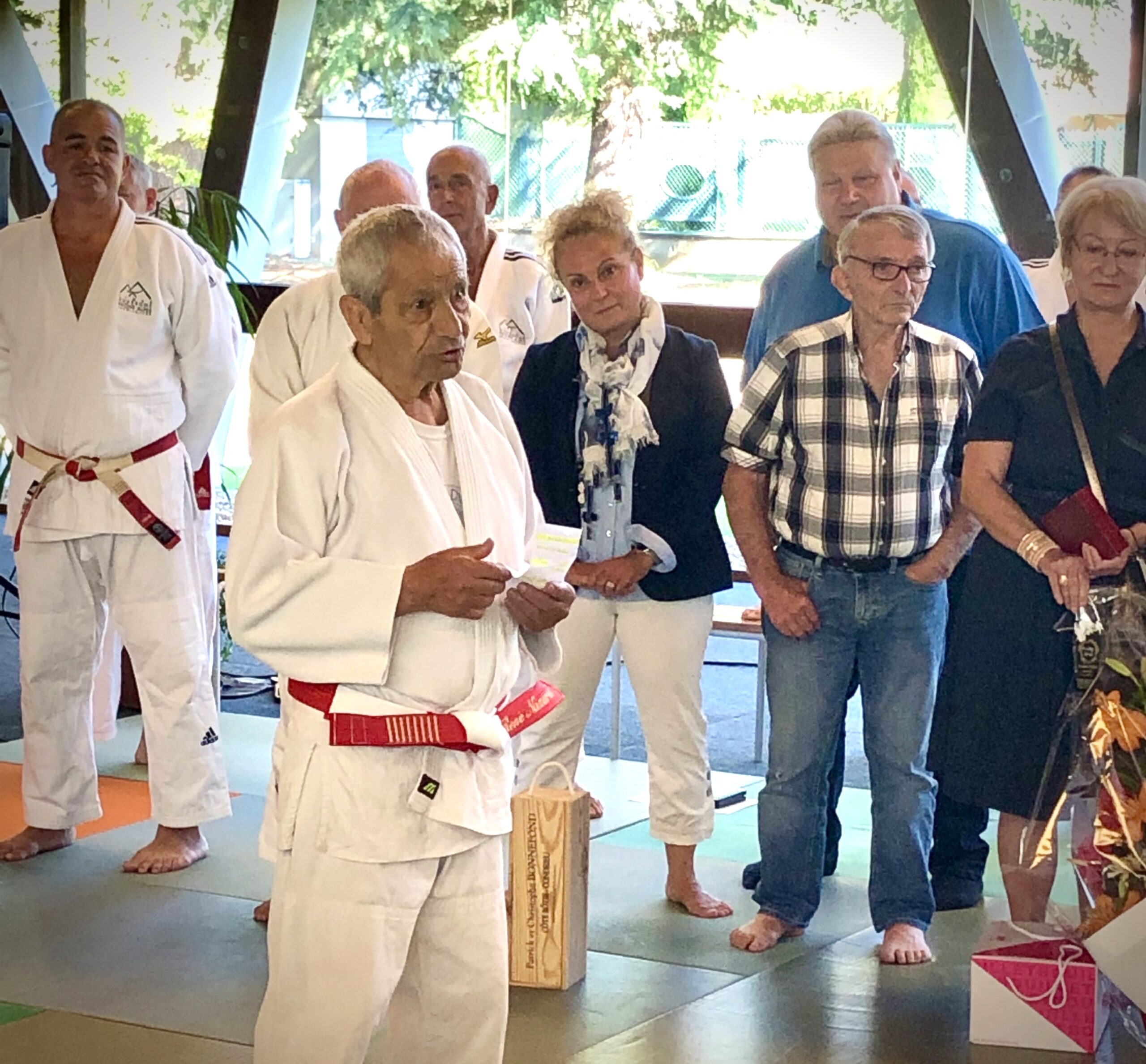
Born on October 20, 1936 in Castelliri (Italy), eighth-dan René “Natch” Nazaret passed away during the night of July 25 to 26, 2026. He was eighty-nine years old. Almost exactly twenty years ago, on July 25 and 27, 2006, we spent two full afternoons at his apartment in Lyon’s seventh arrondissement retracing – with his personal archives to back it up – what would end up being the first three quarters of his life. The final quarter, from 2006 to 2026, would be a string of coffees at his place and conversations about tatami stories, about life… and about that death which haunted him, too. – JudoAKD#057.
A French version of this article is available here.
It was a call from Pierrot Blanc, this Sunday July 26 in the morning, that brought us the sad news. Along with Michel Charrier and the late Romain Pacalier, the four future eighth-dans embodied, in the summer of 2006, something of the musketeers of Lyon judo. It was that same summer that a series of portraits of high-ranking red and white belts began, spread over five years, on behalf of the Rhône Judo Committee.
Of the four, René Nazaret was the one I was geographically closest to. Calling him, dropping by for coffee – that was the promise of an hour or two outside the flow of the present. “You don’t know how lucky you are to be able to just drop in on Natch like that, on the fly,” coach Stéphane Auduc once told me, almost wistfully, from the stands in Tokyo, very caught up at the time with his Parisian athletes but never forgetting his roots in Lyon. Ringing the buzzer at number 12, hearing his gruff-ish “yeah, I’m buzzing you in, hang on,” bounding up his stairs four at a time, and seeing him smile on his landing as he watched me arrive with my bike on my shoulder. “You did well to carry it up, it’s safer than leaving it in the street,” he’d say without fail, stepping aside to let me wedge the thing into the cramped entryway of his flat, where a large photo of him alongside Georges Baudot – a towering figure for several generations of instructors in the region and well beyond – held pride of place.
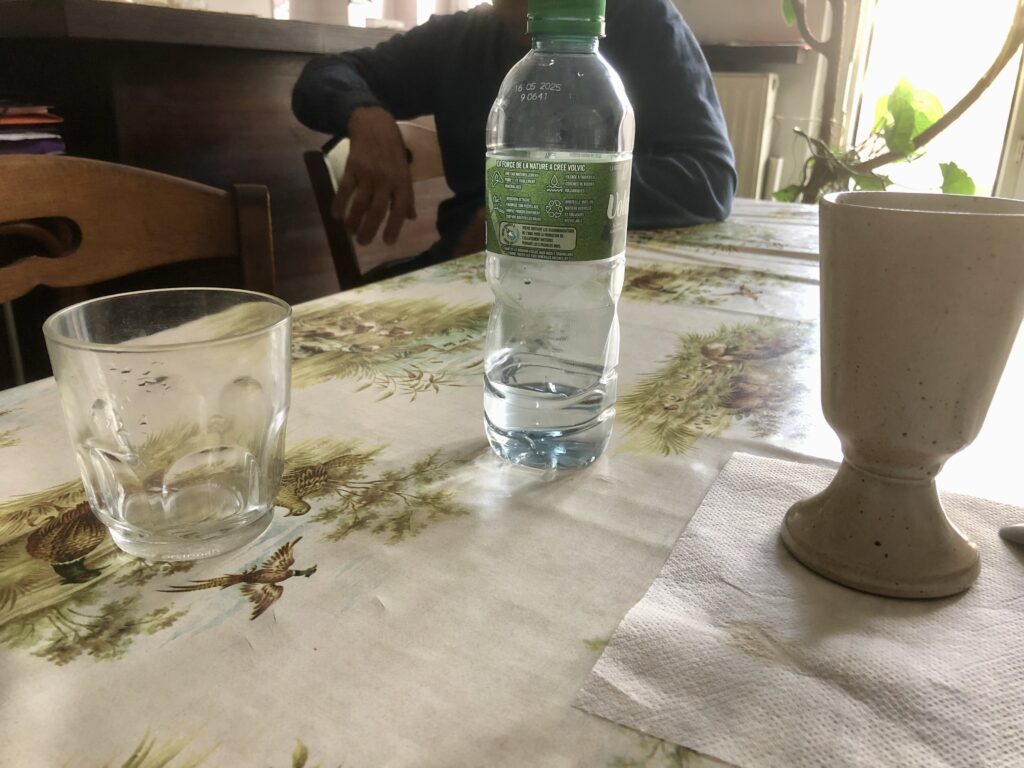
“A judo teacher has two jobs: to give confidence to the shy kids and calm to the restless ones,” he liked to repeat. On the plastic-covered tablecloth of his living-room table, where he’d already served his famous homemade pasta on wooden plates to my children, there’d be a cup of coffee slowly stirred with a spoon in that unique way of his, a folded sheet of paper towel to pick it up “so you don’t burn yourself,” a Duralex glass, and a mini bottle of Volvic “because you must be thirsty.” Sometimes I’d ask if I could turn down his radio, and then the conversation would start. News about his health, first. Then his spirits, which I knew had been shaky ever since I’d seen him, during a lunch at one of those neighborhood bistros where everyone seemed to know and respect him, learn by phone, twenty minutes apart, of the deaths – one after the other – of two old brothers-in-arms… And then we’d move on to judo. We talked little about people – he’d reached that age where everything evens out, where what one says and what another does start to feel like déjà vu. He was more interested in intentions.
Our last coffee together, this past spring, was a chance to show him, on my phone, some beautiful ippons from contemporary champions. An old-school guy who trusted a handshake more than an email, he despaired of ever seeing judo again on free-to-air TV outside the Olympics – the secret tragedy of an entire generation of fans… Old photos that occasionally turned up showed him younger, once striking a flag pose to show off his core strength to less athletic onlookers swooning nearby, another with that weathered face so reminiscent of the stark, unreadable Charles Bronson from Once Upon a Time in the West. “Some people shout to be heard. Others speak to be listened to,” he declared last November during a visit, after an – in his words, endless – stay in a retirement home, which he emerged from gaunt-faced and dark-eyed, having brushed too closely against that preview of the end of the road called physical decline.
“You know, what I’ve encountered least in judo are real judoka,” he once told me – he who, past eighty-eight, would sometimes pick up the phone out of breath because he’d been in the middle of a set of sit-ups, before heading off again to dialysis three afternoons a week… The wound of that 1960 French champion title, won on the mat but stripped from him for not having obtained his French nationality in time, would haunt him until September 2021. That late summer, the lovely party organized in his honor in his home turf of Chassieu seemed to finally stitch up that long-standing scar. Seeing his peers gather around him – even Angelo Parisi, his old village neighbor, who came out of retirement in Italy for the occasion – seemed to put another coin in the jukebox for a few more years, according to everyone who was there.
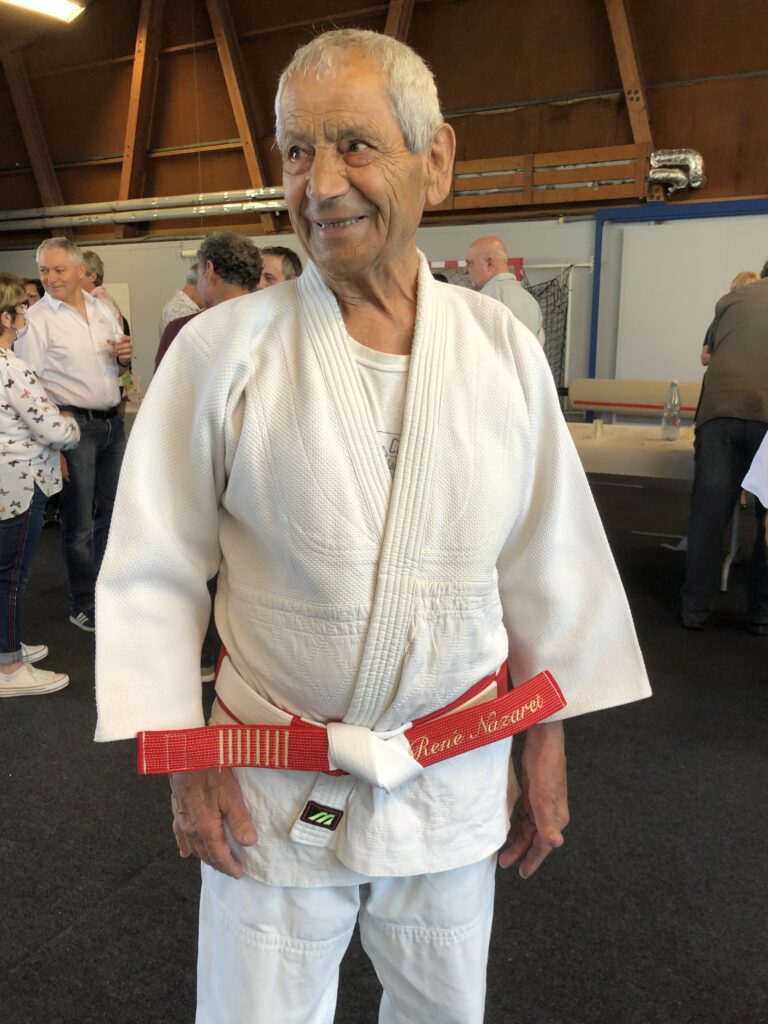
On Wednesday, February 27, 2019, at the opening of the sixth edition of the Sport, Literature and Cinema Encounters organized by Lyon’s Institut Lumière, I had invited Natch to attend a screening of Oliver Stone’s Any Given Sunday – a 1999 film whose pivotal motivational speech has since become a reference point for countless managers around the world. Bruno Génésio, then coach of Olympique Lyonnais, was announced among the guests. Now, Natch had often told me that he wasn’t entirely uninvolved, within the Italian community of the time, in the Génésio parents’ decision to steer their son toward football rather than judo. The thought of the reunion brought him such joy. Alas, a scheduling conflict forced the coach to cancel his appearance. Natch, for his part, kept his. Just before starting the film, Thierry Frémaux, the most judoka of film buffs and vice versa, pointed out to the audience the presence of several big names from the world of sport – but left out René Nazaret, who nonetheless held a special place in his heart, as he would later recount in his essay Judoka (Stock, 2021). “Oh it’s fine, don’t worry about it,” Natch murmured to me with his legendary discretion… When the Cannes Film Festival’s general delegate came back up the stairs to let the screening begin, I gave him a discreet sign, pointing out my distinguished seatmate. Thierry then grabbed his microphone to right the wrong. And Natch stood up, turned to face the audience, and took in, right in the heart, the warm applause of that temple of recognition. Then he sat back down and, with his shy smile, murmured to me as the lights slowly dimmed in the theater: “It’s really kind of Thierry to have taken the trouble to think of me.” – Anthony Diao, summer 2026. Opening picture: ©JudoAKD.
A French version of this article is available here.
More articles in English:
-
- JudoAKD#001 – Loïc Pietri – Pardon His French
- JudoAKD#002 – Emmanuelle Payet – This Island Within Herself
- JudoAKD#003 – Laure-Cathy Valente – Lyon, Third Generation
- JudoAKD#004 – Back to Celje
- JudoAKD#005 – Kevin Cao – Where Silences Have the Floor
- JudoAKD#006 – Frédéric Lecanu – Voice on Way
- JudoAKD#009 – Abderahmane Diao – Infinity of Destinies
- JudoAKD#008 – Annett Böhm – Life is Lives
- JudoAKD#010 – Paco Lozano – Eye of the Fighters
- JudoAKD#011 – Hans Van Essen – Mister JudoInside
- JudoAKD#021 – Benjamin Axus – Still Standing
- JudoAKD#022 – Romain Valadier-Picard – The Fire Next Time
- JudoAKD#023 – Andreea Chitu – She Remembers
- JudoAKD#024 – Malin Wilson – Come. See. Conquer.
- JudoAKD#025 – Antoine Valois-Fortier – The Constant Gardener
- JudoAKD#026 – Amandine Buchard – Status and Liberty
- JudoAKD#027 – Norbert Littkopf (1944-2024), by Annett Boehm
- JudoAKD#028 – Raffaele Toniolo – Bardonecchia, with Family
- JudoAKD#029 – Riner, Krpalek, Tasoev – More than Three Men
- JudoAKD#030 – Christa Deguchi and Kyle Reyes – A Thin Red and White Line
- JudoAKD#031 – Jimmy Pedro – United State of Mind
- JudoAKD#032 – Christophe Massina – Twenty Years Later
- JudoAKD#033 – Teddy Riner/Valentin Houinato – Two Dojos, Two Moods
- JudoAKD#034 – Anne-Fatoumata M’Baïro – Of Time and a Lifetime
- JudoAKD#035 – Nigel Donohue – « Your Time is Your Greatest Asset »
- JudoAKD#036 – Ahcène Goudjil – In the Beginning was Teaching
- JudoAKD#037 – Toma Nikiforov – The Kalashnikiforov Years
- JudoAKD#038 – Catherine Beauchemin-Pinard – The Rank of Big Sister
- JudoAKD#039 – Vitalie Gligor – « The Road Takes the One Who Walks »
- JudoAKD#040 – Joan-Benjamin Gaba and Inal Tasoev – Mindset Matters
- JudoAKD#041 – Pierre Neyra – About a Corner of France and Judo as It is Taught There
- JudoAKD#042 – Theódoros Tselídis – Between Greater Caucasus and Aegean Sea
- JudoAKD#043 – Kim Polling – This Girl Was on Fire
- JudoAKD#044 – Kevin Cao (II) – In the Footsteps of Adrien Thevenet
- JudoAKD#045 – Nigel Donohue (II) – About the Hajime-Matte Model
- JudoAKD#046 – A History of Violence(s)
- JudoAKD#047 – Jigoro Kano Couldn’t Have Said It Better
- JudoAKD#048 – Lee Chang-soo/Chang Su Li (1967-2026), by Oon Yeoh
- JudoAKD#050 – Hermann Monne – Burkina, a Land Already Peopled
- JudoAKD#051 – Mariana Esteves – A Chronicle of Life Passing By
- JudoAKD#052 – Tiphaine Gingelwein – Chechnya and the Caucasus, a Feminine Perspective in Nuance and Complexity
- JudoAKD#053 – Victor Scvortov – Born Again Under a Lucky Star
- JudoAKD#054 – Eric Gervasoni – From Moves to Movies
- JudoAKD#055 – Mihael Žgank – Coming Home Is Where the Real Journey Starts
- JudoAKD#056 – Patrick Grosperrin – Laterality, a Little-Known Lever of Performance
- JudoAKD#058 – Alexandre Paysan – We Saw Him in the Vercors, Bungee Jumping…
- JudoAKD#059 – Habib Alouache – Teaching Joy
- JudoAKD#060 – Diyora Keldiyorova – Another Giant Leap for (Wo)Mankind
Also in English:
- JudoAKDReplay#001 – Pawel Nastula – The Leftover (2017)
- JudoAKDReplay#002 – Gévrise Emane – Turn Lead into Bronze (2020)
- JudoAKDReplay#003 – Lukas Krpalek – The Best Years of a Life (2019)
- JudoAKDReplay#004 – How Did Ezio Become Gamba? (2015)
- JudoAKDReplay#005 – What’s up… Dimitri Dragin? (2016)
- JudoAKDReplay#006 – Travis Stevens – « People forget about medals, only fighters remain » (2016)
- JudoAKDReplay#007 – Sit and Talk with Tina Trstenjak and Clarisse Agbégnénou (2017)
- JudoAKDReplay#008 – A Summer with Marti Malloy (2014)
- JudoAKDReplay#009 – Hasta Luego María Celia Laborde (2015)
- JudoAKDReplay#010 – What’s Up… Dex Elmont? (2017)
- JudoAKDReplay#011 – Zakopane, or Lives Passing By (2017)
- JudoAKDReplay#012 – Thierry Frémaux (1/2) – About The Legend of the Great Judo(2016)
- JudoAKDReplay#013 – Thierry Frémaux (2/2) – Judo in the Light (2021)
And also :
- JudoAKDRoadToLA2028#01 – Episode 1/13 – Summer 2025
- JudoAKDRoadToLA2028#02 – Episode 2/13 – Autumn 2025
- JudoAKDRoadToLA2028#03 – Episode 3/13 – Winter 2026
- JudoAKDRoadToLA2028#04 – Episode 4/13 – Spring 2026
- JudoAKDRoadToLA2028#05 – Episode 5/13 – Summer 2026
JudoAKD – Facebook – Instagram – X (Twitter).